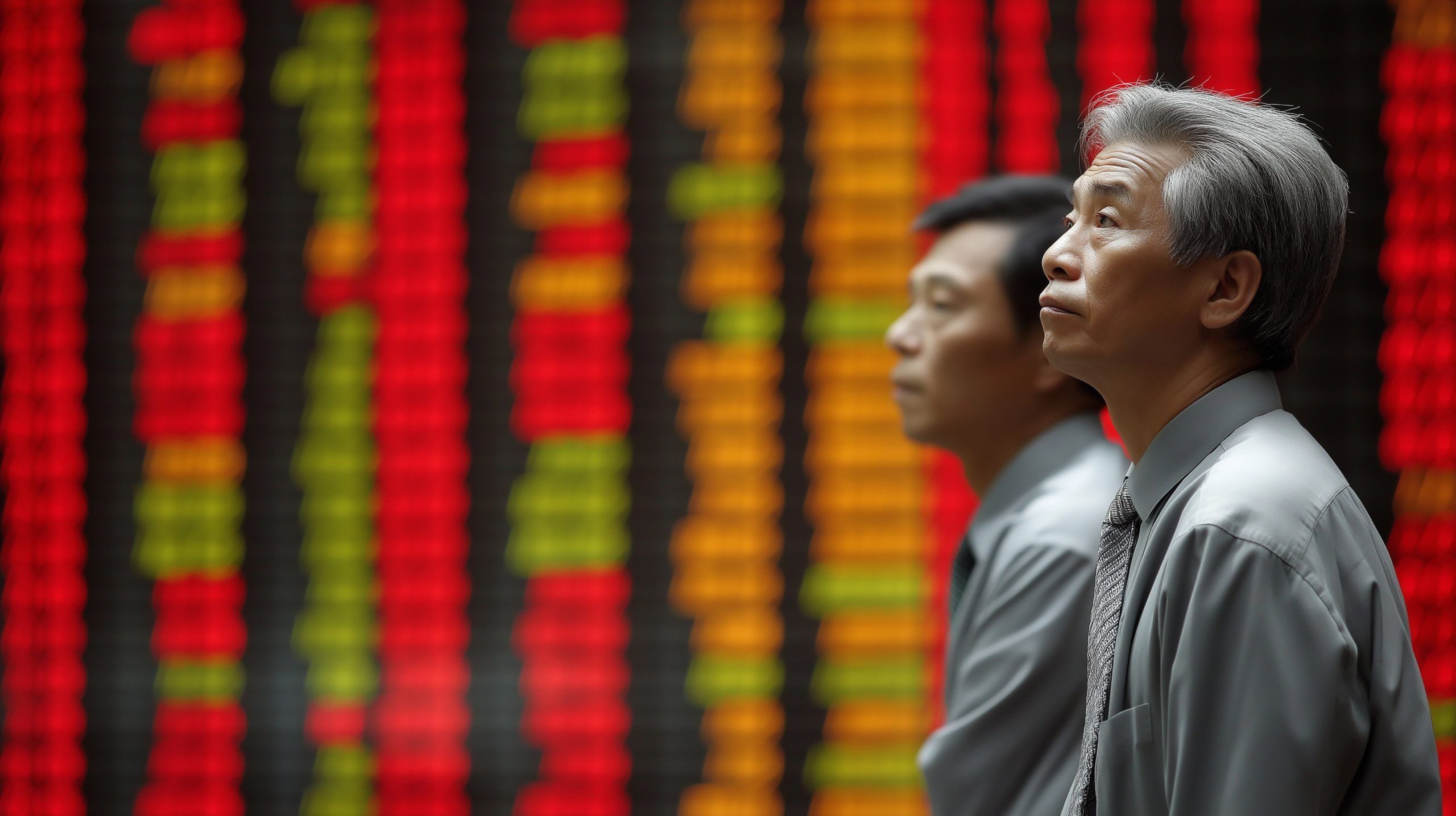

HONG KONG — December 16, 2025: Hong Kong equities closed lower on Tuesday as a fresh wave of risk-off sentiment swept Asian markets, pushing the Hang Seng Tech Index to its weakest level since late November and reinforcing concerns that Hong Kong-listed Chinese shares could keep lagging mainland peers during a global “tech rotation.” news.rthk.hk+2MarketScreener+2
By the close, the Hang Seng Index fell 393 points (‑1.54%) to 25,235, while the Hang Seng Tech Index slipped 95 points (‑1.74%) to 5,402. Mainland gauges also retreated, with the Shanghai Composite down 1.11% and the CSI 300 down 1.2%.
The selloff was fueled by two overlapping anxieties: weakening China growth signals and an international pullback from high-valuation technology and AI-linked trades ahead of major U.S. economic releases that could reset interest-rate expectations.
What happened in Hong Kong: a broad selloff led by tech
Losses were broad through the day. At midday, the Hang Seng Index was down 1.9% to 25,139.16, with all but five stocks on the 89-member benchmark falling, as traders stayed cautious before U.S. jobs data and digested signs that China’s slowdown may be deepening.
Key mega-cap and cyclicals helped drag the market lower:
- Alibaba fell 3.6% (to HK$143.30 at midday),
- Tencent lost 1.4%,
- SMIC slid 3.6%,
- while China Hongqiao (aluminum) and Zijin Mining also dropped sharply.
By the close, Hong Kong’s declines remained significant even after some intraday stabilization, underscoring how sensitive the market has become to global tech sentiment and macro headlines.
Why the Hang Seng Tech Index is taking the hit
The Hang Seng Tech Index is designed to track major Hong Kong-listed technology companies (including platform internet, semiconductors, EV supply chains, and other “new economy” names). That makes it a direct barometer of global appetite for growth stocks—and a prime target when investors rotate out of tech. HSI
On December 16, that rotation theme was visible across the region: Asian tech shares fell broadly, and Hong Kong’s tech gauge was among the hardest hit amid the wider defensive mood.
The macro trigger: China’s data is flagging, and investors are questioning the “easy-stimulus” playbook
A major driver behind Tuesday’s caution was deteriorating confidence in China’s near-term growth trajectory after recent data pointed to softer momentum heading into year-end.
Reuters reported that China’s retail sales posted their weakest performance since the country ended “zero-COVID” curbs, while factory output growth slowed to a 15-month low, reinforcing calls for new growth drivers as the economy looks toward 2026. Reuters
SCMP added that November indicators showed deceleration “across the board,” with retail growth slowing markedly, fixed-asset investment still contracting, and home prices continuing to fall—an uncomfortable backdrop for consumer- and advertising-sensitive tech platforms. South China Morning Post
The market message is shifting: soft data doesn’t automatically translate into an immediate “stimulus rally,” especially when investors also see lingering structural pressure from the property downturn and concerns about deflationary forces. Reuters+1
Global tech rotation: “Tech is the first domino” when rates may reprice
The second pressure point came from outside China: investors are positioning ahead of major U.S. releases—especially delayed employment data—amid uncertainty over how rates could react.
Reuters noted markets were waiting for combined U.S. employment reports for October and November (with some disruptions linked to an extended government shutdown) and an upcoming inflation report later in the week.
In that environment, growth stocks—especially richly valued technology names—tend to move first. Reuters quoted Saxo’s Charu Chanana on the logic: investors don’t want to be “caught long” crowded rate-sensitive trades if yields jump; “That’s why tech is the first domino.” Reuters
Flow data also supports the rotation narrative. A Goldman Sachs note cited by Reuters said hedge funds dumped Hong Kong and Japanese tech stocks ahead of recent declines, with selling concentrated in technology and consumer names amid concerns about an AI bubble.
Hong Kong vs. mainland: why Hong Kong-listed Chinese stocks may keep lagging
Bloomberg flagged an additional market dynamic: Chinese shares listed in Hong Kong may continue to lag mainland counterparts as investors grow wary of “lofty valuations” in AI and related tech plays. Bloomberg
Even without a single “smoking gun,” the ingredients for underperformance are clear:
- Sector mix: Hong Kong’s flagship tech gauge is packed with large platform and growth names that get hit hardest when rate expectations rise.
- Positioning and flows: Hedge-fund activity described by Reuters suggests investors were already reducing exposure to tech-heavy trades in the region.
- Macro sensitivity: When China growth worries intensify, internet platforms can suffer a double impact—pressure on near-term earnings expectations plus a higher discount rate on future growth.
In practice, this mix can leave Hong Kong’s tech complex caught between slowing domestic demand signals and global valuation discipline.
The mainland picture: weak breadth, but pockets of policy-linked strength
Mainland markets ended lower, but the day wasn’t uniformly negative across themes.
RTHK reported that onshore trading saw weakness in several popular sectors—rare earths, new energy, and AI—with the artificial intelligence segment down 2.5% amid “overheated” concerns. news.rthk.hk
At the same time, some policy-linked momentum appeared in autonomous-driving related names after regulators approved, for the first time, two Chinese cars with Level-3 autonomous driving capability—helping lift an intelligent-vehicle index.
This matters for Hong Kong investors too: as themes like autonomous driving and domestic semiconductor capability gain policy backing, capital can rotate quickly—benefiting some names while leaving broad tech benchmarks under pressure.
IPO market remains hot—even as stocks wobble
One of the most striking contradictions of December 16: Hong Kong’s secondary market was sliding, but the listing pipeline still looked unusually active.
A Bloomberg report republished by China Daily said Hong Kong’s IPO market is set to end the year with its busiest month for listings in at least four years, with 19 companies either already listed or planning December debuts. It also said Hong Kong listings have raised more than $34 billion in 2025, the strongest since 2021.
Guoxia Technology surges in debut, bucking the market
While big tech slid, energy-storage systems maker Guoxia Technology (2655.HK) surged in its Hong Kong trading debut—opening 89% higher and rising to HK$45.90 (+128%) by the midday break, according to Bamboo Works.
AAStocks reported similar intraday milestones, including an opening jump to HK$38 from a HK$20.10 listing price and a midday close around HK$45.90.
The strong debut is notable for two reasons:
- it signals selective risk appetite still exists for compelling “new economy” stories (especially those tied to energy infrastructure), and
- it highlights the market’s rotation behavior—where investors abandon some tech exposures while embracing other growth themes (like energy storage) that are perceived differently.
Biren Technology aims for a Hong Kong IPO in coming weeks
In another closely watched development, Reuters reported that Chinese AI chip startup Biren Technology plans to launch a Hong Kong IPO in the coming weeks, potentially raising about $300 million, after China’s securities regulator gave a green light.
Reuters said Biren is part of Beijing’s push to build domestic GPU champions amid U.S. chip curbs, and that the company was valued at roughly 14 billion yuan (about $2 billion) before a mid-2025 funding round.
The timing is telling: even as investors fret about AI valuations in public markets, AI-related capital formation is still moving forward—suggesting the theme is evolving from a pure momentum trade into a longer-term industrial and policy agenda.
What investors are watching next
With volatility rising into year-end, traders are focusing on three immediate catalysts:
- U.S. jobs data and inflation — Any upside surprise could push yields higher and keep pressure on growth/tech stocks globally.
- Central bank decisions — This week’s Bank of England, ECB, and Bank of Japan meetings are in focus, with markets sensitive to tone and forward guidance.
- China policy follow-through — With major policy meetings largely concluded and growth momentum questioned, investors are looking for clearer catalysts strong enough to shift sentiment.
Bottom line
Hong Kong’s December 16 selloff reinforced a new late-2025 reality: Hong Kong tech is no longer trading on “China reopening” optimism, but on a tougher mix of growth skepticism and global valuation discipline. South China Morning Post+2Reuters+2
Yet the day also showed that Hong Kong’s market isn’t simply “risk-off.” Even as the Hang Seng Tech Index hit its lowest level since Nov. 21 and the broader Hang Seng slid, new-economy listings and strategic-tech fundraisings are still accelerating—with IPO winners emerging even in a weak tape. Reuters+4MarketScreener+4news.rthk.hk+4
Related articles: HKG:0700