
HONOLULU, August 16, 2026, 23:52 HST — U.S. premarket trading for Monday has commenced.
- Roughly 130,000 customers on Oʻahu remained without electricity on Sunday morning.
- This represents about 41.8% of Hawaiian Electric’s accounts on Oʻahu.
- HEI reported a 37% drop in core quarterly profit before the storm.
Hawaiian Electric Industries, Inc. NYSE:HE faced Tropical Storm Lala putting pressure on its grid that supplies power to nearly all of Hawaiʻi as the week began. On Sunday morning, approximately 130,000 customers on Oʻahu were still without power, accounting for about 41.8% of the company’s 310,789 accounts on the island.
The concern for investors is the restoration cost. Hawaiian Electric anticipates its 2026 operating expenses will grow at a pace much higher than inflation. In the second quarter, its core profit declined before Lala brought an additional significant storm-related expense.
| Service area and timing | Customers without power | 2025 customer base | Share of accounts |
|---|---|---|---|
| Oʻahu peak, Sunday | Over 220,000 | 310,789 | Above 70.8% |
| Oʻahu, Sunday morning | Roughly 130,000 | 310,789 | 41.8% |
| Hawaiʻi Island, Saturday afternoon | 31,792 | 91,234 | 34.8% |
| Maui County, Saturday afternoon | 7,203 | 72,218 | 10.0% |
By 3:30 p.m. HST Sunday, the total number of outages across the state rose to 183,123. Lala caused damage to no fewer than 100 homes, and repair efforts in some areas were hindered by flooding and trees brought down by the storm. The system was expected to move away from the islands by Monday morning.
Searches for “heco power outage map” spiked on Monday, indicating increased demand for updates on restoration. Search interest indicates public attention, not monetary loss. Google Trends U.S. investor feed
The issue of scale is significant, as Hawaiian Electric manages independent island grids. These networks cannot access backup electricity from a mainland system. Local teams are required to examine and restore transmission and distribution infrastructure.
| Second-quarter measure | 2026 | 2025 | Change |
|---|---|---|---|
| HEI GAAP net income | $123 million | $26 million | up 373% |
| HEI core net income | $22 million | $35 million | down 37% |
| HEI core EPS | $0.13 | $0.20 | off 35% |
| Utility GAAP net income | $138 million | $39 million | higher by 254% |
| Utility core net income | $33 million | $42 million | decreased 21% |
The rise in GAAP results exaggerates the operational gains. A non-cash after-tax gain of $101 million resulted from discounting the outstanding wildfire settlement payments. Core income declined due to increased interest and operating expenses.
HEI anticipates adjusted utility operating expenses, excluding pension-related items, will rise much faster than inflation this year. This outlook had already been shaped by factors such as previous storms, insurance costs, vegetation management, maintenance, cybersecurity, and labor.
CEO Scott Seu stated that HEI intends to concentrate on investments for its wildfire plan, while also “operating efficiently and maintaining financial strength.” Lala now introduces an active gauge of that equilibrium. HEI
| Market measure | Value | Comparison |
|---|---|---|
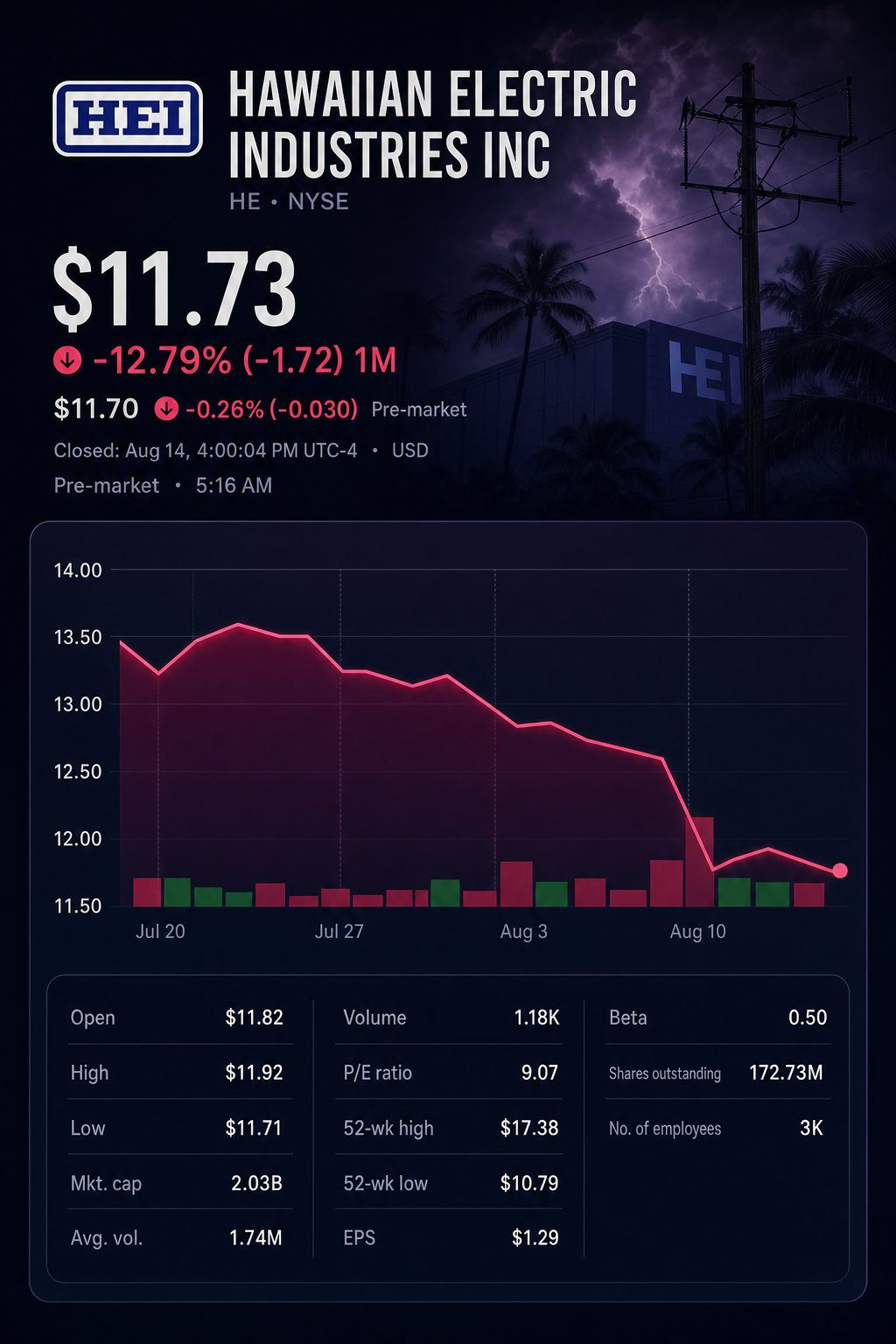
| August 14 closing price | $11.73 | down 0.85% on Friday |
| After-hours trading | $11.76 | up 0.26% |
| Annual peak | $17.38 | 32.5% higher than Friday’s close |
| Annual low | $10.79 | 8.0% under Friday’s close |
| Consensus price target | $11.88 | 1.3% above Friday’s finish |
The stock finished Friday at $11.73, declining 0.85%. It is just 1.3% away from the average analyst price target, offering limited valuation buffer should Lala significantly raise restoration costs.
| Analyst | Firm | Recommendation | Target | Date |
|---|---|---|---|---|
| Michael Lonegan | Barclays | Hold | $12.00 | August 11, 2026 |
| Julien Dumoulin Smith | Jefferies | Sell | $11.75 | July 6, 2026 |
The initial indicator on Monday will be the progress made on restoration, rather than any search activity. After that, management’s assessment of repair expenses and the scope for regulatory recovery will be crucial for investors. Both numbers remained unavailable ahead of the market open.
Risks: The restoration process could be prolonged in areas with damaged roads or transmission infrastructure. Increased storm expenses may impact cash flow, and any postponed recovery in customer rates could intensify this impact. Projections are still provisional pending the company’s inspection completion.
Related articles: Energy