
Sunday, November 16, 2025 — Daily update on IBM’s new quantum roadmap milestones, industry reaction, and what’s next.
Key facts at a glance
- Two new processors: IBM Quantum Nighthawk (120 qubits, 218 couplers) targets near‑term quantum advantage; Quantum Loon demonstrates the core hardware ingredients for fault‑tolerant quantum computing.
- Timelines: IBM reiterates goals of advantage by end‑2026 and fault‑tolerant systems by 2029. Nighthawk is slated for user access by end‑2025.
- Speedups in error correction & software: A decoder implemented on AMD FPGAs hits ~10× faster than current leading approaches; new Qiskit capabilities report ~24% accuracy gains and >100× lower cost for certain mitigations.
- Manufacturing shift: IBM moves quantum processor production to a 300 mm wafer fab at Albany NanoTech, aiming to double R&D speed and 10× chip complexity.
- Today’s coverage (Nov 16): Global outlets are still picking up the story—e.g., Cyprus Mail ran a Reuters recap this morning emphasizing Loon’s role as a step toward useful quantum machines by 2029.
What IBM announced—and why it matters
IBM used its Quantum Developer Conference to unveil two chips that split the roadmap into near‑term utility and long‑term fault tolerance:
- Nighthawk: a 120‑qubit processor with a square qubit topology and 218 couplers (up from Heron’s 176), enabling circuits about 30% more complex with fewer SWAPs. It’s engineered for hybrid quantum‑classical workflows that could demonstrate advantage on specific problems.
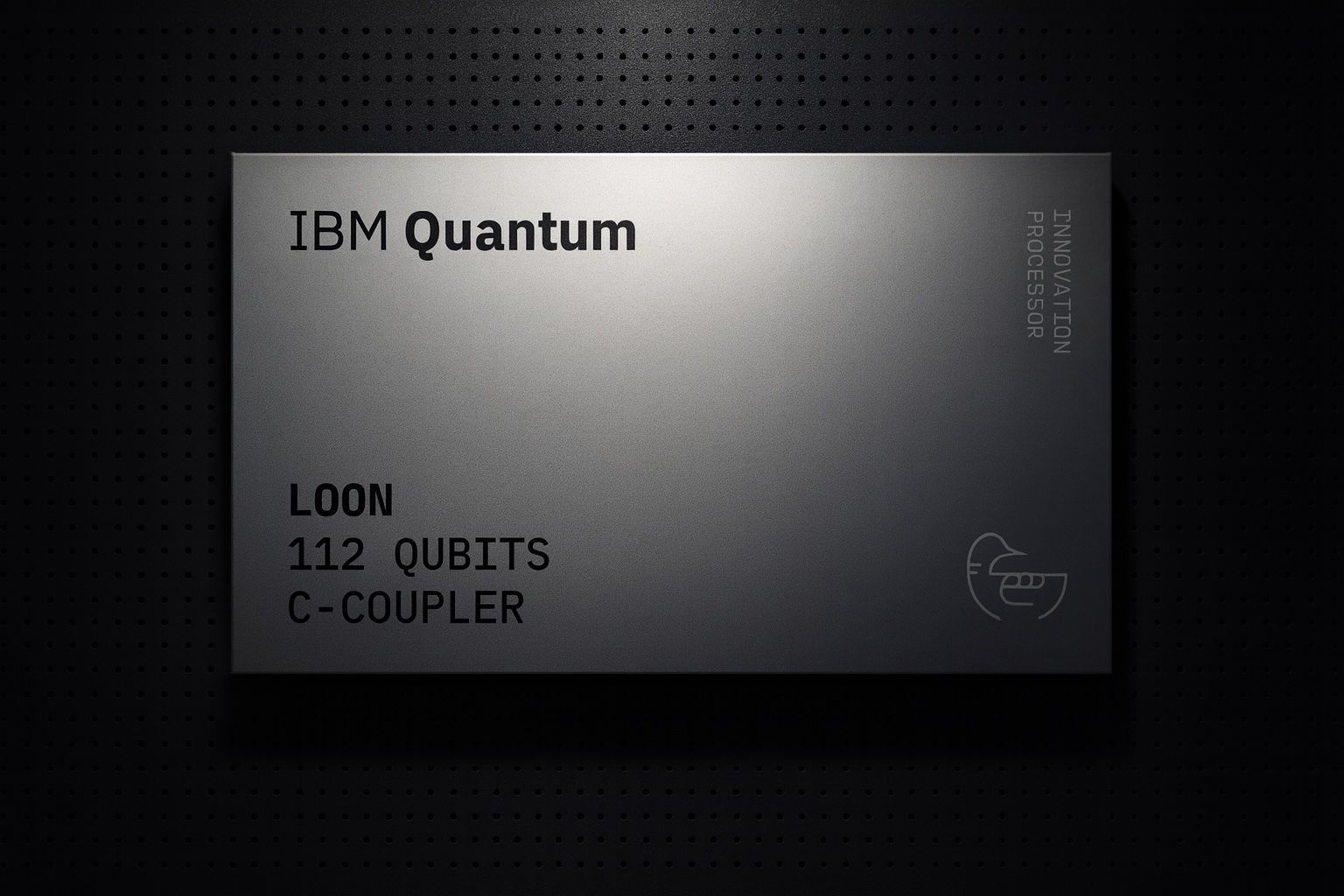
- Loon: an experimental architecture that brings together the hardware elements IBM says are necessary for scalable quantum error correction using qLDPC codes—six‑way qubit connections, long‑range couplers, and reset “gadgets”—designed as a practical stepping stone to fault tolerance. IBM
IBM is also publishing progress beyond hardware: Qiskit v2.x performance improvements (including faster transpilation) and a new Quantum Advantage Tracker—an open, community‑led site with contributors from IBM, Flatiron Institute, Algorithmiq, and BlueQubit—for documenting claims and the classical baselines they must beat.
“IBM is positioned to rapidly invent and scale quantum software, hardware, fabrication and error correction,” said Jay Gambetta, IBM Fellow and Director of IBM Research. IBM Newsroom
What’s new today (Nov 16, 2025)
Coverage continued globally this morning: Cyprus Mail carried a Reuters piece underscoring that Loon is an early, internal test platform while Nighthawk is expected to be accessible to users by year‑end—with IBM aiming to show tasks that beat classical computers by late 2026. Gartner’s Mark Horvath called the approach “very, very clever,” highlighting that IBM is now putting error‑correcting concepts directly into chips. Cyprus Mail
Timelines, targets, and how IBM says it will get there
- 2025: Deliver Nighthawk to users; assemble the first Loon chips.
- 2026: Demonstrate community‑verified examples of quantum advantage via the open tracker and hybrid HPC+quantum workflows.
- 2029: Reach fault‑tolerant quantum computing with the architectures and decoders now being prototyped.
Technically, IBM points to three levers:
- Architectures built for scale: denser connectivity (218 couplers) and modular layouts to reduce circuit depth and error accumulation.
- Error correction at speed: an FPGA‑accelerated decoder (RelayBP) that hits sub‑microsecond latencies—IBM reports achieving a ~10× speedup, a milestone it had slated for next year.
- Faster iteration cycles: shifting chip fabrication to a 300 mm line to double development speed and enable 10× physical complexity—key to testing long‑range couplers and six‑way connectivity.
The DARPA effect—and IBM’s response
Earlier this month, DARPA advanced 11 companies—including IBM, Quantinuum, IonQ, Atom Computing, Xanadu and others—to Stage B of its Quantum Benchmarking Initiative, a year‑long phase focused on concrete R&D plans and risk‑reduction prototypes on the road to a “utility‑scale” machine by 2033. DARPA
Against that backdrop, IBM’s message to the market—captured succinctly by Fast Company—was: “We’re doing great.” The company stresses that it’s hitting roadmap milestones, moving to 300 mm fabrication, and pursuing a two‑pronged hardware strategy (Nighthawk now, Loon for fault tolerance) while seeding an open advantage‑verification ecosystem. Fast Company
Competitive landscape check
The bar is rising industry‑wide. On November 5, Quantinuum launched Helios, described as its “most accurate” commercial system to date, with record gate fidelities and expanded qubit counts—one of the announcements that set the stage for this week’s back‑and‑forth. IBM’s answer focuses less on raw fidelity claims and more on scalable architectures, open validation, and HPC integration. Quantinuum
What to watch next
- User access to Nighthawk before year‑end and first Loon assembly milestones.
- Early advantage experiments submitted to the Quantum Advantage Tracker with transparent classical baselines.
- Continued DARPA Stage B progress reports across multiple architectures (superconducting, trapped‑ion, neutral‑atom, photonic, and silicon‑spin).
FAQ
What’s the difference between Nighthawk and Loon?
Nighthawk is a near‑term, performance‑optimized chip (120 qubits, 218 couplers) aimed at demonstrating advantage in hybrid workloads. Loon is a proof‑of‑concept platform that combines six‑way connectivity, long‑range couplers and reset elements to prototype fault‑tolerant error‑correction architectures.
When might we see verified quantum advantage?
IBM’s public target is by end‑2026, with an open tracker to let the community evaluate results against state‑of‑the‑art classical methods.
How is IBM tackling error correction speed?
A decoder implementation on AMD FPGAs hit ~10× speedups and <480 ns latency—one roadmap item IBM says it delivered a year early.
Why move to a 300 mm fab?
To double development speed and produce more complex chips, enabling faster iteration on layouts required for scalable error correction.
Sources & further reading
- IBM Newsroom (Nov 12, 2025): full announcement of Nighthawk, Loon, software, fabrication and decoder milestones.
- IBM Quantum Blog (Nov 12, 2025): deeper technical detail on couplers, dynamic circuits, decoder latency, and the Quantum Advantage Tracker.
- Reuters via Cyprus Mail (Nov 16, 2025): today’s recap of Loon and IBM’s 2026/2029 targets, with analyst reaction.
- Fast Company (Nov 12, 2025): context after DARPA’s Stage B picks; IBM’s “we’re doing great” message and 300 mm fab strategy. Fast Company
- DARPA QBI (updated Nov 6, 2025): Stage B participants and program goals toward utility‑scale quantum computing by 2033.
Related articles: NYSE:IBM