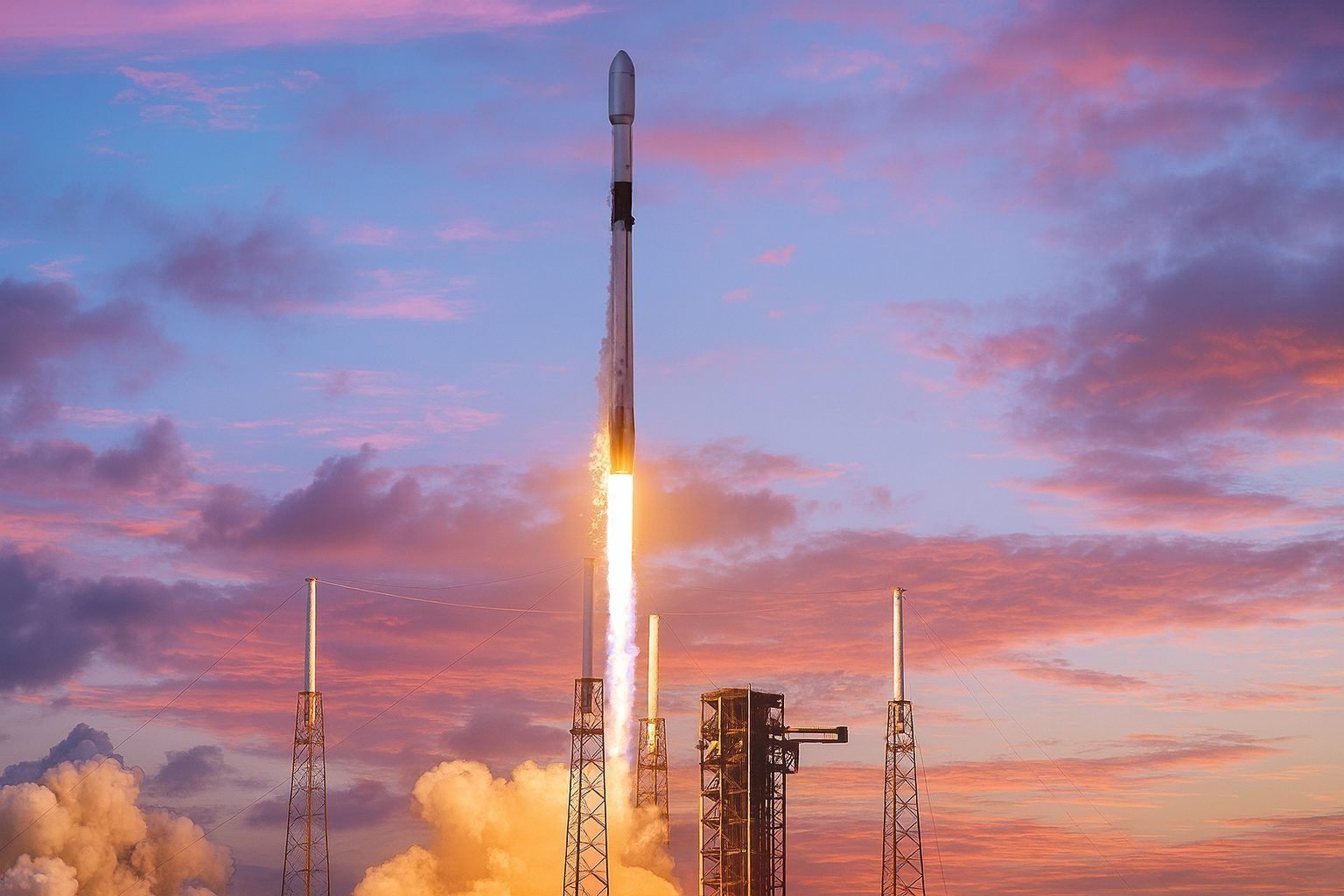
India’s heavy-lift launch vehicle LVM3-M6 — popularly dubbed “Baahubali” — roared off the Second Launch Pad at the Satish Dhawan Space Centre (SDSC SHAR) in Sriharikota on December 24, 2025, successfully deploying BlueBird 6, a next-generation communications spacecraft for U.S.-based AST SpaceMobile. The mission, officially described by ISRO as the LVM3-M6 / BlueBird Block-2 commercial launch, is a landmark on two fronts: it is the heaviest payload ever launched by LVM3 into Low Earth Orbit and a high-visibility demonstration of India’s expanding role in global, fee-for-service satellite launches. www.ndtv.com+2ISRO+2
The satellite was inserted into a circular Low Earth Orbit around 520 km altitude, with ISRO’s mission brochure listing an inclination of about 53 degrees — the orbital “tilt” that determines which latitudes the spacecraft passes over. Separation occurred roughly 15–16 minutes after liftoff, consistent with the mission’s published timeline and international reporting. ISRO+1
A 90-second delay underscored a new reality: crowded orbits and collision avoidance
One of the day’s most striking operational details wasn’t just the liftoff — it was the pause.
Multiple reports noted the launch time shifted from 8:54 a.m. IST to 8:55:30 a.m. IST after ISRO identified a potential conjunction risk (the possibility of crossing paths with space debris or another object) along the planned flight corridor. The short delay, while minor on the clock, was significant in message: modern launch operations increasingly involve real-time coordination with orbital traffic and debris tracking.
What is BlueBird 6, and why the “Block-2” label matters?
BlueBird 6 is widely described as the first of AST SpaceMobile’s next-generation “Block 2/Block-2” class satellites — built to do something that has become one of the most contested goals in telecom and space: connect directly to everyday smartphones from orbit.
According to ISRO’s mission brochure, the BlueBird Block-2 spacecraft is part of a broader planned LEO network intended to enable 4G/5G voice and video calls, messaging, streaming, and data “for everyone, everywhere,” using satellite links rather than ground towers. ISRO
What differentiates BlueBird 6 from earlier designs is scale. Both ISRO materials and AST SpaceMobile’s own announcement emphasize the satellite’s massive communications surface area:
- ISRO’s brochure highlights a ~223 m² phased-array (roughly 2,400 sq ft), calling it the largest commercial communications satellite array deployed in low Earth orbit.
- AST SpaceMobile’s official statement likewise describes BlueBird 6 as nearly 2,400 square feet, “over three times the size” and “10x the capacity” of the company’s earlier satellites, and says the satellite is designed for peak data rates up to 120 Mbps directly to standard, unmodified devices. Business Wire
- Independent coverage echoed the core numbers and noted deployment into orbit about 15.5 minutes after launch, reinforcing the mission’s “as planned” execution. Space
AST SpaceMobile’s CEO Abel Avellan framed the event as a shift from validation to scale, saying the launch marks “the transition to scaled deployment” in the company’s roadmap. Business Wire
The rocket: LVM3-M6 “Baahubali” and why this flight mattered beyond a single satellite
LVM3 (also historically referred to as GSLV Mk III) is ISRO’s operational heavy-lift workhorse — a three-stage vehicle with:
- Two S200 solid strap-on boosters
- A liquid core stage (L110)
- A cryogenic upper stage (C25)
ISRO lists the vehicle at 43.5 meters tall with a ~640-tonne lift-off mass, and the mission brochure reiterates these baseline specifications while also publishing the stage sequence and separation timing.
What made LVM3-M6 stand out is the payload class. The mission brochure explicitly describes BlueBird Block-2 as the heaviest payload (~6,100 kg) into LEO in LVM3’s launch history. That figure also appears repeatedly across same-day coverage.
ISRO also positioned the mission as a milestone in its commercial track record: the brochure calls LVM3-M6 the sixth operational flight and the third dedicated commercial mission for the vehicle, executed under a commercial arrangement involving ISRO’s commercial arm.
Commercial space, made in India: NSIL’s role and the India–U.S. partnership angle
This wasn’t a purely governmental payload — and that is central to why the launch drew such broad coverage across India’s business and national news cycle.
ISRO’s mission brochure states the flight was conducted under a commercial agreement involving NewSpace India Limited (NSIL) and AST’s U.S. entity, underscoring India’s effort to grow as a global launch-services provider — not only for domestic science missions but also for international commercial customers.
The Economic Times’ live coverage explicitly framed the mission as a marker of India–U.S. partnership and commercial positioning, noting how LVM3 increasingly supports high-value international payload deployments.
Why “direct-to-phone” satellites are a big deal — and why BlueBird 6 is being watched globally
BlueBird 6 sits at the center of a rapidly intensifying race: deliver space-based cellular broadband that works with ordinary phones, reducing dead zones for consumers while expanding resilience options for governments and emergency response.
AST SpaceMobile says it has agreements with over 50 mobile network operators globally, representing nearly 3 billion subscribers combined, and lists partnerships that include major telecom and infrastructure players.
Independent international reporting on December 24 emphasized how BlueBird 6’s communications array, at ~223 m², is a step-change compared with earlier AST satellites — and is a key reason this single launch is being treated as a “record-breaking” moment rather than routine orbital logistics. Space
Political and institutional reactions: “heaviest ever” becomes a national headline
Indian reporting on launch day also leaned into the national significance of the achievement.
NDTV reported that ISRO Chairman V. Narayanan described the injection as successful and precise, and emphasized the “heaviest satellite ever lifted from Indian soil using an Indian launcher,” highlighting the vehicle’s commercial performance credentials. The same coverage reported Prime Minister Narendra Modi called the mission a proud milestone that strengthens India’s heavy-lift capability and reinforces its place in the global commercial launch market. www.ndtv.com
A Gaganyaan subtext: LVM3’s reliability narrative continues
Beyond commercial launches, LVM3’s performance carries strategic weight for India’s human spaceflight ambitions.
Economic Times’ live coverage highlighted that LVM3 is the designated launch vehicle for the Gaganyaan programme, and positioned another successful LVM3 mission as confidence-building for future high-stakes flights that demand consistent “human-rated” performance standards. The Economic Times
What happens next: commissioning in orbit and the push toward scale
With separation confirmed, the next phase shifts from launch operations to spacecraft commissioning — deployment steps, systems checkouts, and initial network testing.
AST SpaceMobile’s launch-day statement says this mission kicks off a new execution phase and keeps the company on track to launch 45–60 satellites by the end of 2026, with launches planned every one or two months on average — a cadence that, if achieved, would rapidly expand the potential footprint of direct-to-phone service.
For ISRO and NSIL, the mission adds a headline-grabbing proof point: India’s heavy-lift launcher can place an unusually large, high-profile commercial payload into LEO — and can do so while actively managing conjunction risks in a congested orbital environment.
In the simplest terms, December 24, 2025 wasn’t just another successful launch morning at Sriharikota. It was a day that tied together three of the most important trends shaping space today: commercial launch markets, direct-to-device satellite communications, and the operational realities of crowded low Earth orbit.