
NEW YORK, August 8, 2026, 13:06 EDT — U.S. stock markets have ended trading for the day.
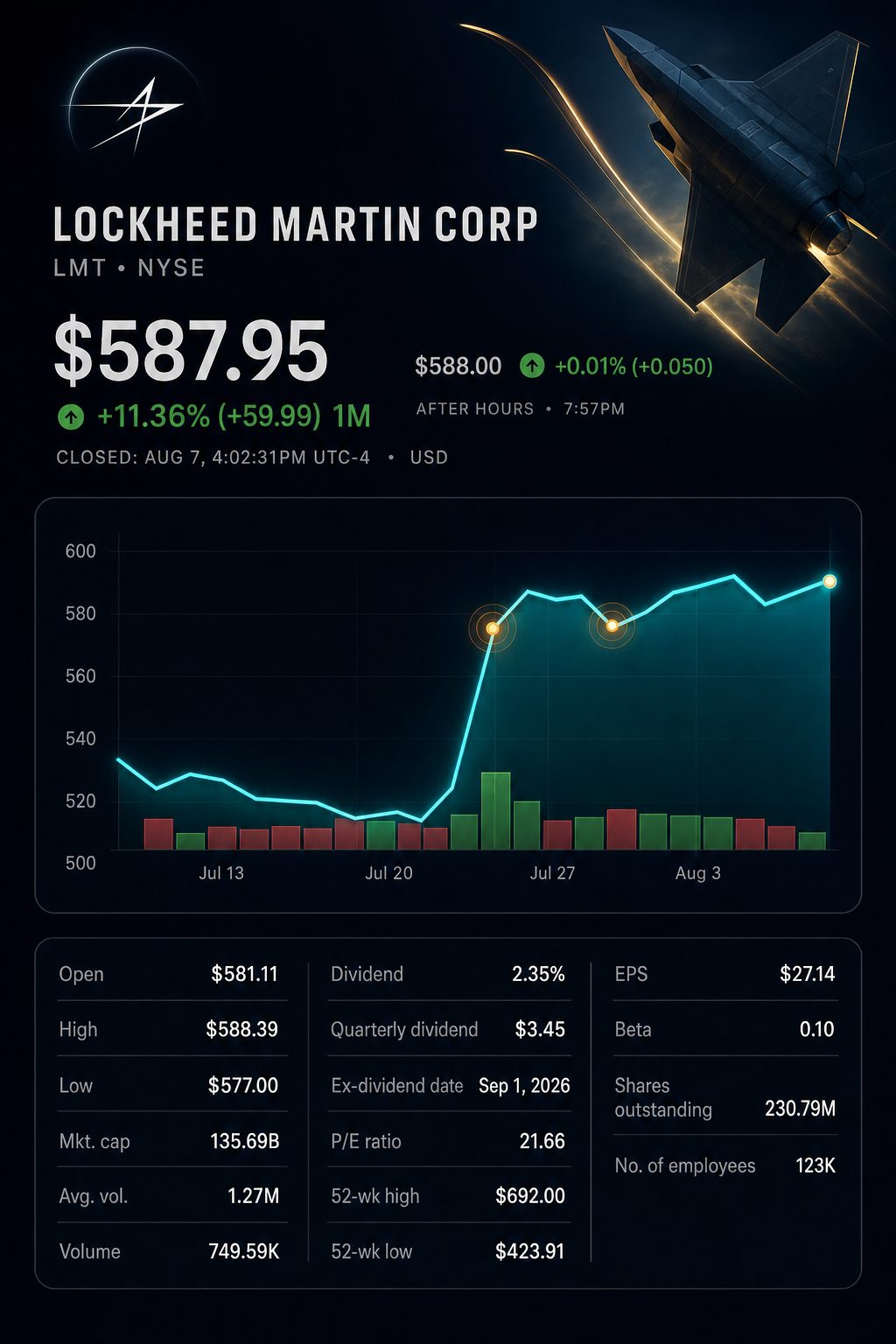
- Lockheed finished Friday’s session at $587.95, bringing its weekly gain to 0.9%. The S&P 500 rose 3.6% in the same period.
- Initial estimates show the book-to-bill ratio for the quarter is 3.2. The backlog stands at 2.85 times the midpoint of projected 2026 sales.
- Rheinmetall AG ETR:RHM anticipates generating its first revenue from proposed ATACMS manufacturing in 2028. The project is pending authorization.
Shares of Lockheed Martin Corporation finished Friday up 0.88% at $587.95. The stock advanced just 0.9% over the week, even as new data pointed to acute missile shortages. The wider market posted a significantly stronger gain.
The issue of the gap is significant. Lockheed’s demand is no longer at the center of discussion. The company’s backlog increased by 38.3% over the past year to $230.4 billion. Orders in the second quarter totaled $65 billion.
An initial estimate shows those orders are 3.24 times quarterly sales. The backlog stands at 2.85 times the midpoint of full-year sales guidance. Demand is clear. The rate of conversion remains uncertain.
Week-on-week market overview
| Security | July 31 close | August 7 close | Weekly change |
|---|---|---|---|
| Lockheed Martin | $582.74 | $587.95 | up 0.9% |
| Northrop Grumman NYSE:NOC | $542.48 | $571.58 | up 5.4% |
| RTX NYSE:RTX | $215.22 | $223.03 | up 3.6% |
| General Dynamics NYSE:GD | $383.42 | $392.05 | up 2.3% |
| S&P 500 | 7,489.72 | 7,757.64 | up 3.6% |
Weekly movements are early estimates based on closing price data.
Trading volumes were low on Friday’s advance, with around 749,000 shares changing hands—59% of the 65-day average. This indicates investors refrained from making strong new commitments.
New data underscored the need for caution. Rheinmetall CEO Armin Papperger stated that reestablishing German ATACMS production to restore low stockpiles would be a process of several years. “That won’t happen in two years,” he said. “It will take much longer.” The company projects initial revenue in 2028. Reuters
The argument for scarcity is still strong. According to a Reuters-cited estimate, the United States used roughly 65% of its Patriot interceptors between February and July. There are now likely fewer than 850 left, compared with about 2,330 previously.
Lockheed has secured a PAC-3 MSE contract for seven years, worth up to $58.62 billion. The firm plans to boost its production capacity by three times by the end of 2030. Jobs at its Camden, Arkansas site are projected to rise by 50%.
Production-conversion metrics and backlog indicators
| Indicator | Current figure | Comparison | Change or ratio |
|---|---|---|---|
| Q2 new orders compared with sales | $65.0B / $20.06B | — | 3.24x book-to-bill |
| Backlog in relation to 2026 sales midpoint | $230.4B / $80.75B | — | 2.85x |
| Missiles and Fire Control revenue | $4.10B | $3.43B year earlier | +19% |
| Missiles and Fire Control operating margin | 14.5% | 14.0% year earlier | +50 basis points |
| 2026 free cash flow midpoint | $7.10B | $6.65B prior midpoint | +6.8% |
Preliminary calculations apply to ratios and midpoint changes. Free cash flow is reported as a non-GAAP metric.
The missile division is more effective at turning demand into profit compared to Lockheed’s other units. It accounted for approximately 20% of quarterly revenue, while contributing about 27% of operating profit from business segments. These figures are based on initial estimates from the company’s data.
Management is urging both suppliers and government clients to accelerate. Chief Executive Jim Taiclet noted the Pentagon’s consistent push was for “faster, faster, faster.” While increased flexibility in contracting is expected to assist, expanding physical capacity remains a time-consuming process. Reuters
Analyst ratings as of Friday’s market close
| Recommendation measure | Current | Three months earlier | Change |
|---|---|---|---|
| Buy ratings | 6 | 5 | +1 |
| Overweight ratings | 4 | 3 | +1 |
| Hold ratings | 13 | 16 | -3 |
| Underweight ratings | 1 | 1 | — |
| Sell ratings | 1 | 1 | — |
| Consensus | Overweight | Hold | Upgraded |
| Average price target | $633.21 | — | 7.7% higher than Friday close |
| Target range | $503–$756 | — | Large spread |
The estimated upside is an initial figure based on the closing price from Friday.
The spread of ratings has gotten better. However, 15 out of 25 remain at Hold or below. Analysts’ views on execution and long-term margins vary widely, reflected in a $253 gap between the most optimistic and most pessimistic price targets.
Lockheed is not set to post earnings next week. Market sentiment will instead hinge on inflation and interest rate outlooks. Forecasts show annual consumer inflation at 3.4% in July, and core inflation projected at 2.5%.
Calendar for the upcoming week
| Date | Scheduled event | Time or consensus | Investor relevance |
|---|---|---|---|
| Monday, August 10 | U.S. markets reopen for regular trading | 09:30 EDT | Initial market response to weekend news |
| Wednesday, August 12 | July CPI data | 08:30 EDT; 3.4% annual consensus | Key for interest rate outlook |
| Thursday, August 13 | July PPI data | 08:30 EDT | Indicates upstream inflation |
| Friday, August 14 | U.S. retail sales data | 08:30 EDT | Gauge of consumer spending |
Lockheed’s upcoming quarterly results are set for release on October 27. In the meantime, investors are monitoring supplier agreements, contract closures, and tangible missile production.
Risks: Major missile awards continue to face exposure to supplier limitations and pending contract definitization. Delays in partner approvals are also possible. Program charges present an ongoing execution risk, and increased inflation may raise yields and put pressure on valuation multiples.
At present, Lockheed’s demand outlook appears more robust than recent weekly stock moves. One more contract announcement alone is unlikely to suffice. A consistent revaluation will require increased production speed and improved cash generation.