
NEW YORK, August 9, 2026, 10:06 EDT
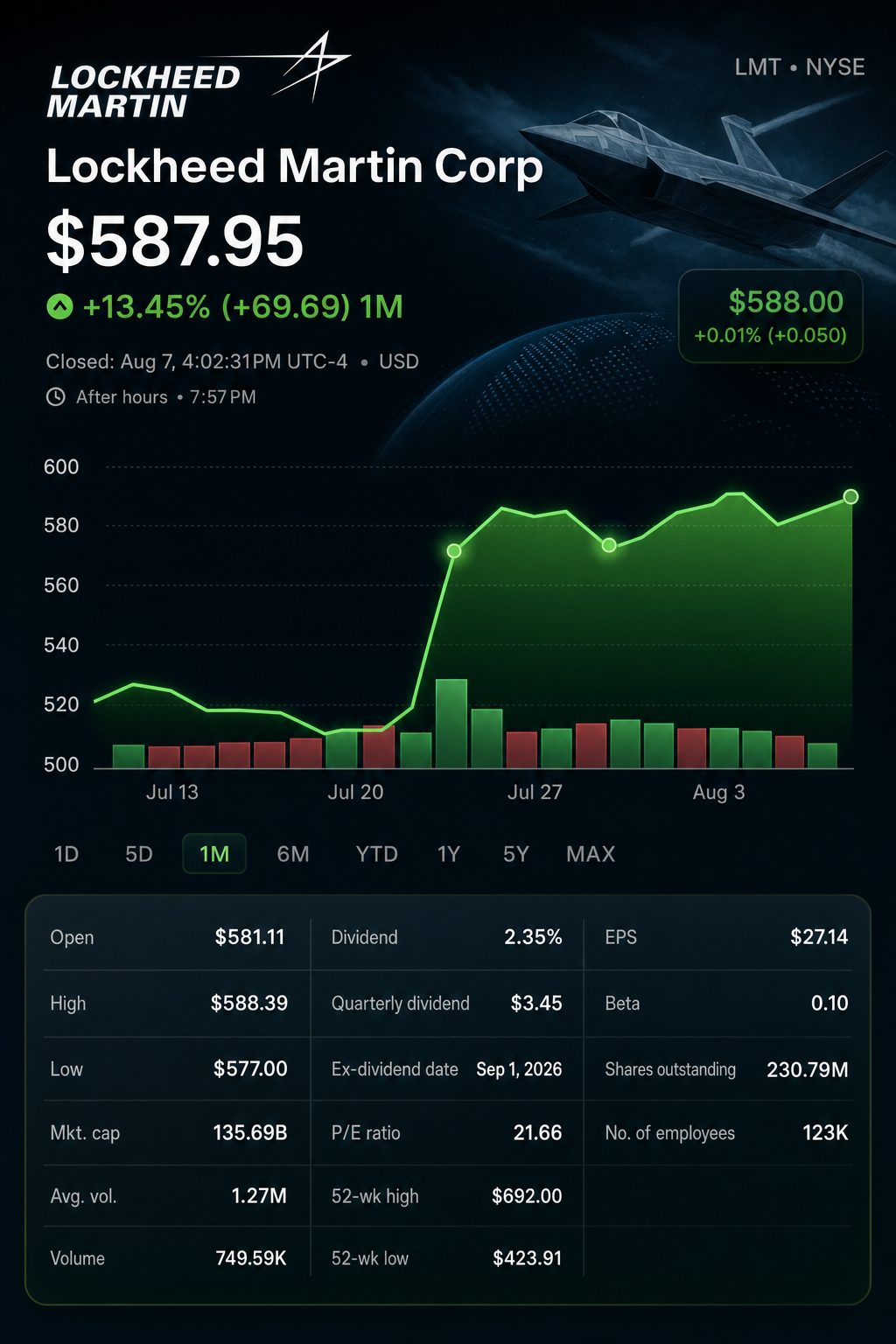
- Lockheed ended Friday at $587.95, up 0.9% over the week. The S&P 500 advanced 3.6%.
- The Army’s PAC-3 ceiling totals $58.6 billion for fiscal years 2026 to 2032. If divided evenly, this would amount to $8.4 billion per year. However, this figure is meant for illustration only and does not represent company guidance.
- The analyst consensus has moved to Overweight from Hold. The mean price target of $633.21 suggests a 7.7% potential gain from Friday’s close.
Lockheed Martin starts Monday with an all-time high backlog for the second quarter and has secured a fresh missile contract valued at as much as $58.6 billion. However, its stock rose just 0.9% last week. U.S. cash markets did not open on Sunday.
This difference shapes the trade. Demand has shifted; it is no longer hard to find. Investors are watching how soon contract maximums turn into booked orders, actual deliveries, improved margins and free cash flow.
Each of the three chosen U.S. defense peers outperformed Lockheed over the week.
Week prior: July 31-August 7
| Security | Friday close | Weekly change |
|---|---|---|
| Lockheed Martin | $587.95 | up 0.9% |
| Northrop Grumman Corporation NYSE:NOC | $571.58 | gained 5.4% |
| RTX Corporation NYSE:RTX | $223.03 | rose 3.6% |
| General Dynamics Corporation NYSE:GD | $392.05 | increased 2.3% |
| S&P 500 | 7,757.64 | advanced 3.6% |
Returns are based on July 31 closing prices.
Friday’s uptick was accompanied by lighter activity, with around 750,000 shares changing hands—only 59% of the 65-day average. While this does not necessarily indicate caution, it does reflect a lack of strong volume support.
Valuation is another limiting factor. Lockheed’s trading multiple is higher than Northrop’s trailing figure, yet it remains lower than those of RTX and General Dynamics.
Market value as of Friday’s close
| Company | Market value | Trailing P/E |
|---|---|---|
| Lockheed Martin | $135.7 billion | 21.7 |
| Northrop Grumman | $81.4 billion | 18.2 |
| RTX | $300.6 billion | 39.3 |
| General Dynamics | $106.1 billion | 23.9 |
The PAC-3 deal is significant in scale, though its immediate impact on earnings will be modest. Congressional approval is still needed for funding, and the precise conditions and schedule for delivery are still being discussed.
Calculating missile demand conversions
| Metric | Reported or derived value | Investor context |
|---|---|---|
| PAC-3 award ceiling | Up to $58.6 billion | Draft framework covers seven years |
| Straight-line annual equivalent | $8.37 billion | Represents 10.4% of 2026 sales midpoint |
| Missiles and Fire Control backlog | $87.88 billion | Backlog climbed 88.4% since December |
| Missile segment share of total backlog | 38.1% | Lockheed’s largest segment backlog |
| PAC-3 ceiling versus Q2 backlog | 25.4% | Comparison of scale only |
| Modernization programme | $8 billion-$9 billion | Spending continues through 2030 |
Figures shown are for example only and do not represent company forecasts. The backlog as of June 28 does not include the July 29 PAC-3 contract. The contract ceiling is not recognized as revenue.
Conversion is underway. Sales from Missiles and Fire Control climbed 19% in the second quarter. Operating profit grew 24%, with margins widening to 14.5% from 14.0%. Expansion of PAC-3, THAAD and Precision Strike Missile programs fueled the gains.
Chief Executive Jim Taiclet stated, “We now anticipate accelerated year-over-year sales growth of approximately 8%.” Lockheed additionally projected 2026 free cash flow between $7.0 billion and $7.2 billion. PR Newswire
Preliminary estimate: The Center for Strategic and International Studies calculates that U.S. forces used around 65% of their Patriot interceptors from February through July. Fewer than 850 are thought to be left, according to the estimate. Because stockpile numbers are classified, these figures are unofficial.
Developing new capacity is a lengthy process. Rheinmetall AG ETR:RHM intends to manufacture ATACMS missiles in Germany with Lockheed, but the joint project is still pending approval. Chief Executive Armin Papperger stated the scale-up “will take much longer” than two years. Initial revenue is anticipated in 2028. Reuters
Raw materials present an additional challenge. On Friday, Washington unveiled $3 billion in investments for critical minerals and batteries. Lockheed is additionally seeking domestic sources of scandium and germanium, though price levels and limited processing capacity still pose challenges.
Analyst positioning has become more favorable, but conviction continues to be mixed.
Analyst ratings
| Recommendation | Three months ago | Current |
|---|---|---|
| Buy | 5 | 6 |
| Overweight | 3 | 4 |
| Hold | 16 | 13 |
| Underweight | 1 | 1 |
| Sell | 1 | 1 |
| Consensus | Hold | Overweight |
| Average target | — | $633.21 |
| Median target | — | $620.00 |
| Implied average upside | — | 7.7% |
The number of analysts covering the stock dropped to 25 from 26 in the referenced period.
The progress is genuine, though not universal. There are still thirteen Hold ratings compared to six Buys. This balance reflects a business with robust demand outlook and a rigorous production timeline.
No Lockheed investor events are on the calendar for the upcoming week. Instead, attention will be on July’s consumer price data set for release Wednesday, followed by producer price figures on Thursday. Both reports are scheduled for 8:30 a.m. Eastern Time.
Risks: The PAC-3 figure represents a maximum limit rather than assured income. Factors such as Congressional budget approval, unresolved delivery timelines, mineral supply, and supplier capability might postpone manufacturing. The $8 billion to $9 billion modernization initiative could further impact short-term cash flow.
Lockheed’s current valuation factors in strong missile demand, but not perfect operational performance. A more significant revaluation may depend on increased production, resilient missile profit margins and parallel gains in free cash flow.
Related articles: NYSE:LMT
Further analysis
**Did Lockheed significantly increase its earnings forecast for 2026?**
Sales for the second quarter increased 11% to $20.1 billion, and diluted EPS stood at $7.94. The company raised its 2026 sales outlook to $79.75–$81.75 billion and EPS guidance to $29.95–$30.65. Free cash flow projections were lifted to $7.0–$7.2 billion, reflecting improved anticipated cash generation. However, the prior year's EPS comparison factored in $1.6 billion in program losses. ([Lockheed Martin Corp][1])
**To what extent do the latest missile contracts enhance visibility into future revenues?**
Backlog at the end of the quarter stood at $230 billion after the company secured $65 billion in second-quarter orders. This figure includes the THAAD multiyear contract, with a ceiling of $35 billion. ([Lockheed Martin Corp][1]) On July 29, Lockheed was awarded a new $53.86 billion PAC-3 modification, raising the total PAC-3 multiyear ceiling to $58.62 billion. Since the July award was granted after the quarter closed, the updated backlog does not include the modification. The stated “up to” figures represent contract ceilings rather than funded revenue in the near term. ([Media - Lockheed Martin][2])
**Has Lockheed moved past the major risks of losing key programs?**
Not completely. Aeronautics margin improved to 9.4%, up from negative 1.3% a year ago, mostly because there was no repeat of the $950 million classified-program loss seen in 2025. RMS recorded $115 million in negative adjustments related to Heavy Lift and Seahawk. Additionally, the first half included $125 million in negative F-16 adjustments. ([Lockheed Martin Corp][3])
**How is the market valuing the revised outlook?**
LMT closed at $587.95 on Friday, August 7. This represents approximately 19.4 times the midpoint figure from 2026 EPS guidance. Estimated free cash flow guidance suggests a yield of about 5.2% on the current market cap. At this price, the annualized dividend of $13.80 offers a yield near 2.35%. ([Lockheed Martin Corp][1])
**How much capacity is left for further share repurchases?**
Lockheed projects 2026 free cash flow of $7.0–$7.2 billion. The company has also reached an agreement to acquire Ultra Maritime for $3.45 billion. Plans call for $8–$9 billion in munitions investment by 2030. No share buybacks took place in the first half, with dividends totaling $1.6 billion. Present outlook does not factor in Ultra, pending transaction completion. ([Lockheed Martin Corp][1])
[1]: https://investors.lockheedmartin.com/news-releases/news-release-details/lockheed-martin-reports-second-quarter-2026-financial-results/ "Lockheed Martin Posts Second-Quarter 2026 Results | Lockheed Martin Corp"
[2]: https://news.lockheedmartin.com/2026-07-29-Department-of-War-Awards-Lockheed-Martin-58-62B-for-Multiyear-PAC-3-MSE-Production-to-Strengthen-the-Arsenal-of-Freedom "Department of War Grants Lockheed Martin $58.62B Multiyear PAC-3 MSE Contract to Boost Arsenal of Freedom - Jul 29, 2026"
[3]: https://investors.lockheedmartin.com/static-files/21ba3d1e-4093-4848-8606-dac82add19ce "Lockheed Martin Corp 10-Q Filed 07/23/2026"