NEW YORK, July 28, 2026, 15:57 EDT — Trading on Nasdaq continued as usual.
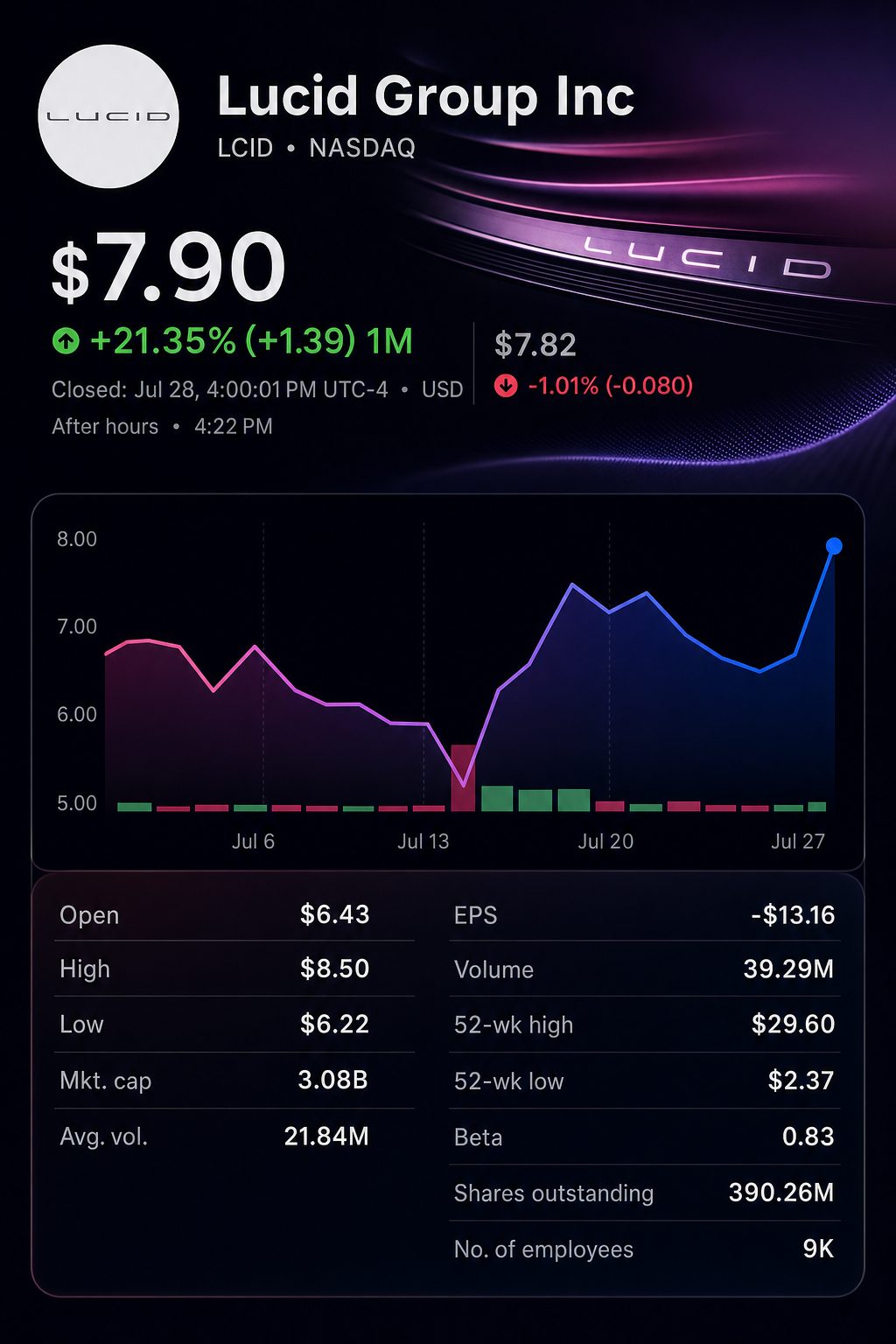
Shares of Lucid surged 21.8% to $7.92 late Tuesday, following news that Prince Alwaleed Bin Talal revealed a 5% stake. The stock climbed as high as $8.50, with trading volume reaching 35.2 million shares.
The response surpassed the size of the holding. Early estimates show Lucid’s implied single-day equity gain at around $554 million. By late trade, the value of the stake was about $155 million.
The difference stands at 3.6 to one. The filing revealed details of ownership rather than new Lucid funds. Sentiment shifted, but the balance sheet numbers were unchanged.
Prince Alwaleed disclosed holding 19.513 million shares with exclusive voting authority. The Schedule 13G indicates that this ownership level was reached on July 23. The filing affirms that the acquisition was not made to seek control.
Initial estimates are based on the $7.92 late price and 390.26 million shares in circulation. Figures reflect market projections and do not represent company guidance.
The market’s reaction could have been intensified by the structure itself. As of July 15, short interest totaled 65.01 million shares, accounting for 37.82% of Lucid’s publicly traded shares. The prince’s stake makes up 30% of that short position. This does not confirm forced short covering.
Other stocks in the sector were mixed. Rivian Automotive NASDAQ:RIVN rose 0.7%, while Tesla NASDAQ:TSLA slipped 0.9%. Lucid’s moves were not mirrored across the sector.
Lucid’s communications chief Nick Twork described the acquisition as an “independent vote of confidence.” The company would not provide additional details about specific investments. TechCrunch
However, the recovery has yet to offset previous declines. Shares are still off roughly 27% for the year and 70% over the past 12 months.
Cash burn continues to be the main challenge. Lucid posted a free-cash-flow outflow of $1.439 billion in the first quarter. Pro forma liquidity stood at $4.7 billion following the funding round in April.
On July 6, the company secured an additional $800 million from an affiliate of the Public Investment Fund. This amount exceeded the prince’s previous stake value by more than five times.
Production for the second quarter totaled 4,774 vehicles, while deliveries amounted to 3,953. The resulting gap of 821 units was much smaller compared to the 2,407-unit difference seen in the first quarter.
During the first half, production outpaced deliveries by 3,228 vehicles. This is not an inventory total. Attention remains on converting these vehicles into revenue and cash.
Lucid is set to release its second-quarter earnings on August 4 at 5:30 p.m. EDT. The automaker paused its 25,000-to-27,000 vehicle forecast in May. Markets will focus on new guidance and cash flow updates, with those factors expected to outweigh the importance of Tuesday’s filing.
Cantor Fitzgerald analyst Andres Sheppard anticipates that Napoli will present a strategy for “accelerating Lucid’s path to profitability.” Sheppard holds a Hold rating on the stock with a price target of $8. On Tuesday, shares closed about 1% under that level. Barron’s
Risks: The passive investment does not ensure additional funding in the future. Lucid continues to encounter risks related to suppliers, demand, and potential dilution. According to its own filing, the company states that further growth will demand significant funding beyond anticipated cash generated from vehicles.
The mood in the market shifted after Tuesday’s filing. The operating math must shift on August 4.
What caused Lucid shares to surge recently, and is there an impact on funding?
Lucid last changed hands at $7.86 on July 28, a gain of 20.9%. Trading volume hit 35.3 million shares, with the session's top at $8.42. The advance occurred after Prince Alwaleed revealed a 5.00% passive holding. His filing lists 19,513,000 shares and states no intent to seek control of the company. The disclosure is not a form of financing and provides no additional capital.
Which upcoming event is expected to impact Lucid's share price?
Lucid is set to release second-quarter results on August 4 at 5:30 p.m. Eastern. Investors are expected to focus on revenue, gross margin, cash burn, inventory levels, and possible changes to guidance. The company reported $282.5 million in revenue for Q1, with free cash flow at negative $1.44 billion. In May, management withdrew its previous production forecast of 25,000 to 27,000 vehicles. Revised guidance is likely to steer the market reaction to the earnings.
Did second-quarter deliveries indicate tangible progress in operations?
Vehicle deliveries in Q2 increased to 3,953, representing a 27.8% gain from the previous quarter and a 19.5% rise against the same period a year ago. Production dropped 13.2% sequentially to 4,774 vehicles but remained 23.6% higher versus Q2 2025. Production in the first half reached 10,274 units, with deliveries amounting to 7,046. The difference of 3,228 vehicles between production and deliveries highlights potential issues concerning inventory management and the timing of deliveries.
Is Lucid still able to achieve its previous 2026 production target?
Lucid has yet to reinstate its 2026 production outlook following suspension. Previously, the target was set at 25,000 to 27,000 vehicles. Hitting the 25,000 mark would mean producing 14,726 vehicles in the second half, or 7,363 each quarter, representing a 54% rise over Q2 output. The calculations illustrate the challenge. Still, this previous target no longer represents current official guidance.
What are key financial indicators aside from quarterly revenue?
Q1 GAAP gross margin stood at about minus 110% based on disclosed data. Inventory increased by 32% during the period, reaching $1.47 billion, which is $359 million higher than the figure at December. Investors require improved gross margin and moderation in inventory expansion. Rising revenue alone is not enough to address Lucid’s cash burn issue.
What is the current level of liquidity, and could more dilution occur?
Lucid reported $3.2 billion in liquidity at the end of Q1. Pro forma liquidity increased to about $4.7 billion following April transactions, which comprised $1.05 billion in preferred and common equity. Lucid also accessed $500 million from a larger PIF-linked term loan. According to management, available liquidity is expected to support operations through the second half of 2027. As a result, substantial dilution risk remains for common shareholders.
Do Lucid's layoffs significantly impact its cash position?
Lucid will reduce its U.S. workforce by about 18%. The company has scrapped AMP-1’s second shift and has done away with the COO role. Leadership forecasts $158 million in yearly cost reductions following $32 million in related charges. Most measures are expected to wrap up by the close of Q3. The planned savings represent around 11% of the Q1 free-cash-flow burn rate, though that figure may fluctuate due to volatility in quarterly cash consumption.
Does verified information indicate a likely bankruptcy filing in the near future?
Lucid dismissed the July bankruptcy report as entirely untrue. The company said it has not created a special board committee for Chapter 11 or privatization. Reuters found no public filing confirming a current bankruptcy process. In Q1, Lucid reported a net loss attributable to common shareholders of $1.13 billion, while free cash flow was negative $1.44 billion, underscoring ongoing funding risks. The stock’s rapid drop to a July low of $2.37 highlighted the market's swift reaction to fear.
Could the Gravity model and Uber's robotaxi initiative impact Lucid's prospects?
Prospects for growth increasingly depend on Gravity and robotaxi initiatives. Uber has widened its commitment to a minimum of 35,000 Lucid vehicles. Nuro secured a driverless-testing permit in California, with a tentative launch set for later in 2026. Lucid's Arizona plant is expected to begin producing production-intent robotaxis within the year. This commitment does not generate immediate revenue. The timeline for deliveries, potential profit margins, and investment needs remain unclear.
Mateusz Kaczmarek is a financial and technology journalist at TS2.tech. His coverage ranges from stocks and artificial intelligence to semiconductors and developments across global markets. He graduated from the Poznań University of Economics and Business and worked in financial analysis before becoming a business journalist. Follow Mateusz Kaczmarek on Google News.
A figure above or below the 12.0 consensus could impact Treasury yields, the dollar, and cyclical stocks by influencing short-term growth outlooks.
#2
NAHB Housing Sentiment
A reading above or below 33 will influence expectations for housing demand, mortgage rate trends, and homebuilder stocks.
#3
Fabrinet After the Close
Investors are focusing on revenue, margins, and comments on datacom as key factors for companies involved in optical networking and AI infrastructure supply chains.