NEW YORK, July 28, 2026, 15:59 EDT — U.S. cash markets are now open.
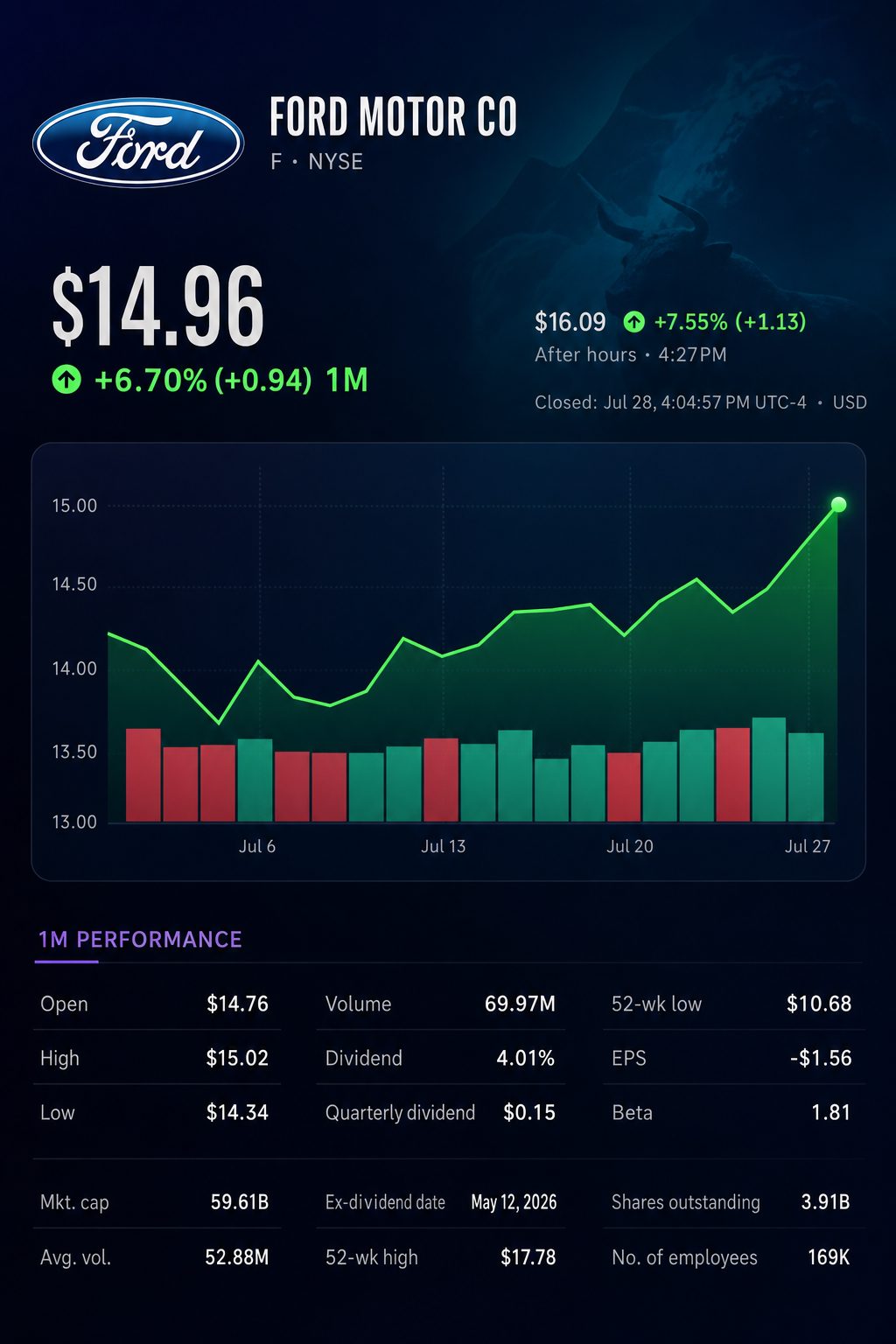
Ford Motor Company NYSE:F gained 1.5%, reaching $14.91 in after-hours trading.
Bloomberg’s initial consensus projects second-quarter adjusted EBIT at $2.15 billion.
The Q1 tariff advantage represents 23% of expected first-half adjusted EBIT.
Ford shares hovered close to $15 shortly before the market close. The company’s results are expected at 4:05 p.m. EDT.
The headline numbers look solid, but profit quality is more constrained. An initial boost comes largely from a one-off tariff advantage.
Ford reported adjusted EBIT of $3.5 billion for the first quarter. Bloomberg consensus projects $2.15 billion in adjusted EBIT for the second quarter, putting estimated first-half EBIT at $5.65 billion.
The sum amounts to nearly 60% of Ford’s $9.5 billion guidance midpoint. However, the first quarter featured a one-time tariff gain of $1.3 billion.
The benefit accounts for 23% of projected first-half EBIT. Without this item, the preliminary total stands at $4.35 billion.
Ford requires $3.85 billion in the second half to achieve the midpoint, which is 32% less than reported first-half EBIT. If the benefit is excluded, the difference narrows to 11%.
Ford adjusted EBIT walk
$ billion
Status
Q1 adjusted EBIT
3.50
Reported
Q1 single-occurrence tariff benefit
1.30
Included above
Q2 adjusted EBIT
2.15
Consensus preliminary
First-half reported EBIT
5.65
Preliminary
First-half excluding benefit
4.35
Preliminary
2026 target midpoint
9.50
Company forecast
Second-half required EBIT
3.85
Estimate derived
Second-quarter and first-half numbers are provisional estimates. Sources: Ford, Bloomberg consensus and calculations.
Business composition is more significant than surpassing earnings estimates by one cent. Ford Pro operates as the commercial segment. Ford Blue encompasses combustion and hybrid vehicle models.
Combined, these units generated close to $3.6 billion in Q1 EBIT. The Model e electric vehicle division posted a loss of $777 million.
Ford projects Pro will generate between $6.5 billion and $7.5 billion by 2026. Blue is expected to contribute $4.5 billion to $5.0 billion. Model e could report a loss ranging from $4.0 billion to $4.5 billion.
CFO Sherry House stated in April that “the path to higher margins is clear.” The Q2 results need to demonstrate improvement, and not simply benefit from a fresh tariff boost.
Philippe Houchois, an analyst at Jefferies Financial Group NYSE:JEF, upgraded Ford to Buy on Monday, raising the price target from $14.50 to $17.50. Jefferies described Q2 as a possible “margin trough” and projected adjusted EBIT of $2.5 billion. Barron’s
General Motors Company NYSE:GM was also given a Buy upgrade. The stock added 3.5% on Tuesday, compared with a 1.5% rise for Ford. Optimism is not limited to Ford.
Ford shares rose on Monday after the automaker joined a U.S. Army tactical truck competition. Ford plans to construct three prototypes based on its Super Duty platform.
Risks: An increase in commodity prices, rising warranty costs, softer U.S. demand, or higher EV losses could deplete the buffer. Ford’s forecast does not account for a significant U.S. recession or ongoing Middle East conflict.
The threshold to meet is not simply $0.36 per share. Shareholders require proof that EBIT in the second half can be sustained independently of the one-time gain.
At what level is Ford's stock priced ahead of the earnings announcement?
Ford was last at $14.90 late Tuesday, up around 1.5% on the day. The automaker's market capitalization stood at approximately $60.7 billion. Shares remained down about 16% from the May 29 peak of $17.78. Ford entered Tuesday with a gain of roughly 12% for the year so far and up 30% over the past twelve months.
What does Ford need to post in order to meet Wall Street’s second-quarter expectations?
Analysts on Wall Street project sales of about $47.2 billion and adjusted EBIT of $2.1 billion. Adjusted earnings per share are forecasted in the range of $0.35 to $0.36. Revenue estimates reported differ because some analysts only include automotive revenue. Ford has set its earnings release for 4:05 p.m. ET on July 28, marking the near-term test.
Is Ford planning to maintain or increase its outlook for 2026?
Ford had forecast adjusted EBIT between $8.5 billion and $10.5 billion for April. The company also expected adjusted free cash flow in the range of $5 billion to $6 billion. Projected capital expenditures were outlined at $9.5 billion to $10.5 billion. The outlook was based on $1 billion in tariff costs and an estimated $2 billion in commodity headwinds, alongside a $1.3 billion tariff benefit and a $1 billion recovery from Novelis. Analyst focus may shift more toward forward guidance than the quarterly results.
Do Ford Blue and Ford Pro continue to shoulder most of the workload?
Ford Blue posted earnings of $1.94 billion on revenue of $23.9 billion in Q1, with an EBIT margin of 8.1%. Ford Pro reported earnings of $1.69 billion from $14.7 billion in revenue, achieving an 11.4% margin as paid software subscriptions increased 30% to 879,000. Combined, these divisions delivered around $3.63 billion in segment EBIT. Investors rely on this profitability to withstand softer headline volume.
What is the scale of the Model e's losses?
Model e reported a $777 million loss for Q1 with revenue of $1.2 billion. Ford maintains its projection for a loss between $4.0 billion and $4.5 billion in 2026. Management has allocated around $1 billion more for Model e investment. The Louisville facility is undergoing upgrades to produce an affordable electric pickup in the coming year. A reduction in losses would be positive, while a further increase would not.
Do Ford's most recent U.S. sales figures back up its earnings narrative?
Ford reported selling 549,200 vehicles in the U.S. during Q2, marking a 10% decline from a year earlier. Daily rental sales fell 69%, and model phase-outs affected total volume. Despite this, June retail market share climbed 0.2 points to 12.3%. F-Series sales for the first half totaled 357,801, outpacing Silverado by over 80,000 units. Maverick Hybrid achieved a record quarter with 29,457 units sold. Underlying model mix outperformed the headline figure.
What portion of Ford's latest profit resulted from one-time items?
First-quarter adjusted EBIT totalled $3.5 billion, factoring in a $1.3 billion boost from tariffs. Stripping that out, the figure stands near $2.2 billion ahead of further adjustments. Adjusted EPS for the quarter reached $0.66, surpassing the consensus for the following period. That puts the spotlight on the quality of earnings, with investors set to scrutinise pricing, product mix, warranty outlay, and cash conversion rates.
Is Ford able to maintain its dividend and cash flow?
Ford reported $22.0 billion in cash and $43.1 billion in liquidity at the close of Q1. Adjusted free cash flow for the period was negative $1.9 billion. The most recently declared regular dividend remains $0.15 per share. On an annualized basis, this amounts to $0.60, which is roughly a 4.0% yield at $14.90. Cash conversion in the second quarter is expected to provide further insight into dividend coverage.
After its recent rally, is Ford stock still considered inexpensive?
Ford's current trailing valuation is affected by a trailing EPS of minus $1.55. Consensus projections for adjusted EPS in 2026 are about $1.62 to $1.64. At $14.90 per share, the stock trades at approximately nine times its forward earnings. The average price target listed by WSJ was $15.16, suggesting limited potential gains. Jefferies recently upgraded Ford and lifted its price target to $17.50. The lower valuation remains subject to certain factors.
Iwona Majkowska is a financial markets journalist at TS2.tech. She covers stocks, artificial intelligence and technology, with a focus on the stories moving U.S. and global markets. Before turning to financial journalism, she worked in equity research and financial analysis. She is a graduate of the Warsaw School of Economics. Follow Iwona Majkowska on Google News.
A figure above or below the 12.0 consensus could impact Treasury yields, the dollar, and cyclical stocks by influencing short-term growth outlooks.
#2
NAHB Housing Sentiment
A reading above or below 33 will influence expectations for housing demand, mortgage rate trends, and homebuilder stocks.
#3
Fabrinet After the Close
Investors are focusing on revenue, margins, and comments on datacom as key factors for companies involved in optical networking and AI infrastructure supply chains.