Dateline: Nov. 13, 2025
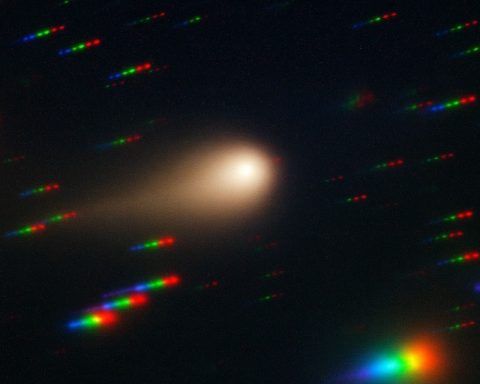
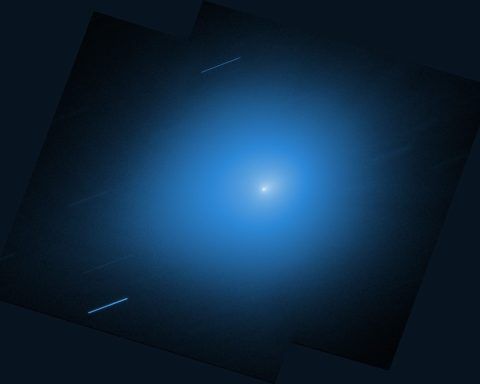
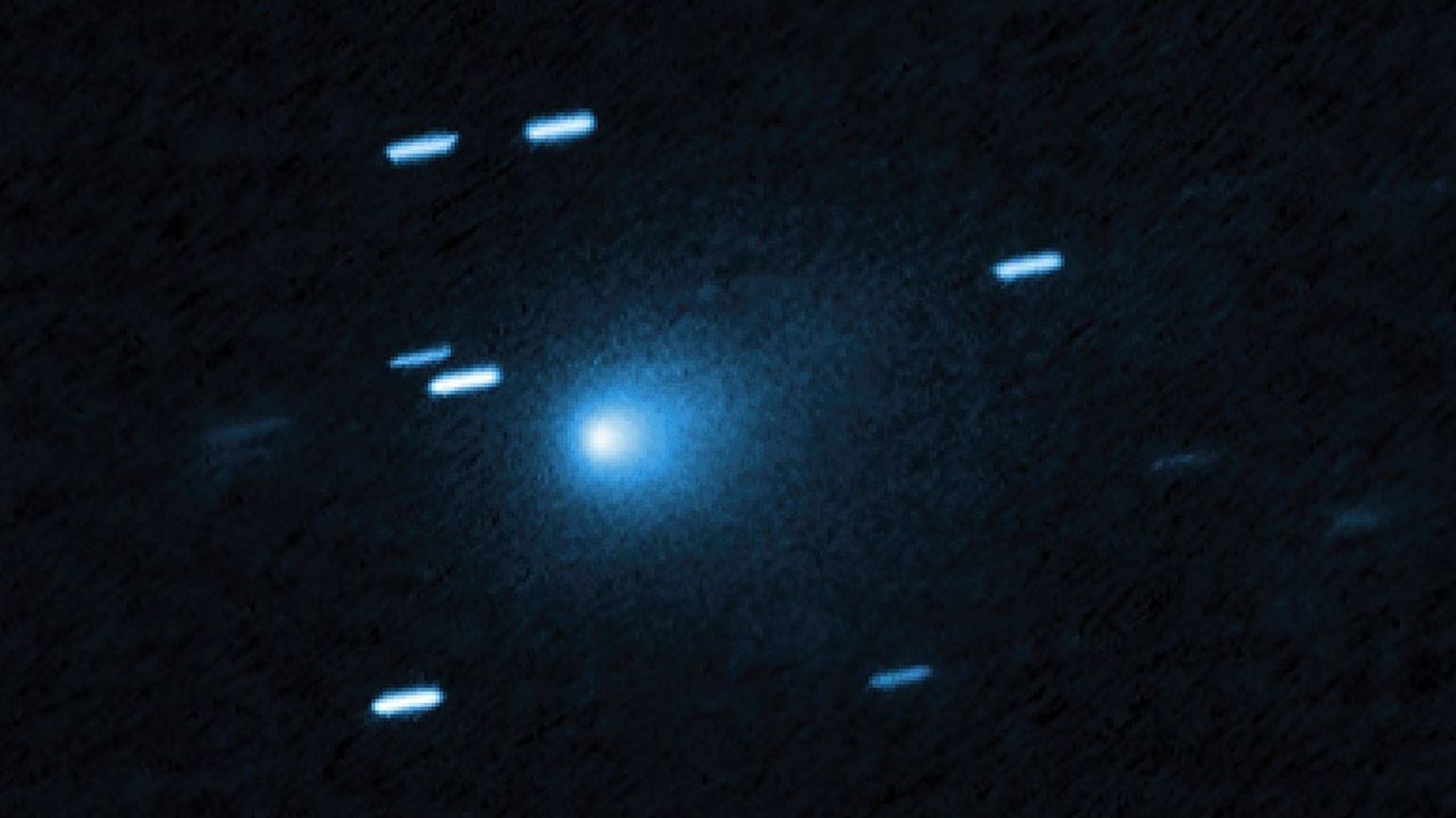
South Africa’s MeerKAT radio array has picked up the first confirmed radio signal from the interstellar comet 3I/ATLAS, a detection that strongly supports the object’s natural, cometary identity and undercuts recent “alien probe” speculation. The signal—two narrow features at 1665 and 1667 MHz—matches classic hydroxyl (OH) absorption produced when sunlight breaks apart water vapor outgassed from a warming comet. The Astronomer’s Telegram
What astronomers actually detected
The team reported OH absorption in both the 1665 MHz and 1667 MHz lines while observing 3I/ATLAS on Oct. 24, 2025, when the comet sat just 3.76° from the Sun on the sky. That geometry favors absorption (against the Sun’s radio glow) rather than emission, which is why the “signal” should not be confused with any sort of technological transmission. In other words, it’s a chemical fingerprint, not a message. The Astronomer’s Telegram
Hydroxyl is a telltale daughter product of water: as 3I/ATLAS neared perihelion, solar ultraviolet light split molecules in the comet’s coma, leaving OH that absorbs at specific L‑band frequencies. That’s textbook comet physics—and exactly what MeerKAT saw. Live Science
The timeline: from silence to signal
MeerKAT tried twice in September and saw nothing. On Oct. 24, sensitivity and geometry lined up, and OH popped out at the expected Doppler shifts. Those specifics—dates, frequencies, and line strengths—appear in an Astronomer’s Telegram posted by members of the South African Radio Astronomy Observatory (SARAO) and collaborators, providing the community’s first formal radio confirmation for 3I/ATLAS. The Astronomer’s Telegram
Why this matters
- It settles the nature debate. The OH detection aligns with weeks of optical/UV evidence that 3I/ATLAS is an active, water‑bearing comet. Media summaries this week and earlier analyses make clear the radio “signal” is natural, not artificial. Live Science
- It builds on earlier water findings. In October, researchers reported unusually strong water activity—likened to a “fire hydrant”—as 3I/ATLAS brightened approaching the Sun, and the radio result dovetails with that behavior. WIRED
- It’s a first for this interstellar visitor. While previous interstellar comet 2I/Borisov ultimately yielded OH at radio wavelengths, the MeerKAT detection is the first radio confirmation specifically for 3I/ATLAS and arrives at a scientifically crucial moment near perihelion. The Astronomer’s Telegram
Today’s coverage at a glance (Nov. 13)
Outlets and commentators continued clarifying what the radio lines mean—and what they don’t. ScienceAlert’s explainer today emphasizes that every datapoint so far fits a “weird but natural” comet, not an alien craft; IFLScience and others lay out the OH‑line details and the failed September attempts before the successful Oct. 24 run. Indian and global outlets have echoed the same bottom line. The Times of India
Where 3I/ATLAS is now—and what’s next
- Perihelion & reappearance. 3I/ATLAS reached closest approach to the Sun around Oct. 29–30, 2025. It’s reappearing from solar glare this month for renewed observing campaigns. Live Science
- Closest to Earth. The comet won’t come near our planet; NASA lists a minimum distance of ~1.8 AU. Some coverage pegs its closest Earth approach in mid‑December, but even then it remains far and faint. NASA Science
- Follow‑up radio/spacecraft checks. Expect more L‑band work as the geometry improves. A few researchers have suggested opportunistic listening when 3I/ATLAS passes near Jupiter in March 2026 (potentially within Juno’s radio‑sensing range), though that’s a proposal rather than an announced NASA plan. WIRED
Debunking the conspiracy cycle
The radio detection has been framed in some corners as “proof” of transmissions. It’s not. These are absorption lines from hydroxyl radicals—a normal by‑product of cometary water—sitting exactly where chemistry says they should be. The detection undercuts viral claims about artificial origin, exploding nuclei, or “deployed probes,” all of which have been addressed and dismissed by ongoing observations. Live Science
Quick facts: 3I/ATLAS (C/2025 N1)
- Discovery: July 1, 2025 (ATLAS survey; later reclassified as interstellar). NASA Science
- Type: Interstellar comet on a hyperbolic path—third known interstellar visitor after 1I/ʻOumuamua (2017) and 2I/Borisov (2019). NASA Science
- Perihelion: ~Oct. 30, 2025. NASA Science
- Minimum Earth distance: ~1.8 AU (no threat). NASA Science
- New radio result: MeerKAT detects OH absorption at 1665/1667 MHz on Oct. 24, 2025. The Astronomer’s Telegram
Key takeaways for readers and editors
- The “radio signal” from 3I/ATLAS is natural chemistry, not communication.
- MeerKAT’s detection provides independent, physics‑based evidence that the object is an active, water‑bearing comet.
- Fresh coverage on Nov. 13 continues to debunk alien‑craft narratives and focuses on the science: composition, activity, and how interstellar comets challenge our models. ScienceAlert
Sources & further reading
- Astronomer’s Telegram: Detailed observing note confirming OH absorption with MeerKAT on Oct. 24, including frequencies, geometry, and earlier non‑detections. The Astronomer’s Telegram
- NASA overview: Official background on 3I/ATLAS, perihelion timing, and safe Earth distance. NASA Science
- Wired (Nov. 10): What the radio detection means and why it favors absorption near the Sun. WIRED
- Live Science (Nov. 11): Explainer on hydroxyl formation and debunking of alien‑signal claims. Live Science
- IFLScience (Nov. 13): Context on the October detection and the September non‑detections. IFLScience
- ScienceAlert (Nov. 13): Today’s analysis placing the radio result within broader evidence for a natural, if unusual, comet. ScienceAlert
Editor’s note: Some outlets have loosely called this the “first‑ever radio detection from an interstellar object.” Historically, 2I/Borisov yielded marginal OH at 18‑cm after extensive integration, so the safest phrasing is first confirmed radio detection for 3I/ATLAS. Usra