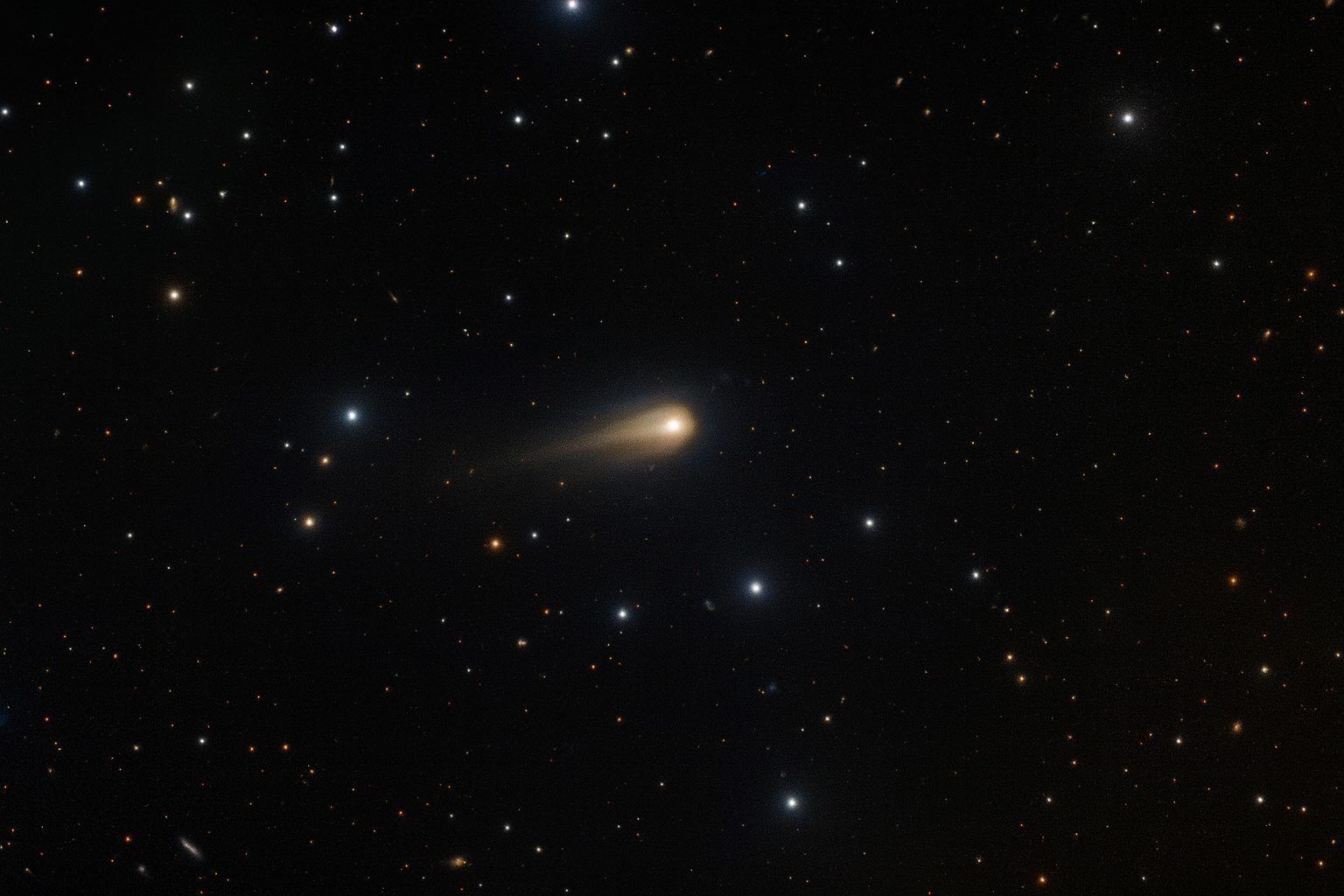
As of December 10, 2025, NASA and partner observatories are racing to squeeze every last photon out of interstellar comet 3I/ATLAS — a green-glowing, ice‑volcano‑blasting visitor loaded with the chemical “ingredients for life.” Here’s the latest on what we’ve learned and what to watch in the days ahead.
What is 3I/ATLAS, and why is it such a big deal?
3I/ATLAS — also cataloged as C/2025 N1 (ATLAS) — is only the third confirmed object ever seen passing through our solar system from another star system, after 1I/ʻOumuamua in 2017 and 2I/Borisov in 2019.NASA Science+1
It was discovered on July 1, 2025, by the NASA‑funded ATLAS (Asteroid Terrestrial‑impact Last Alert System) telescope in Río Hurtado, Chile, part of the agency’s planetary‑defense sky‑survey network.NASA Science+1
Key facts from NASA and ESA:
- Interstellar origin: Its path through space is a hyperbolic trajectory — it’s moving too fast to be gravitationally bound to the Sun, so it’s just passing through and will never return.NASA Science+1
- Size: Hubble data suggest a solid nucleus somewhere between about 440 meters and 5.6 kilometers across — a modest comet by solar‑system standards but enormous compared with most human‑made spacecraft.NASA Science
- Speed: It raced into the inner solar system at ~137,000 mph (221,000 km/h) and hit ~153,000 mph (246,000 km/h) near its closest point to the Sun.NASA Science+1
- Safe distance: 3I/ATLAS will come no closer to Earth than about 1.8 astronomical units — roughly 170 million miles (270 million km) — on December 19, 2025, almost twice the Earth–Sun distance.NASA Science+1
Both NASA and ESA are clear: the comet poses zero impact risk to Earth.NASA Science+1
A fast tour through the inner solar system
In only a few months, 3I/ATLAS has threaded its way past several planets on a steeply tilted, retrograde path closely aligned with the plane of our solar system:Wikipedia+1
- July 1, 2025: Discovery by ATLAS in Chile; early observations show a faint, active object inbound from the direction of Sagittarius, toward the Milky Way’s central region.esa.int+1
- October 3, 2025: Passes about 0.19 AU (~29 million km) from Mars; ESA’s Mars Express and ExoMars Trace Gas Orbiter (TGO) collect crucial images and spectra, helping refine its trajectory by a factor of ten.esa.int+1
- October 29, 2025 (perihelion): Sweeps just inside Mars’ orbit, about 1.36 AU from the Sun, while almost directly behind the Sun from Earth’s point of view — invisible to ground‑based telescopes but tracked by spacecraft like SOHO, PUNCH and STEREO.esa.int+2NASA Science+2
- November 2025: Emerges from solar conjunction into the dawn sky; ESA’s Juice spacecraft near the inner solar system and NASA’s heliophysics missions capture views of its developing tails.esa.int+2NASA Science+2
- December 19, 2025: Closest approach to Earth at ~1.8 AU, on the far side of the Sun. After that, it will climb out through the outer solar system, passing about 0.36 AU from Jupiter in March 2026 before disappearing back into interstellar space.Wikipedia+1
For backyard observers, 3I/ATLAS has always been a telescope‑only object. Even around perihelion, it peaked around magnitude 9–11 and has already faded to around magnitude 11–12 by early December — far too dim for the naked eye, but a reachable smudge in medium‑sized amateur instruments under dark skies.Wikipedia+2Sky Telescope+2
New NASA & ESA images: a bright coma, complex tails and a global campaign
Hubble’s fresh look (November 30)
On November 30, NASA’s Hubble Space Telescope pointed back at 3I/ATLAS with its Wide Field Camera 3, just as the comet was receding from the Sun and heading toward its Earth flyby. The newly released image, published in a NASA blog on December 4 and highlighted again on December 9, shows:NASA Science+2NASA Science+2
- A compact bluish coma surrounding the nucleus
- Faint hints of a tail and jets of material flowing away
- Background stars smeared into streaks because Hubble tracked the fast‑moving comet, not the stars
NASA says Hubble and other missions will keep observing the comet “for several more months” as it races outward.NASA Science+1
Multipoint “solar system selfie”
In a separate campaign update, NASA revealed that at least a dozen spacecraft have now imaged 3I/ATLAS from different vantage points, turning the comet into a kind of solar‑system‑wide science target:NASA Science+1
- At Mars:
- Mars Reconnaissance Orbiter (HiRISE) captured some of the closest images as the comet passed just 19 million miles (30 million km) from the planet.
- MAVEN recorded an ultraviolet glow of hydrogen atoms around the comet, a signature of water molecules broken apart by sunlight.
- Perseverance rover on the Martian surface even managed a faint telescopic glimpse.NASA Science+2Popular Science+2
- Near the Sun:
- STEREO‑A, SOHO, and the new PUNCH mission tracked the comet as a faint, moving blur in coronagraph and wide‑field solar images, revealing its evolving tail as it plunged past the Sun.NASA Science+2NASA Science+2
- Deep‑space asteroid explorers:
- Psyche and Lucy — both en route to asteroid targets — grabbed long‑distance images that help refine the comet’s path and probe its diffuse coma and tail.NASA Science
ESA’s Juice and the double‑tail view
ESA’s Jupiter Icy Moons Explorer (Juice), currently near the inner solar system on its long journey to Jupiter, had one of the best geometric views. Juice observed 3I/ATLAS in November, capturing images that show both a dust tail and a plasma (ion) tail, while simultaneously using spectrometers and particle instruments to sample the environment. However, because Juice is using a lower‑bandwidth antenna and sits on the far side of the Sun, most of its 3I/ATLAS data will not arrive on Earth until February 2026.esa.int+2Live Science+2
Today’s headline: the comet is spewing “key ingredients for life”
The biggest breaking story on December 10, 2025 is chemical. A NASA‑led team using the Atacama Large Millimeter/submillimeter Array (ALMA) in Chile has announced that 3I/ATLAS is unusually rich in methanol and hydrogen cyanide, molecules that play important roles in prebiotic chemistry.Chron+2VICE+2
Highlights from the new ALMA results and related coverage:
- Methanol bonanza: Methanol appears to make up about 8% of all vapor streaming from the comet — roughly four times higher than typical solar‑system comets.Chron+2VICE+2
- Hydrogen cyanide (HCN): The comet is also unusually abundant in HCN, a molecule that can participate in pathways that build amino acids and nucleobases in lab experiments.Chron+2Chron+2
- Complex internal chemistry: Methanol appears both in the icy nucleus and in the extended coma, implying active chemistry inside the comet and in the gas flowing off it.VICE+2arXiv+2
Some outlets have framed this as the comet “releasing the ingredients for life,” echoing long‑standing ideas that comets may seed young planets with organic molecules and water.VICE+1
Crucially, NASA and the researchers are not claiming that 3I/ATLAS carries life itself — only that it’s unusually rich in chemical feedstock that, under the right planetary conditions, could contribute to life’s recipe.
A green, irradiated, ice‑volcano comet
If 3I/ATLAS had a personality, it would be “dramatic.” Over the past few months, astronomers have watched it:
- Turn bright green
- Sprout multiple tails, including a strange “anti‑tail”
- Undergo a sharp and sustained brightening near the Sun
- Show signs of global cryovolcanism (“ice volcanoes”)
Why is 3I/ATLAS green?
Recent images from Lowell Observatory’s Discovery Telescope and other facilities show the comet wrapped in a emerald glow, especially in narrowband filters. Astronomers explain this as a classic comet effect: sunlight breaks down carbon‑rich molecules in the coma, producing diatomic carbon (C₂) that fluoresces green.Live Science+2The Economic Times+2
At times, 3I/ATLAS seemed to “lose” its tail entirely in images that showed only a bright head; later analysis revealed this was a perspective trick — the tail was pointing almost directly away from Earth, effectively hidden behind the coma.Live Science+1
Ice volcanoes and a naked surface
A new wave of research suggests that the comet’s surface may be erupting with cryovolcanoes — jets of volatile ices blasting into space as subsurface pockets heat up.
- A preprint led by Josep Trigo‑Rodríguez and colleagues, supported by Live Science and other outlets, describes spiral jet structures and a global surge in activity, consistent with ice‑rich cryovolcanic eruptions.Live Science+2Phys.org+2
- Analyses indicate that, unlike most long‑period comets from our own Oort Cloud, 3I/ATLAS may lack a thick, insulating dust mantle, allowing large regions of its surface to switch on at once as it warms.Phys.org+1
Taken together with the ALMA and JWST data — which show a coma dominated by carbon dioxide (CO₂) with water, carbon monoxide, OCS and icy grains mixed in — many researchers think 3I/ATLAS is a primitive, metal‑rich carbonaceous body, similar in some ways to outer solar‑system objects like trans‑Neptunian ice‑dwarfs, but forged in a completely different planetary system.arXiv+2arXiv+2
Radio waves and fresh X‑rays: new windows on an interstellar comet
First radio “signal” — and it’s not aliens
In November, astronomers using South Africa’s MeerKAT radio telescope reported the first radio emission ever detected from an interstellar comet. The signal is not a technological transmission but a natural spectral signature from hydroxyl (OH) radicals produced when sunlight breaks apart water molecules in the comet’s coma.Live Science+2Live Science+2
This radio detection independently confirms vigorous water outgassing and offers a new tool to measure how fast the comet is losing mass as it hurtles past the Sun.
Brand‑new: the first X‑ray glow from an interstellar comet
Today’s other big headline: the Japanese‑led XRISM X‑ray observatory has detected a faint but extended X‑ray glowaround 3I/ATLAS — the first confirmed X‑ray detection of any interstellar comet.xrism.jaxa.jp+2The Economic Times+2
- XRISM observations taken in late November show an X‑ray halo stretching roughly 400,000 km from the comet’s nucleus.
- Scientists suspect the glow comes from charge‑exchange reactions between highly charged particles in the solar wind and neutral gas in the comet’s coma — a process seen around solar‑system comets as well.
- Teams caution that instrument effects must be carefully ruled out, but early analyses suggest 3I/ATLAS interacts with the solar wind in ways broadly similar to “normal” comets.The Economic Times+1
These multiwavelength detections — ultraviolet, optical, infrared, submillimeter, radio and now X‑ray — are building a uniquely detailed physical portrait of an object born around another star.
Is 3I/ATLAS an alien spacecraft? Scientists say no.
Interstellar visitors inevitably attract wild speculation, and 3I/ATLAS is no exception. Harvard astrophysicist Avi Loeband a few others have floated ideas ranging from artificial propulsion to “seeding” life via interstellar probes.New York Post+2The Economic Times+2
But the mainstream scientific view, reinforced by NASA and ESA in multiple releases, is straightforward:
- 3I/ATLAS shows classic cometary behavior: an icy nucleus, dusty coma, multiple tails, jets, and outgassing‑driven non‑gravitational accelerations, all consistent with sublimating ices rather than engines.esa.int+2Live Science+2
- Its unusual chemistry (CO₂‑rich, methanol‑ and HCN‑rich, metal‑bearing) falls within the spectrum of natural comet diversity, especially for bodies that formed in different radiation environments.arXiv+2arXiv+2
- NASA explicitly reiterated in a November 19 update that “3I/ATLAS is a comet” and not evidence of aliens, releasing multi‑mission imagery to back up that conclusion.Live Science+1
Put bluntly: 3I/ATLAS is strange because it was forged under alien conditions — not because it is an alien artifact. Extraordinary claims still lack extraordinary evidence.
Where did this interstellar snowball come from?
No one has pinned down 3I/ATLAS’s exact home star, but orbital reconstructions and population studies suggest:Wikipedia+2esa.int+2
- It likely formed in the “thick disk” of the Milky Way, an older stellar population with many low‑metallicity stars, meaning the comet could be several billion years older than our solar system.
- Gravitational interactions in its original planetary system — possibly involving giant planets — probably ejected it into interstellar space long ago, after which it wandered the galaxy for billions of years.
- By the time it reached us, the comet had accumulated a thick, irradiated crust; only now, as it heats up, is that shell cracking open and revealing fresher material from its interior.
In that sense, 3I/ATLAS is a time capsule from an ancient planetary system, carrying clues about when and how planet‑building materials formed elsewhere in the galaxy.
What happens next? Forecast for December 2025 and beyond
Sky‑watching outlook
Between now and its December 19 closest approach to Earth, 3I/ATLAS will:Wikipedia+2EarthSky+2
- Drift through the constellations Virgo and Leo in the early‑morning sky.
- Stay relatively faint — around magnitude ~11–12 — requiring at least a small telescope and dark, clear skies to spot.
- Move farther from the Sun in the sky, making it easier (and safer) for big telescopes to point at it without risking damage from scattered sunlight.
For most people, the comet will remain something you read about rather than see. But for dedicated astrophotographers and observatories, December offers a brief sweet spot where 3I/ATLAS is both active and geometrically observable.
Science priorities for the next few months
Scientists are lining up a final series of observations before the comet fades beyond reach:esa.int+3arXiv+3Chron+3
- JWST follow‑up: Scheduled December observations with the James Webb Space Telescope aim to track how the CO₂‑dominated coma evolves after perihelion and whether water now dominates as the comet recedes.
- ALMA & radio arrays: Additional ALMA runs and radio telescopes like MeerKAT and the VLA will refine production rates of methanol, HCN, OH and other species, probing the comet’s internal chemistry over time.
- XRISM & X‑ray telescopes: Further X‑ray monitoring should test whether the newly discovered glow waxes and wanes with changes in solar wind conditions, and confirm its physical origin.
- Juice data drop (Feb 2026): When ESA finally downlinks Juice’s full dataset, scientists will get high‑quality spectra and particle measurements from a vantage point very different from Earth’s.
By spring 2026, as 3I/ATLAS crosses Jupiter’s orbit and fades, the observational window will effectively close — leaving researchers with petabytes of data and likely years of analysis ahead.
Why 3I/ATLAS matters far beyond the 2025 flyby
Even after it vanishes into the dark, 3I/ATLAS will leave an outsized legacy:
- Sampling exoplanetary materials without leaving home
- Its CO₂‑heavy, methanol‑rich, water‑bearing composition suggests that planet‑forming disks around other stars can produce icy bodies very different from typical solar‑system comets — yet with familiar building blocks for organics.arXiv+2Chron+2
- Testing ideas about life’s cosmic ingredients
- The combination of methanol, hydrogen cyanide, water and other volatiles supports models in which comets help deliver complex organics to young planets, both here and possibly on worlds orbiting other stars.VICE+2Discover Magazine+2
- Pushing planetary‑defense and survey systems
- 3I/ATLAS was spotted by a planetary‑defense survey telescope, not a dedicated comet‑hunter, underscoring how important all‑sky monitoring is for detecting rare interstellar visitors.NASA Science+1
- Shaping future missions
- ESA’s planned Comet Interceptor mission is designed to wait in space for a suitable target — possibly a long‑period or even interstellar comet. Lessons from 3I/ATLAS will inform how scientists prioritize such targets and what instruments they need.esa.int
- Refining our picture of the Milky Way’s “dirty snowballs”
- The emerging view of 3I/ATLAS as a primitive, metal‑bearing, carbonaceous comet experiencing global cryovolcanism gives theorists a new data point for how solids form and evolve in distant protoplanetary disks.arXiv+2IFLScience+2
The bottom line
As of December 10, 2025, NASA’s interstellar comet 3I/ATLAS is:
- Safely sailing past on a one‑time visit
- Glowing green in telescopes as it sheds exotic ices
- Spraying out methanol and hydrogen cyanide in quantities rarely seen in local comets
- Lighting up in radio and X‑rays as it interacts with sunlight and the solar wind
- And giving scientists an unprecedented, multi‑wavelength peek at raw materials from another star’s planetary nursery
For the rest of December, every new spectrum, image and light curve is another clue to how worlds — and maybe life’s chemistry — might arise elsewhere in the galaxy. Then 3I/ATLAS will be gone, leaving only its data, its mysteries, and the blueprint for how we’ll study the next interstellar wanderer that strays through our sky.