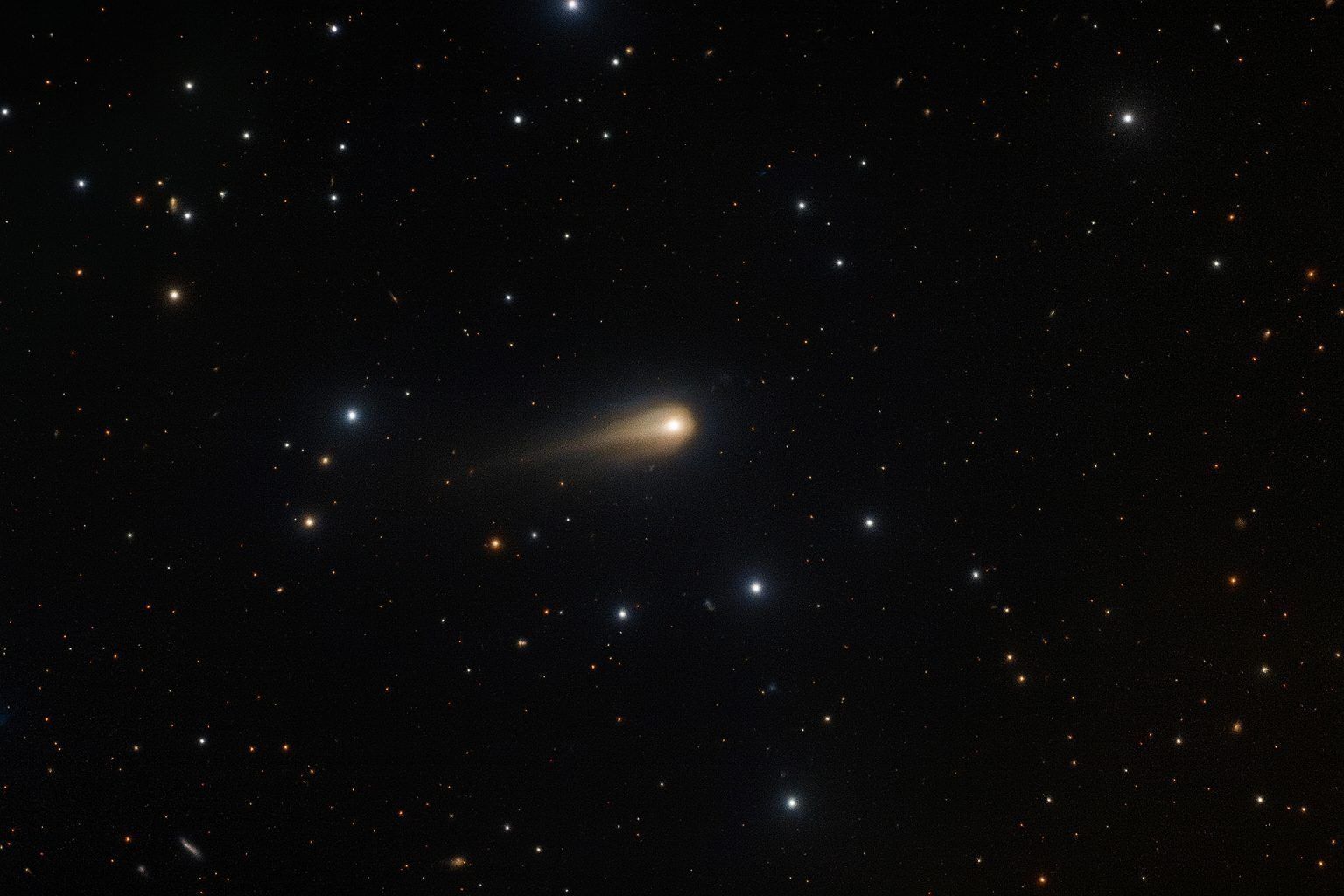

Published: December 3, 2025
NASA has just added a dramatic new chapter to the story of interstellar comet 3I/ATLAS. Today, the agency revealed that its Psyche spacecraft — currently en route to a metal‑rich asteroid — has captured detailed observations of the comet, sharpening its trajectory and feeding into a solar‑system‑wide campaign that now includes a United Nations–backed planetary‑defense exercise.
At the same time, fresh science is pouring in: “ice volcanoes” erupting from the comet’s surface, radio signals revealing its chemistry, and Mars‑orbiting spacecraft narrowing its path by a factor of ten.Universe Today+3Live Science+3Discover Magazine+3
Below is a deep dive into what’s new about 3I/ATLAS as of December 3, 2025 — and why NASA, ESA and the UN are so intensely focused on an object that will never come anywhere near hitting Earth.
What NASA announced today: Psyche tracks 3I/ATLAS from deep space
In a blog post dated December 3, 2025, NASA confirmed that its Psyche mission used its multispectral imager to observe 3I/ATLAS for eight hours on Sept. 8–9, 2025. At the time, the comet was about 33 million miles (53 million km) from the spacecraft.
Those observations:
- Captured a series of images over an eight‑hour span as the comet moved against the star field.
- Are being used to refine the comet’s trajectory, adding yet another independent vantage point to an already crowded network of watchers.
- Demonstrate how “bonus science” from missions en route to other targets can boost planetary‑defense capabilities and comet science at the same time. NASA Science+1
Psyche joins at least a dozen NASA assets that have now imaged or measured 3I/ATLAS — including Hubble, the James Webb Space Telescope (JWST), SPHEREx, Swift, Mars Reconnaissance Orbiter (MRO), MAVEN, Perseverance, Lucy, STEREO, PUNCH and others.
3I/ATLAS 101: NASA’s new interstellar visitor explained
Discovery and name
- Discovery date: July 1, 2025, by the NASA‑funded ATLAS survey telescope in Río Hurtado, Chile, as part of the planetary‑defense network.
- Formal designation: C/2025 N1 (ATLAS), later reclassified as 3I/ATLAS when its interstellar trajectory was confirmed.
- What the name means:
- “3” – third known interstellar object.
- “I” – “interstellar.”
- “ATLAS” – the survey program that first spotted it. European Space Agency+1
The only previous confirmed interstellar visitors were 1I/‘Oumuamua in 2017 and 2I/Borisov in 2019. 3I/ATLAS is the third, and by far the easiest to study in detail.
Size, speed and orbit
NASA’s Hubble images suggest that the nucleus of 3I/ATLAS is between about 1,400 feet (440 m) and 3.5 miles (5.6 km) across.
Key orbital facts:
- Interstellar, hyperbolic trajectory: eccentricity ≈ 6.1 — far above the value of 1 that separates bound orbits from escape trajectories.
- Entry speed: about 137,000 mph (221,000 km/h) when first observed entering the inner solar system.
- Perihelion (closest to the Sun):
- Date: 29–30 October 2025
- Distance: ~1.36–1.4 AU, about 130 million miles (210 million km) — between Earth and Mars.
- Closest approach to Earth:
- Date: 19 December 2025
- Distance: ~1.8 AU, roughly 270 million km (170 million miles).
- Future flyby: It will pass 0.36 AU (53 million km) from Jupiter on 16 March 2026, then leave the solar system forever.
NASA and ESA both emphasize that 3I/ATLAS poses no danger to Earth; at closest approach it will still be more than 700 times farther away than the Moon.
What it’s made of
Multi‑wavelength spectra from Hubble, JWST, and ground‑based telescopes reveal a classic but chemically rich comet: NASA Science+3European Space Agency+3Wikipedia+3
- An icy nucleus wrapped in a coma (gas‑and‑dust cloud)
- Strong carbon dioxide (CO₂) emission
- Water vapor, traced through ultraviolet hydroxyl (OH)
- Carbon monoxide, other volatile gases
- Cyanide (CN) and even nickel, detected in the coma
A recent preprint analyzed high‑resolution images and spectra and argues that the comet’s surface chemistry looks surprisingly similar to trans‑Neptunian objects and to carbonaceous chondrite meteorites that helped deliver the ingredients of life to early Earth.
New science: erupting “ice volcanoes” and a natural radio ‘voice’
Cryovolcanoes on an interstellar world
On December 1, Live Science reported that 3I/ATLAS appears to be erupting with cryovolcanoes — “ice volcanoes” —as it responds to sunlight. Live Science+1
Using the Joan Oró Telescope in Spain and partner observatories, a team led by Josep Trigo‑Rodríguez captured images showing spiraling jets of gas and dust blasting off the nucleus. Their analysis suggests:
- The comet entered a more intense outgassing phase as it came within ~378 million km of the Sun, brightening rapidly.
- Sublimating CO₂ likely opened pathways for oxidizing liquids to penetrate the interior, reacting with iron‑nickel grains and sulfides and powering the jets.
- Spectra compared with carbonaceous chondrites — including Antarctic samples studied by NASA — indicate a metal‑rich, primitive composition.
If confirmed, that would mean an object forged in another star system behaves a lot like the icy bodies that inhabit the outskirts of our own — a tantalizing clue that planetary systems may share common building blocks.
Radio signals that confirm it’s a natural comet
Meanwhile, astronomers using a South African radio telescope detected radio absorption signatures from hydroxyl radicals (OH) in the coma — essentially “listening” to the comet’s water. Discover Magazine
This detection:
- Confirms that 3I/ATLAS is actively releasing water, just like solar‑system comets.
- Provides an independent, physics‑based check that the object is a natural, icy comet, not a spacecraft or metallic object.
Sharpening its path: Mars orbiters and a ten‑fold boost in accuracy
One of the most impressive technical feats so far comes from ESA’s ExoMars Trace Gas Orbiter (TGO).
On October 3, 2025, as 3I/ATLAS passed just 18.6 million miles (30 million km) from Mars, TGO grabbed a series of challenging long‑exposure images of the faint comet.
By combining:
- Those TGO images,
- Precise knowledge of the orbiter’s position around Mars, and
- Existing ground‑based observations from Earth,
ESA scientists improved the predicted trajectory of 3I/ATLAS by a factor of ten.
It’s the first time data from a spacecraft orbiting another planet have been accepted into the International Astronomical Union’s Minor Planet Center to refine a small body’s orbit — a landmark for both planetary defense and comet science.
Universe Today notes that this Mars‑based triangulation is a valuable rehearsal: if a genuinely hazardous object were ever headed our way, combining Earth‑ and Mars‑based measurements could dramatically tighten impact predictions.
ESA’s JUICE mission is now attempting its own observations as the comet moves outward; data are expected to be downlinked in early 2026 due to limited communications while the spacecraft cruises near the Sun.
The UN’s planetary‑defense drill: 3I/ATLAS as a global test target
Although 3I/ATLAS is not dangerous, it has become the centerpiece of a two‑month international planetary‑defense exercise.
The International Asteroid Warning Network (IAWN), in cooperation with the UN and national agencies including NASA’s Planetary Defense Coordination Office, is running a “comet astrometry campaign” from 27 November 2025 through 27 January 2026. iawn.net+2blogs.timesofisrael.com+2
According to IAWN’s campaign page and UN communications:
- The exercise was planned well before 3I/ATLAS was discovered, as a way to practice precise position measurements of comets, which are fuzzier and harder to measure than asteroids.
- 3I/ATLAS was chosen because it is faint but trackable for months, is scientifically compelling, and — crucially — poses no threat.
LBC’s coverage of the UN announcement highlights that this is the eighth IAWN observing exercise since 2017 and part of broader efforts to coordinate global response to potential future near‑Earth objects.
NASA’s 12‑asset “multiple lenses” campaign
In a Nov. 19 update, NASA described 3I/ATLAS as the focus of an “unprecedented solar‑system‑wide observation campaign”: twelve missions and observatories spread from Earth orbit to deep space have now turned their instruments toward the comet. NASA Science+2NASA Science+2
Highlights include:
- Hubble Space Telescope – First high‑resolution images, constraining nucleus size and structure of the coma.
- JWST (NIRSpec) – Spectra of the coma revealing water, CO₂, carbon monoxide and other volatiles, plus an unusually CO₂‑rich composition.
- SPHEREx – Infrared measurements of water ice and CO₂, helping quantify how fast the comet is venting gas.
- Swift – Ultraviolet detection of hydroxyl, a decay product of water, confirming ongoing water loss.
- Mars Reconnaissance Orbiter & MAVEN – The closest imagery so far, capturing 3I/ATLAS from just tens of millions of kilometers away during its Mars flyby and mapping hydrogen around the comet.
- Perseverance rover – Faint images from the Martian surface, demonstrating that even rover cameras can contribute to interstellar science.
- STEREO, SOHO & PUNCH – Views of the comet as it passed near the Sun from Earth’s perspective, showing tail evolution and how the solar wind shapes the coma.
- Lucy & Psyche – Bonus deep‑space perspectives from missions bound for asteroids, adding extra geometry for trajectory and coma studies.
On Nov. 17, NASA issued a media advisory and on Nov. 19 held a widely watched live event to showcase these images and to answer questions — including, prominently, whether 3I/ATLAS might be alien technology.
The official answer, backed by NASA scientists and independent researchers alike: everything seen so far is consistent with a natural comet from another star system.
Weird behavior, wild theories — and the scientific reality
3I/ATLAS has displayed some undeniably strange behavior:
- A long, structured ion tail that has grown dramatically in recent weeks.
- A faint anti‑tail — dust appearing to point toward the Sun due to perspective effects.
- An unexpected brightening, a temporary color shift, and even a brief disappearance of the tail as seen in stacked images.
These quirks, plus its extreme speed and age (perhaps several billion years older than the solar system), have fueled a wave of speculation — including claims that 3I/ATLAS might be alien hardware.
Recent tabloid coverage has highlighted:
- A supposed “heartbeat” in the comet’s brightness, and
- Ideas that its tail or “swarm” of objects could be technosignatures. New York Post+2New York Post+2
However:
- NASA’s official materials repeatedly state that 3I/ATLAS “looks and behaves like a comet,” and that no data require an artificial explanation. NASA Science+3Space+3Live Science+3
- ESA’s FAQ notes that its activity and composition match expectations for highly processed comets exposed to intense starlight over billions of years.
- The recent radio detection of water‑related OH, together with cryovolcanic jets driven by carbon dioxide and internal chemistry, fits naturally into a cometary model.
In short: 3I/ATLAS is weird because interstellar comets are rare and ancient, not because there’s credible evidence of alien technology.
How and when you might see 3I/ATLAS
Even at its brightest, 3I/ATLAS is too faint for the naked eye and will barely be accessible to backyard observers.
From Earth’s perspective:
- Throughout December 2025, the comet climbs into the pre‑dawn eastern sky, moving through Virgo into Leo.
- Around its closest approach to Earth (Dec. 19), observers with dark skies and at least a 30 cm (12‑inch) telescopemay glimpse it under the star Regulus in Leo as a dim, fuzzy patch.
- As it recedes, it is expected to fade beyond magnitude 12, remaining a target mainly for serious amateurs and professional observatories.
NASA’s monthly skywatching guide and local observatory events can help you time any attempted observations, but most people will experience 3I/ATLAS through the flood of images and videos from professional telescopes across the solar system.
Why 3I/ATLAS matters for NASA and planetary science
3I/ATLAS is far more than a curiosity on a one‑way trip:
- A probe of other solar systems
Its chemistry hints at how ices and metals are mixed in distant planetary nurseries, and how those materials change after billions of years in interstellar space. - A testbed for planetary defense
- Mars‑based triangulation, UN‑coordinated observing exercises, and deep‑space spacecraft opportunistically tracking the comet all serve as dress rehearsals for any future object that does pose a risk.
- A bridge to future missions
ESA’s upcoming Comet Interceptor and NEOMIR missions, along with NASA’s ongoing work on near‑Earth object surveys, will build on techniques honed during the 3I/ATLAS campaign. - A public‑engagement powerhouse
From NASA’s live briefing to the flood of professional and amateur imagery, 3I/ATLAS has become a case study in how interstellar visitors can galvanize interest in both astronomy and planetary defense — while also showing how scientists carefully separate solid evidence from speculation.
Quick FAQ: NASA & interstellar comet 3I/ATLAS
Is 3I/ATLAS going to hit Earth?
No. The comet’s closest approach to Earth will be on December 19, 2025, at about 270 million km (170 million miles)— nearly twice the distance between Earth and the Sun.
Why is NASA so interested if it’s harmless?
Because 3I/ATLAS is only the third interstellar object ever detected, it offers a unique chance to compare the chemistry and structure of another star system’s debris with our own comets, and to practice global tracking techniques on a real‑world target.
Is there any real evidence it’s an alien spacecraft?
No. Detailed observations — optical, infrared, ultraviolet and radio — all support a natural comet with a volatile‑rich nucleus, coma, and tails shaped by solar radiation and the solar wind. Unusual features, like rapid brightening or tail changes, can be explained by outgassing and viewing geometry.
Where did 3I/ATLAS come from, and how old is it?
Trajectory modeling suggests it may have been ejected from a star in the Milky Way’s thick disk, potentially making it several billion years older than our solar system. That makes it one of the oldest nearby objects astronomers have ever studied.
What happens after it passes Earth and Jupiter?
After its Jupiter flyby in March 2026, 3I/ATLAS will continue into interstellar space, never to return. Observatories like Hubble and JWST plan to keep monitoring it as long as it’s bright enough, squeezing every last bit of data from this once‑in‑a‑lifetime visitor.