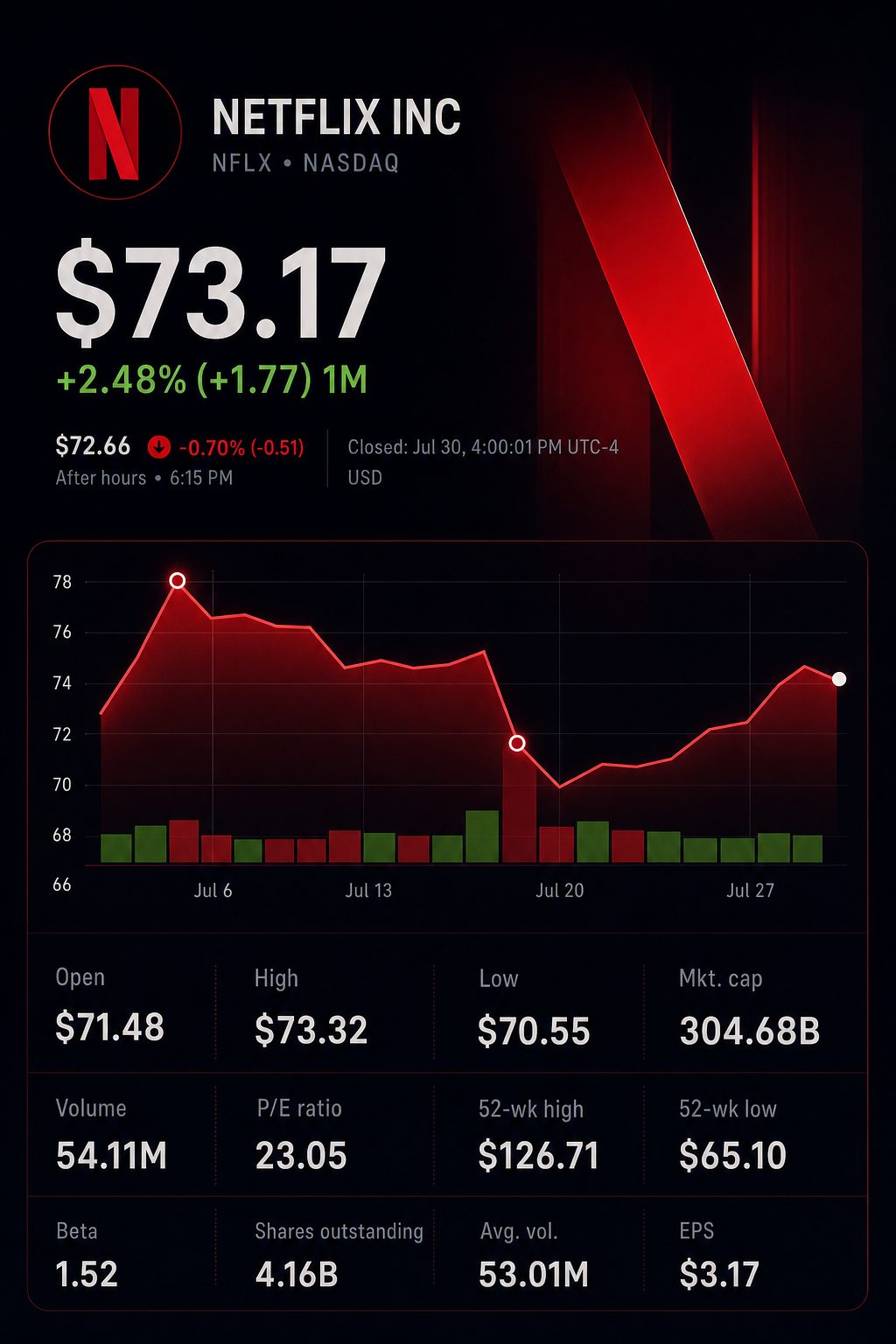
Shares of Netflix Inc. NASDAQ:NFLX ended Thursday down 0.6% at $73.17, while the S&P 500 rose 1.7%. The firms further revealed a worldwide licensing deal. AMC Global Media Inc. (NASDAQ:AMCX) placed the agreement’s value at $500 million.
The agreement, set for five years, includes seven Walking Dead series and a total of 371 episodes. Initial estimates value the nominal payment at $1.35 million for each episode. AMC holds onto streaming rights, making the deal co-exclusive.
Annual cash payments are expected to total roughly $100 million from 2027 to 2030. This represents 0.5% of Netflix’s anticipated spending on films and series. It amounts to 3.3% of expected advertising revenue in 2026.
Scale is what matters to investors. Netflix is able to rent an extensive franchise catalog rather than purchase the studio. However, these rights return to AMC following every five-year period.
Netflix’s trailing earnings valuation is 46% higher than Disney’s, and its multiple is nearly triple that of Comcast. This elevated premium provides less buffer for underperforming content.
U.S. regular markets had closed, with after-hours trading still ongoing. Netflix stood 4.2% higher than the previous week. It declined 2.9% for the month and dropped 37.4% over the past 12 months.
The financial impact of the agreement is limited for Netflix. The following ratios are provisional estimates.
Measure
Disclosed figure
Comparison with Netflix scale
Licensed episodes
371
$1.35 million nominal cost per episode
2026 cash payments
About $25 million
0.13% of planned content spend
Annual cash, 2027–2030
About $100 million
0.5% of content budget
Annual cash versus ads
About $100 million
3.3% of forecasted ad sales
Aggregate license fees
$500 million
Rights revert following five-year periods
Lori Conkling, vice president of licensing at Netflix, said the original series “continues to attract new fans.” AMC’s Chief Executive Kristin Dolan described the deal as a “meaningful source of cash flow for years to come.” About Netflix
The advantage for the seller is more straightforward to quantify. AMC anticipates licensing revenue of $200 million to $225 million in 2026 and again in 2027. No viewership or retention benchmarks for Netflix were disclosed as part of Thursday’s updates.
Netflix continues to show moderating growth in its operations, while maintaining steady margins.
Metric
Q2 2025
Q2 2026
Q3 2026 forecast*
Revenue
$11.08 billion
$12.56 billion
$12.86 billion
Year-on-year increase
15.9%
13.4%
11.7%
Operating margin
34.1%
33.4%
33.2%
Diluted EPS
$0.72
$0.80
$0.82
The company’s Q3 outlook is provisional.
Third-quarter revenue is expected to rise by 11.7%, a decrease compared to the 13.4% increase seen in the second quarter. The operating margin is projected to stay close to 33%. According to management, the outlook suggests a further slowdown in sales growth.
Advertising accounts for a minor share of overall sales, yet has a significant impact on the margin. The 2026 numbers and ratios presented here are early estimates.
Metric
2025 actual or implied
2026 forecast
Change
Total revenue
$45.18 billion
$51.20 billion midpoint
$6.02 billion
Advertising revenue
Over $1.50 billion
Near $3.00 billion
Increase of less than $1.50 billion
Advertising share of revenue
Above 3.3%
Estimated at 5.9%
Lower by about 2.6 percentage points
Ads’ share of total revenue growth
—
—
Under roughly 25%
Advertisements are projected to account for roughly 5.9% of revenue in 2026. If the forecast, which anticipates near-double growth, materialises, ads could contribute almost a quarter of the sales growth expected this year. As a result, established library content carries greater significance than its top-line expense might imply.
Netflix recorded over 97 billion hours of viewing during the first half, a rise of 2%. Live shows will take in upwards of 5% of content investment but are projected to account for only about 1% of viewing. The AMC licensing deal introduces an additional route for engagement, but projected viewing figures have not been disclosed.
Wednesday will bring the most direct peer comparison next week. Disney is set to announce fiscal third-quarter earnings before the market opens on August 5. Investors will focus on streaming profitability and advertising performance to gauge Netflix’s valuation.
Risks: Rights are co-exclusive and launch schedules differ across regions. Lower viewership, reduced ad demand or increased amortization expenses may offset the projected cost benefit. Starting in 2027, yearly view-hour disclosures will complicate return tracking.
What is the current trading level of Netflix shares, and how much have they declined?
Netflix finished July 30 at $73.17, down 0.62% on the day. marketwatch.com
So far this year, shares have dropped around 22%, while SPY advanced 7.3%.
XLC, the communication-services sector ETF, declined 6.7%, meaning Netflix is underperforming its sector. marketwatch.com
The stock stands 42% beneath its 52-week peak of $126.71.
Netflix is trading roughly 12% above its annual low of $65.08. marketwatch.com
Prices reflect the ten-for-one stock split that Netflix enacted in November 2025.
Did Netflix surpass Wall Street’s forecasts for the second quarter?
Revenue for the second quarter rose to $12.56 billion, up 13.4% year-over-year. The figure came in about $20 million under FactSet’s consensus estimate of $12.58 billion. Diluted earnings per share were $0.80, topping consensus by one cent. Operating margin was 33.4%, down from 34.1% a year ago. Results were strong overall, though short of a clear beat.
What caused Netflix shares to drop following the results?
Management projects third-quarter revenue at $12.86 billion, with earnings per share seen at $0.82.
Analysts had expected around $13.0 billion in revenue and $0.84 per share. Reuters
The outlook points to revenue growth moderating to 11.7% from 13.4%.
Shares declined 8.6% in after-hours trade after the update.
A reduction in viewing metric disclosures further fueled worries about operational transparency.
What are the implications of Netflix’s guidance for the full year 2026?
Netflix tightened its revenue outlook to a range of $51.0 billion to $51.4 billion. The midpoint indicates year-on-year growth of about 13.3% compared to 2025’s $45.18 billion. The company kept its operating margin forecast for the full year steady at 31.5%. Based on the midpoint, this equates to an estimated $16.1 billion in operating income. Netflix’s free-cash-flow projection for 2026 is unchanged near $12.5 billion. While the forecast range narrowed, the midpoint saw little change.
Has Netflix stock become undervalued after its significant drop?
According to data providers, Netflix’s trailing price-to-earnings ratio is around 22 to 23. marketwatch.com
The figure is boosted in part by a $2.8 billion termination fee. SEC
With an equity value near $310 billion, Netflix is indicating a free-cash-flow yield close to 4.0%.
The price-to-sales ratio stands about 6.1 times the midpoint of its revenue outlook.
The company’s stock is trading lower than it was a year ago.
However, whether the shares are truly undervalued is still open to question.
Is it possible for advertising to serve as a significant secondary driver of growth?
Netflix projects its advertising revenue will be near $3 billion in 2026. That would represent about 5.9% of total revenue at the midpoint of its forecast. The company’s management cited robust upfront interest in live events and entertainment ad slots. Currently, advertising is a smaller part of the business. Still, swift expansion in ads may have a significant impact on total revenue growth.
Does engagement remain strong even with reduced operating disclosures?
Members streamed over 97 billion hours in the first half.
Viewership climbed 2%, up from a 1.5% gain in 2025.
More than one-third of all member viewing came from non-English titles. SEC
Netflix plans to release annual detailed viewing reports starting in 2027.
The company discontinued reporting quarterly membership numbers in 2025. SEC
Although engagement remains solid, independent checks are now rarer.
Do Netflix share repurchases boost per-share performance?
Netflix bought back $4.7 billion worth of stock in the second quarter, acquiring 52.9 million shares for its largest quarterly repurchase on record. The company's diluted share count dropped roughly 2.0% from the prior year. The remaining buyback authorisation stands at $27.1 billion, equating to about 8.7% of the current market capitalisation. Execution remains crucial. Authorisation does not guarantee actual share purchases.
What is the condition of Netflix's cash flow and balance sheet?
Netflix closed June holding $9.1 billion in cash and $14.4 billion in debt. Net debt stands at roughly $5.3 billion. Commitments for streaming content increased to $25.1 billion, up from $24.0 billion in December. Free cash flow in the second quarter dropped to $1.5 billion from $2.3 billion. The decline was partly due to higher cash taxes driven by a termination payment. The company continues to target about $12.5 billion in free cash flow for the year. Netflix is preparing to refinance around $1 billion in debt set to mature in 2026.
What is suggested for Netflix shares by the most recent analyst consensus?
Consensus figures indicate an average target of $94.33 across 51 analysts. That suggests an upside of about 29% from the most recent closing value of $73.17. Price targets span from $70 to $135, reflecting significant divergence. marketscreener.com At least 18 analysts lowered their targets following the second-quarter update. Reuters The broad spread reflects high uncertainty among analysts. The projection is not considered reliable.
Michał Rogucki is a senior markets reporter at TS2.tech. His coverage ranges from stocks and technology to economic developments affecting global markets. He graduated from Humboldt University of Berlin and worked in investment research and market analysis before becoming a financial journalist.