
NEW YORK, June 9, 2026, 04:11 (EDT)
Nvidia Corp. shares were last quoted at $208.64, up $3.60, or about 1.8%, leaving the chipmaker with a market value of roughly $5.09 trillion as investors looked past last week’s chip wobble and focused on fresh AI-infrastructure deals.
That matters now because Nvidia is still one of the market’s largest weights, and small moves in the stock can pull the broader tech tape with it. The Nasdaq Composite closed Monday at 25,929.66, up 0.86%, after a Friday selloff, while the Invesco QQQ Trust, a widely used fund tracking the Nasdaq-100, rose about 1.6% in the latest available quote.
The latest company news was not a single product launch. It was supply and customers.
Nvidia and SK hynix said on Sunday they had agreed to a multiyear technology partnership to codevelop next-generation memory for what Nvidia calls AI factories — data centers built to train and run artificial-intelligence models. Nvidia CEO Jensen Huang said advanced memory was “essential to their performance,” a point investors read as another reminder that GPU demand is only as strong as the parts supply around it. NVIDIA Newsroom
Nvidia also said NAVER would expand sovereign AI infrastructure — computing capacity controlled locally for companies and governments — starting at 55 megawatts and with plans to move to gigawatt scale using Nvidia’s DSX platform. NAVER founder and chairman Haejin Lee said the buildout would help customers move from AI tests to “production-scale AI factories.” NVIDIA Newsroom
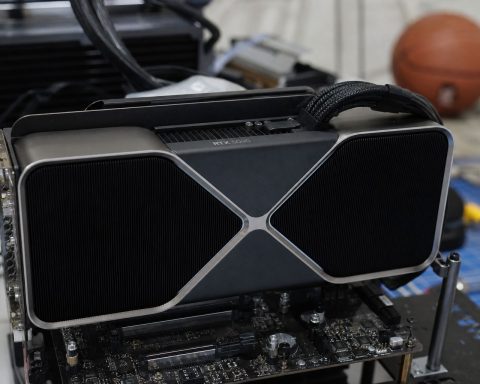
The PC story is murkier. Reuters reported on Monday that Nvidia’s RTX Spark superchip, aimed at running large AI models on laptops and desktops, may be less a mass-market breakthrough than a bet on developers and creators willing to pay for local AI computing. Local, or on-device, inference means running an AI model on the user’s machine instead of sending the work to a cloud data center.
Kevin Hein, an analyst at Tirias Research, called RTX Spark a “new category between the workstation and the AI server.” Bob O’Donnell, president at TECHnalysis Research, said traditional Windows PCs using chips from Intel, AMD and Qualcomm would still account for most PC sales for several years. Tom Mainelli, a group vice president at IDC, said some companies would test “on-device inferencing.”
The competitive tape helped Nvidia. AMD was last up about 5.1% and Broadcom about 2.8%, keeping the chip trade broadly bid. Intel also stayed in view after Reuters reported that Google had ordered more than 3 million tensor processing units — AI chips Google designs for its own workloads — from Intel, while Nvidia had evaluated Intel’s technology but had not placed an order.
There was a second-order effect in Asia. AP reported South Korea’s Kospi rebounded sharply on Tuesday, with SK Hynix soaring after the Nvidia partnership, a move that underlined how Nvidia-related announcements can move suppliers as well as Nvidia itself.
But the trade has a clear weak point. Premium prices, tight memory supply and a still-unproved reason for mainstream buyers to pay up for AI PCs could keep RTX Spark devices in a niche, while cloud customers keep testing in-house chips and alternative suppliers. Higher bond yields would add another pressure point, since richly valued growth stocks tend to suffer when investors demand a higher return for holding risk.
For now, investors appear willing to pay for the core data-center story and treat the AI-PC push as an option, not the base case. That keeps the burden on Nvidia’s next set of orders, partner rollouts and supply deals.
The stock’s next test is less about whether AI spending is real. It is about whether Nvidia can keep turning that spending into shipped systems, memory-backed capacity and margins high enough to justify a stock already trading above $5 trillion.
Related articles: NASDAQ:NVDA