
AUSTIN, Texas, Sept. 3, 2026, 7:49 p.m. EDT — Tesla, Inc. NASDAQ:TSLA closed 5.42% higher at $376.365 on Thursday, a one-session gain worth roughly $76.4 billion across the 3.949 billion shares outstanding at June 30. Trading volume reached 63.57 million shares, 1.64 times Nasdaq’s average, as the company put dozens of its steering-wheel-free Cybercabs on Austin streets. The stock eased to $374.6797 in after-hours trading, down 0.45% from the close, according to real-time Nasdaq data.
The rally says investors care far more about the size of a future robotaxi network than about any one crash claim. Fresh attention to two Autopilot cases does not create a measurable new cash charge for Tesla, and a federal crash record does not establish that its system caused a fatal Ohio collision. It does, however, put the main condition attached to Thursday’s enthusiasm in sharper focus: Tesla must show that autonomous miles can scale without legal costs, safety interventions and regulatory limits scaling with them.
Tesla session markers
Cash-market closes and the latest after-hours trade; this is not an intraday price trace. As of .
What the Moraine record shows
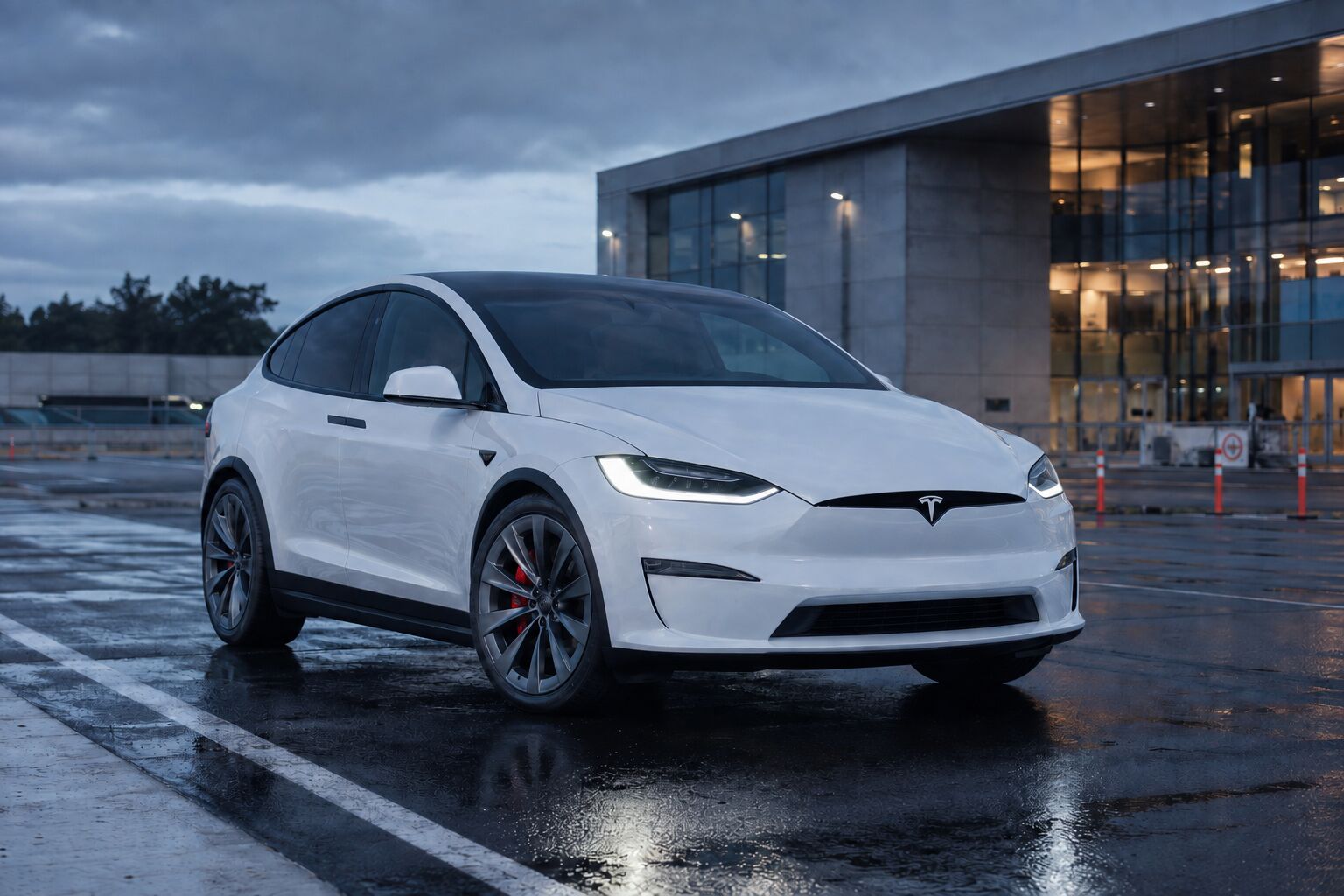
A row in the National Highway Traffic Safety Administration’s driver-assistance crash file, downloaded at 7:40 p.m. EDT Thursday, identifies a 2024 Model X involved in a July 2025 fatal collision with a motorcycle in Moraine, Ohio. Tesla’s filing lists an advanced driver-assistance system as “verified engaged” and gives the Model X’s pre-crash speed as 49 mph. It also says event-data-recorder, police, telematics and video material is available. Tesla marked the system version, operating-domain field and narrative as confidential business information in NHTSA report 13781-11411.
That is evidence of engagement, not causation. Moraine police told the Dayton Daily News that the motorcyclist lost control, crossed into oncoming traffic and collided with the Tesla; the Tesla then sideswiped a pole and caught fire. Nothing in the public NHTSA row says how the assistance system responded, whether its response changed the outcome or what the driver did.
NHTSA gives another reason for caution. Its Standing General Order guidance says Level 2 systems must be reported when they were engaged within 30 seconds of a crash involving a fatality, a vulnerable road user or another listed outcome. The agency warns that its database is not normalized for miles driven, varies with each manufacturer’s access to crash data and may contain incomplete or unverified information. It cannot support a Tesla-versus-peer safety-rate comparison on its own.
| Evidence | What is known | What remains unresolved |
|---|---|---|
| Moraine crash record | ADAS verified engaged; fatal motorcycle collision; 49 mph reported pre-crash speed | System behavior, driver behavior and causation |
| Local police account | Motorcyclist crossed into the Tesla’s lane, according to police | Whether driver assistance altered the severity or aftermath |
| Mendoza settlement | Tesla reportedly settled a separate fatal Autopilot case before trial | Terms are confidential, so the cash cost cannot be estimated |
| Benavides verdict | $129 million compensatory award, with Tesla found 33% at fault, plus $200 million punitive | Appeal is pending; Tesla calls its accrual immaterial |
The legal numbers are small against the valuation, large against quarterly profit
The Ohio disclosure arrived as Tesla reportedly reached a confidential settlement in the Mendoza case, which concerned a 2019 Model 3 crash into a fire truck. Because the terms were not disclosed, treating that settlement as a recurring cost would be guesswork.
The company’s own filing offers a better yardstick. In the Benavides litigation, a jury awarded $129 million in compensatory damages and assigned Tesla 33% of the fault, then awarded $200 million in punitive damages. The gross amount attributable to Tesla under that verdict is about $242.6 million. Tesla appealed on July 2 and recorded what it described as an immaterial accrual, according to its second-quarter Form 10-Q.
At Thursday’s $1.486 trillion market capitalization, $242.6 million is only 0.016%. Against Tesla’s $398 million of second-quarter operating income, however, it is 61%. A single verdict does not threaten the equity value. A series of judgments, recalls or operating restrictions could matter to earnings and, more importantly, slow the autonomous fleet growth embedded in that value.
Cybercab now needs operating proof
Dozens of vehicles on public streets are firmer evidence than a stage prototype. The Associated Press reported that Cybercabs without steering wheels or pedals were operating on Austin streets Thursday. Tesla also published a new Cybercab rider guide and a form for companies interested in purchasing fleets or providing infrastructure. The form contains no pricing, delivery schedule or minimum order, so it is a demand-gathering signal rather than a booked-sales disclosure. CEO Elon Musk has said Cybercab will eventually be Tesla’s highest-volume vehicle, Reuters reported. That ambition makes unit economics and deployment speed central to the stock case.
In July, Tesla said Cybercab production had started and showed about 2.4 million cumulative paid robotaxi miles through June in its second-quarter update. That figure establishes real service activity. It does not reveal the cost per mile, remote-assistance rate, rider-only intervention rate or economics of a purpose-built Cybercab fleet. Those are the numbers needed to bridge Thursday’s product excitement to cash flow.
The next useful test is therefore operational, not theatrical: Cybercabs in paid service, rider-only miles by city, interventions and reportable crashes per mile, and fleet pricing with a delivery timetable. A clean rise in those measures would make isolated legal losses easier to absorb. Restrictions, opaque safety data or repeated adverse verdicts would attack the timing and margin of the autonomy business that investors added roughly $76 billion to Tesla’s value to celebrate on Thursday.
Related articles: NASDAQ:TSLA