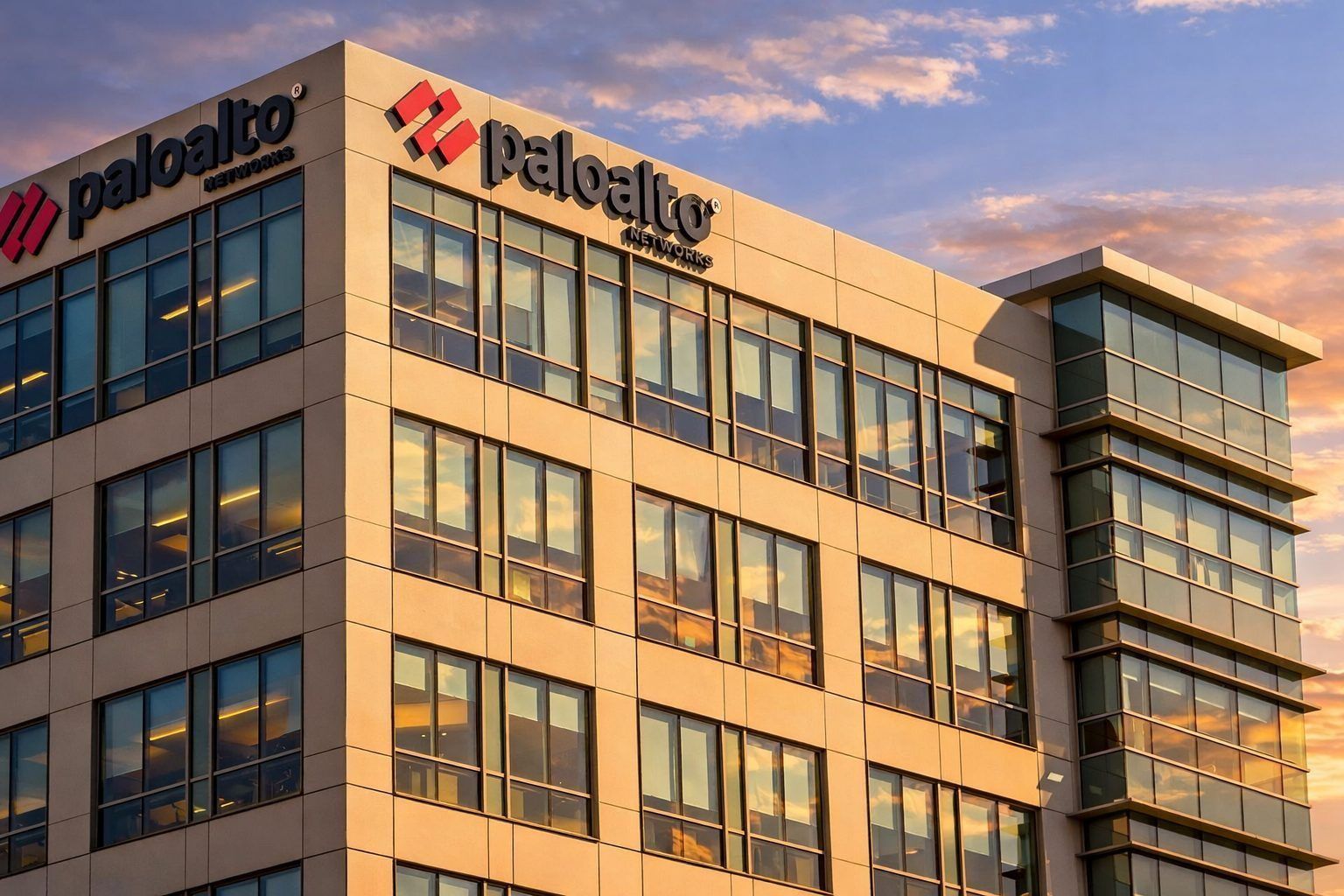

Dec. 20, 2025 — Palo Alto Networks, Inc. (NASDAQ: PANW) stock is in focus this weekend after a high-impact week of AI-security headlines and fresh valuation debate. Shares were last around $186.88, after closing Dec. 19 at $186.88.
The near-term narrative is being shaped by a landmark expansion of Palo Alto Networks’ partnership with Google Cloud—described publicly as “multibillion-dollar,” and reported by Reuters as “approaching $10 billion” over several years—alongside the company’s broader push into agentic AI security, platform consolidation, and two major acquisitions queued for fiscal 2026. AP News+3Reuters+3PR Newswire+3
Below is a comprehensive, publication-ready overview of today’s (Dec. 20, 2025) key PANW stock news, analyst forecasts, and the leading bull/bear arguments investors are weighing.
Why Palo Alto Networks stock is in the spotlight today
Three themes dominated the latest coverage around PANW going into Dec. 20:
- A deepened Google Cloud alliance that adds new AI security integrations and includes Palo Alto migrating internal workloads to Google Cloud under a multibillion-dollar agreement.
- AI-driven cloud security urgency, supported by Palo Alto’s own “State of Cloud Security Report 2025,” which highlights near-universal AI-related attacks reported by surveyed organizations. Palo Alto Networks+1
- A valuation and expectations tug-of-war: bullish consensus targets remain well above the current share price, but some analysts point to a premium multiple and limited room for further estimate upgrades.
The headline catalyst: Palo Alto Networks and Google Cloud expand partnership
What was announced
On Dec. 19, Palo Alto Networks and Google Cloud announced a significant expansion of their partnership aimed at securing the development and deployment of AI solutions and cloud applications—especially in hybrid multicloud environments.
Reuters reported that the expanded partnership includes a commitment by Palo Alto to pay a sum “approaching $10 billion” to Google Cloud over several years, citing a person with direct knowledge of the matter. Executives did not confirm the figure publicly, but emphasized that AI is accelerating demand for security and reshaping the threat landscape. Reuters
What customers get: Prisma AIRS, secure AI development, and tighter cloud integrations
The joint announcement frames the partnership as “security built in” rather than bolted on. The companies describe deeper integration across:
- End-to-end AI security from code to cloud, including protecting AI workloads and data on Google Cloud services such as Vertex AI and Agent Engine using Palo Alto’s Prisma AIRS platform.
- AI-driven, next-generation software firewall enhancements (VM-Series) with deeper Google Cloud integrations.
- AI-driven SASE improvements, with Palo Alto’s Prisma Access leveraging Google’s network and Cloud Interconnect to maintain consistent security policies across multicloud WAN environments.
- A simplified and unified security experience, positioning the combined solutions as “pre-vetted” and engineered to work together to reduce operational friction. PR Newswire+1
The press release also notes the partnership builds on more than 75 joint integrations and $2 billion in sales through Google Cloud Marketplace.
The migration and AI model angle: a “platform bet,” not just a reseller partnership
Beyond product integrations, Palo Alto said it is expanding its commitment to run its security platforms on Google Cloud by migrating key internal workloads under a new multibillion-dollar agreement, and that it is using Google Cloud’s Vertex AI platform and Gemini models to power Palo Alto’s copilots.
Reuters also highlighted that some of the spending is tied to migrating Palo Alto offerings to Google’s platform, while a “sizable portion” is aimed at new AI-driven services. Reuters
Why this matters for investors: A deal of this size and scope can be interpreted as (1) a stronger long-term cloud infrastructure commitment; (2) a tighter go-to-market alignment; and (3) a credibility signal that large enterprises are prioritizing AI security architectures now, not later.
The broader tailwind: AI is expanding the cloud attack surface
Palo Alto’s messaging this week is anchored by its State of Cloud Security Report 2025. In its Dec. 16 release, the company said:
- 99% of respondents reported at least one attack on AI apps and services in the past year
- GenAI-assisted coding is increasing the volume of insecure code, while only 18% of teams that ship weekly can fix vulnerabilities at that pace
- The survey covered 2,800+ security executives and practitioners across 10 countries Palo Alto Networks+1
Third-party coverage has amplified these findings, emphasizing that AI adoption is expanding attack surfaces, identity challenges, and API risks in cloud environments.
For PANW stock watchers, this matters because Palo Alto is positioning its product strategy around platform consolidation—a thesis that security buyers will increasingly prefer unified platforms that cover cloud, network, SOC operations, and AI security rather than fragmented point solutions.
Fundamentals check: last reported results and guidance remain central to the stock story
While the Google Cloud announcement is the freshest catalyst, PANW’s valuation ultimately rests on revenue durability, ARR expansion, margins, and cash generation.
Fiscal Q1 2026 results: growth + “platformization wins”
In its fiscal first quarter 2026 results (quarter ended Oct. 31, 2025), Palo Alto reported:
- Revenue up 16% year over year to $2.5 billion
- Next-Generation Security ARR up 29% year over year to $5.9 billion
- Remaining performance obligation (RPO) up 24% year over year to $15.5 billion
- Non-GAAP diluted EPS of $0.93 PR Newswire
Management explicitly tied momentum to “platformization wins” and pointed to the strategic acquisitions of CyberArk and Chronosphere as part of its AI-era positioning. PR Newswire+2Reuters+2
Guidance: Q2 FY2026 and full-year FY2026 targets
Palo Alto’s outlook (as provided in the earnings release) included:
Fiscal Q2 2026 guidance
- Next-Gen Security ARR: $6.11B–$6.14B (about 28% YoY growth)
- RPO: $15.75B–$15.85B (about 21%–22% YoY growth)
- Revenue: $2.57B–$2.59B (about 14%–15% YoY growth)
- Non-GAAP diluted EPS: $0.93–$0.95 PR Newswire
Full-year FY2026 guidance
- Next-Gen Security ARR: $7.00B–$7.10B (about 26%–27% YoY growth)
- RPO: $18.6B–$18.7B
- Revenue: $10.50B–$10.54B
- Non-GAAP operating margin: 29.5%–30.0% PR Newswire
Additional reporting also highlighted strong operating cash flow and free-cash-flow performance in the quarter, underscoring the company’s cash-generation story (a key support for premium software multiples).
M&A and “platformization”: CyberArk + Chronosphere are the other big levers
The Chronosphere deal: $3.35B to push deeper into observability + AI ops
Palo Alto announced in November it would acquire Chronosphere for $3.35 billion, with plans to integrate it with Cortex AgentiX to help detect and investigate cloud performance issues using AI agents. Reuters noted investor concerns around price (nearly 21x ARR) and deal timing ahead of the CyberArk close.
The CyberArk deal: a $25B identity security push
Palo Alto’s proposed acquisition of CyberArk (valued around $25 billion, per AP) is widely seen as a strategic move into identity security—an area increasingly tied to machine identities and agentic AI workflows.
Why investors care: These acquisitions can accelerate the “platform” thesis, but they also introduce integration complexity, execution risk, and the possibility of multiple compression if synergy or growth expectations disappoint. Reuters+1
Analyst forecasts on Dec. 20, 2025: targets still imply upside, but valuation concerns persist
Consensus price targets: roughly $224–$226 average, with highs around $255
As of Dec. 20 data pulls:
- MarketBeat shows an average 12-month price target of about $226.20, with a high of $255 and low of $135, and a consensus rating of “Moderate Buy.” MarketBeat
- StockAnalysis shows an average price target of $224 and a median around $230, with a consensus rating of “Buy.” StockAnalysis
From a purely mechanical standpoint, those averages suggest analysts—on balance—see the stock trading below their central 12-month fair-value estimates.
Notable recent calls: JPMorgan’s Overweight vs. HSBC’s Reduce
Recent examples of how divided sentiment can be:
- JPMorgan reaffirmed/reiterated an Overweight stance with a $235 price target (per MarketBeat’s summary of the note).
- HSBC downgraded PANW to Reduce with a $157 target, explicitly citing valuation and “limited scope” for estimate upgrades in FY2026–FY2027. Investing.com
This split is important: it means PANW’s next major move may depend less on “is cybersecurity in demand?” (most agree it is) and more on whether PANW can keep compounding growth and cash flow fast enough to justify a premium multiple. Investing.com+1
Valuation debate: discounted cash flow says “undervalued,” P/E lens says “overvalued”
One of the most discussed angles around PANW heading into Dec. 20 is that different valuation methods point in different directions:
- Simply Wall St’s DCF model cited an intrinsic value around $246.21 per share, implying the stock could be ~24% below that modeled value.
- In the same analysis, the firm also highlighted a high P/E (around 116.6x) versus a proprietary “fair ratio” (about 43.1x), implying the stock could look overvalued on earnings-multiple grounds. Simply Wall St
How to interpret this (without the hype):
- Bulls often emphasize free cash flow durability, subscription-like contract structures, and a long runway for platform consolidation in AI security.
- Bears point to multiple risk: if growth normalizes, deals slow, or integration costs rise, high-multiple stocks can re-rate quickly even if fundamentals remain “good.” Investing.com+1
Technical and trading snapshot: mixed signals after a choppy December
Technical indicator dashboards are not fundamentals, but they often influence short-term positioning—especially for a widely held mega-cap software name.
Investing.com’s technical readout around this period flagged:
- RSI (14-day) around 49.6 (neutral)
- MACD slightly negative
- Moving averages (5-day, 50-day, 200-day) leaning bearish in their model’s signal mix Investing.com
Separately, the stock’s recent closes show a volatile mid-December tape, including a sharp drop earlier in the week followed by modest rebounds into the Friday close.
Ownership and insider activity: institutional adds, plus continued insider selling headlines
Institutional activity in fresh 13F-related coverage
Several automated “instant alert” summaries published on Dec. 20 highlighted incremental institutional buying and positioning changes, including:
- Franklin Street Advisors increasing its stake (per its filing coverage summary) MarketBeat
- BDF Gestion initiating a position (per its filing coverage summary) MarketBeat
These items are not the same as real-time conviction buys (13Fs are delayed), but they can influence the sentiment narrative when PANW is already in the news cycle.
Insider selling remains a headline risk for some readers
Some coverage this week also pointed to insider selling and specific Form 4-related transactions. For example, Investing.com reported director James J. Goetz sold shares worth about $4.88 million in early December.
Meanwhile, MarketBeat summaries referenced notable insider dispositions over recent months, framing it as a potential near-term caution signal (though interpretation varies widely because insiders sell for many reasons).
What could move PANW stock next: the 5 things investors are watching
With Dec. 20 landing on a weekend, the next set of catalysts will likely come from execution updates and sector-wide risk sentiment. Here are the most practical “watch items” implied by this week’s news flow:
- Clarity on the economic footprint of the Google Cloud deal
Investors will look for future disclosures that help separate “cloud spend/migration” from incremental product revenue impact, and how quickly AI security integrations drive measurable bookings or ARR. Reuters+1 - Progress toward closing (and integrating) CyberArk and Chronosphere
Deal timing, regulatory/approval pathways, and early cross-sell traction will be scrutinized—especially given the size of the CyberArk transaction. - Follow-through on FY2026 guidance and Next-Gen Security ARR
With Next-Gen Security ARR and RPO highlighted prominently, those metrics are likely to remain the “show me” numbers in the next earnings cycle. PR Newswire+1 - Multiple sensitivity and the “premium software” trade
The HSBC downgrade and the valuation debate underscore that PANW may trade as much on expectations and rate/multiple sentiment as on quarterly beats. Investing.com+1 - AI threat headlines and platform consolidation trends across cybersecurity
Palo Alto’s cloud report narrative—and the broader market’s push toward consolidation—continues to be a sector-level tailwind that can lift platform leaders, but it also raises competitive pressure as rivals reposition.
Bottom line on Dec. 20, 2025: PANW is trading on “AI-security platform leadership” vs. “valuation discipline”
Palo Alto Networks stock enters the final stretch of 2025 with a high-profile catalyst (the Google Cloud expansion) reinforcing its AI-security platform story—and with analysts, on average, still projecting upside from current levels.
At the same time, the valuation conversation is getting louder, with skeptics arguing that even great cybersecurity businesses can stumble when expectations are high, M&A is heavy, and multiples are rich.
For investors, the practical question going into early 2026 is whether Palo Alto can convert its AI-security momentum—Prisma AIRS, agentic security tooling, and deep cloud integrations—into sustained ARR expansion and cash flow growth fast enough to keep the market comfortable paying a premium.


![US Stock Market Today 08/28/2026 [UPDATE: 01:00 EDT] [Marvell Pins Near Overnight Low as Analyst Targets Diverge]](https://ts2.tech/wp-content/uploads/2026/08/US-market-dashboard-2026-08-28-0058-480x384.jpg "US Stock Market Today 08/28/2026 [UPDATE: 01:00 EDT] [Marvell Pins Near Overnight Low as Analyst Targets Diverge]")