What caused Parsons shares to drop close to 38% today?
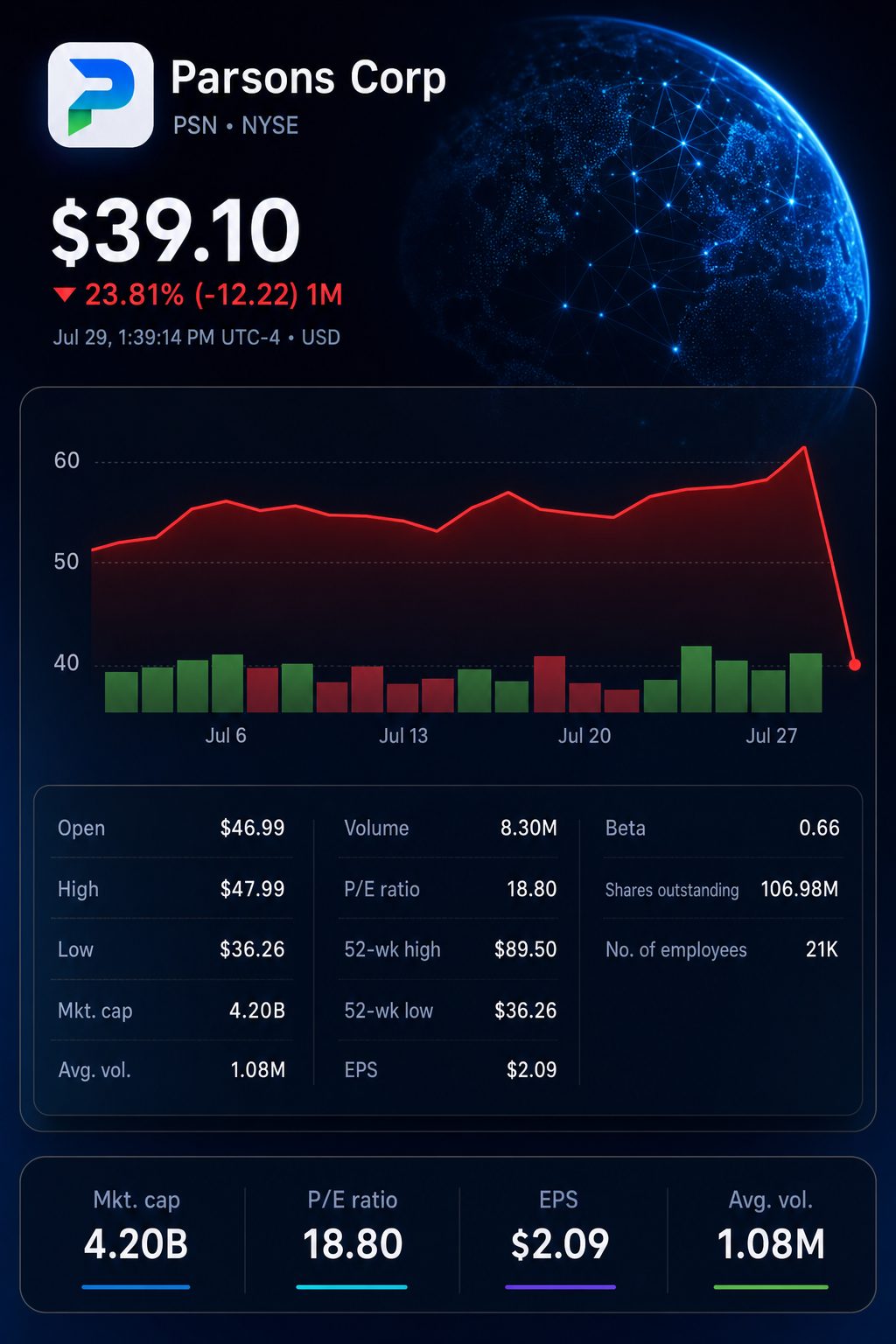
PSN shares were down nearly 38.0% at $38.43 as of 12:43 p.m. ET on July 29. The stock opened at $47.28 after closing at $62.03 on Tuesday, and fell as low as $36.27. SPY dropped 1.1% and MDY slid 1.7%. The discrepancy highlights a shock specific to the company. Investors are adjusting for $118 million in charges and a steep cut to 2026 outlook.
Did Parsons fall short of estimates for the second quarter?
Second-quarter revenue was $1.576 billion, declining 1% from a year earlier. GAAP net income turned to a loss of $15.2 million. Adjusted EPS came in at negative $0.06, compared to $0.78 in the prior year. Management’s non-GAAP adjusted EPS, excluding two charges, was $0.86. TD Cowen said the figure topped the $0.76 consensus by approximately 13%. Normalized EBITDA climbed 8% to $160.6 million, representing a 10.1% margin. Core segment results remained resilient, though headline financials worsened significantly.
What was the size of Parsons' reduction to its 2026 guidance?
The company lowered revenue guidance to $6.2-$6.5 billion from a previous range of $6.5-$6.8 billion, trimming the midpoint by 4.5%. Adjusted EBITDA guidance slipped to $500-$560 million from $615-$675 million, down 17.8% at the midpoint. Operating cash-flow guidance dropped $40 million at the midpoint, marking an 8% decrease. Management attributed $85 million to divestitures, $125 million to the timing of infrastructure, and $90 million to federal delays. The decline in EBITDA guidance outpaced the revenue reduction, a disparity that appears to have accelerated the selloff.
Is there a decline in customer demand, or are contract signings just postponed?
Second-quarter awards totaled $1.869 billion, a 24% increase, leading to a book-to-bill ratio of 1.2x. The backlog amounted to $9.257 billion, with $6.581 billion funded. Federal book-to-bill stood at 1.3x and Critical Infrastructure at 1.1x. But $215 million of guidance headwinds resulted from timing, funding and pass-through assumptions. Demand remains solid, but converting these awards into 2026 revenue poses a greater challenge.
Which Parsons division appears to be performing best at present?
Critical Infrastructure posted revenue of $815 million, up 5% compared with a year earlier. EBITDA—excluding the joint-venture charge—stood at $96.9 million, reflecting an 11.9% margin. Federal revenue came in at $761 million, a 6% decrease on a reported basis. When adjusted for the lost confidential contract and certain portfolio actions, Federal revenue increased 11%. Normalized Federal EBITDA fell by 5% to $63.8 million, delivering an 8.2% margin. Critical Infrastructure continues to provide a more consistent earnings performance.
Is the $118 million in charges genuinely non-recurring?
Parsons posted a $77.5 million loss from two contracts classified as held for sale. The company also incurred a $40.9 million charge in its joint venture due to rainfall and delays in the program. A separate divestment of SETA led to a pre-tax gain of $19.3 million. Management anticipates the joint-venture project to reach 90% completion by year-end and notes Parsons stopped seeking out comparable consortium arrangements after 2019. However, the sale process is still ongoing and the project is not yet finished. Additional expenses may still arise.
Is Parsons positioned to achieve its annual cash flow target?
Operating cash flow for the first half reached just $53.9 million, falling from $148.0 million. To meet the full-year guidance of $430-$490 million, the company needs to generate $376-$436 million in the second half, resulting in a significant and back-loaded requirement. Management forecasts Q3 revenue will grow about 3% sequentially, followed by an increase of approximately $20 million in Q4. The company maintained its target for free-cash-flow conversion above 100%. Acceleration in collections, inventory monetization, and Middle East payments is needed.
Is Parsons' balance sheet still solid following the setback?
As of June 30, cash stood at $266 million, including $79.8 million held by consolidated joint ventures. Long-term debt totaled $1.474 billion, which brings reported net debt to roughly $1.21 billion. That figure is approximately 2.3 times the revised EBITDA midpoint. Current assets were $2.72 billion, compared with $1.64 billion in current liabilities. Liquidity appears sufficient, though leverage is no longer minor. Cash dropped by $200 million over a half-year period marked by $330 million in acquisition expenditures.
Is Parsons stock considered undervalued following today’s sharp drop?
Parsons trades at $38.43, reflecting an equity value of about $4.11 billion. Including reported net debt brings enterprise value to roughly $5.32 billion, or close to 10.0 times the updated 2026 EBITDA midpoint. Including a $118 million adjustment for charges, the normalized multiple is approximately 8.2 times. Using management’s sales guidance, the price-to-sales ratio stands at about 0.65 times at the midpoint. Shares remain significantly discounted, though continued stability relies on consistent operational delivery. These multiples are sustainable only if large one-off charges are not repeated.
What is a practical outlook for Parsons' share price going forward?
I see PSN trading between $34 and $48 in the short term as the market reacts to the earnings surprise. For the next twelve months, I expect a base range of $46 to $54, which suggests potential gains of about 20% to 41%. This outlook assumes 2027 EBITDA of around $690 million and an enterprise value multiple of 9 to 10 times. Management continues to target mid-single-digit or higher growth and slight margin improvement by 2027. Downside risk is $28 to $36 if guidance is cut again or if new charges emerge. On the upside, the stock could reach $63 to $72 if improvements are seen in cash conversion and backlog execution. TD Cowen maintained its $72 target; Stifel held at $79 but forecasts lower estimates. William Blair is assessing its investment thesis.
What caused Parsons shares to decline close to 38% today?
PSN shares traded at $38.43 at 12:43 p.m. ET, down roughly 38.0%. The stock opened at $47.28 after closing at $62.03 the previous day and touched $36.27 intraday. SPY was 1.1% lower, with mid-cap MDY off by 1.7%. The performance signals a move specific to the company. Investors are adjusting to $118 million in charges and a significant cut to 2026 outlook.
Was Parsons unable to meet expectations for the second quarter?
Second-quarter revenue came in at $1.576 billion, a decrease of 1% from a year earlier. The company posted a GAAP net loss of $15.2 million. Adjusted earnings per share were negative $0.06, compared to $0.78 a year ago. Management’s specially normalized adjusted EPS was $0.86, which excluded two charges. TD Cowen noted this figure topped the $0.76 consensus by about 13%. Normalized EBITDA rose 8% to $160.6 million, for a margin of 10.1%. Core business remained resilient, but reported results showed a sharp deterioration in overall economics.
What was the extent of Parsons’ reduction to its 2026 guidance?
Revenue guidance was lowered to $6.2-$6.5 billion from a previous $6.5-$6.8 billion, reducing the midpoint by 4.5%. The range for adjusted EBITDA dropped to $500-$560 million from $615-$675 million, bringing the midpoint down by 17.8%. Operating cash-flow guidance at midpoint declined by $40 million, an 8% decrease. Management attributed $85 million to divestitures, $125 million to infrastructure timing, and $90 million to federal delays. The sharper decline in EBITDA guidance compared to revenue guidance likely contributed to the selloff.
Are contracts being pushed back, or is there a downturn in customer demand?
Second quarter awards totaled $1.869 billion, a rise of 24%, and resulted in a book-to-bill ratio of 1.2x. Overall backlog amounted to $9.257 billion, with $6.581 billion already funded. The federal book-to-bill landed at 1.3x, while Critical Infrastructure reported 1.1x. Guidance faced $215 million in pressure due to timing, funding, and pass-through considerations. Demand remains strong. The key challenge is transforming the awards into revenue for 2026.
Which of Parsons' business units appears to be performing best right now?
Critical Infrastructure revenue totaled $815 million, increasing 5% from the previous year. EBITDA, excluding the joint-venture charge, stood at $96.9 million with a margin of 11.9%. Federal revenue was reported at $761 million, reflecting a 6% decrease. Adjusted for the lost confidential contract and related portfolio actions, Federal revenue grew 11%. Normalized Federal EBITDA came to $63.8 million, a 5% decline, with an 8.2% margin. The Critical Infrastructure segment currently presents a clearer earnings profile.
Is the $118 million in charges genuinely non-recurring?
Parsons posted a $77.5 million loss on two contracts classified as held for sale and recorded a $40.9 million charge from its joint venture due to rain and schedule setbacks. A separate SETA divestiture resulted in a $19.3 million gain before tax. The company estimates the joint-venture project will reach 90% completion by year-end. It said that Parsons ceased chasing similar consortium projects after 2019. The sale process is still pending, and the project is not yet finished. Additional expenses may occur.
Is Parsons still on track to achieve its full-year cash-flow objective?
Operating cash flow for the first half came in at just $53.9 million, down from $148.0 million. To hit the full-year target of $430-$490 million, the company needs to generate $376-$436 million in the second half, making for a significant and back-weighted cash requirement. Management projects Q3 revenue will increase around 3% from the previous quarter, followed by a further $20 million rise in Q4. The company also maintained its aim of free-cash-flow conversion above 100%. Improvements in collections, inventory monetization, and Middle East payments are needed promptly.
Is Parsons' balance sheet still robust following the setback?
As of June 30, cash stood at $266 million, with long-term debt at $1.474 billion. The cash figure included $79.8 million held within consolidated joint ventures. This results in an approximate reported net debt of $1.21 billion. Net debt amounts to about 2.3 times the revised EBITDA midpoint. Current assets were $2.72 billion, set against $1.64 billion in current liabilities. Liquidity remains sufficient, though leverage has become more significant. Cash declined by $200 million during a half-year in which $330 million was allocated to acquisitions.
Does Parsons stock appear undervalued following today’s sharp decline?
Parsons traded at $38.43, reflecting an equity value of about $4.11 billion. Enterprise value, factoring in reported net debt, stands close to $5.32 billion. That puts the revised 2026 EBITDA midpoint multiple at roughly 10.0x. Adjusting for $118 million in charges brings the estimated normalized multiple down to around 8.2x. At the guidance midpoint, price-to-sales is near 0.65x. While the stock is notably less expensive, execution must remain strong for safety. These multiples are viable only if sizable charges are not repeated.
What is a plausible outlook for Parsons' share price going forward?
I see short-term support for PSN between $34 and $48 while markets absorb the current earnings surprise. For the next twelve months, my central scenario is $46 to $54, representing close to 20%-41% potential gains. This outlook is based on an estimated $690 million in 2027 EBITDA and a 9-10x enterprise value multiple. Management maintains an outlook for growth in the mid-single digits or higher, combined with some margin improvement by 2027. If guidance is cut again or new charges surface, shares could fall to $28-$36 in a bear scenario. If cash flow and backlog performance improve, the bull case is $63-$72. TD Cowen reiterated a $72 price target; Stifel held at $79 but anticipates lower estimates, while William Blair is reassessing its position.
Investing.comvvvvvvvvvvvvvvvvvvvvvvvvvvvvvvvvvvvvvvvvvvvvvvvvvvvvvvvvvvvvvvvvvvvvvvvvvvvvvvvvvvvvvvvvvvvvvvvvvvvvvvvvvvvvvvvvvvvvvvvvvvvvvvvvvvvvvvvvvvvvvvvvvvvvvvvvvvvvvvvvvvvvvvvvvvvvvvvvvvvvvvvvvvvvvvvvvvvvvvvvvvvvvvvvvvvvvvvvvvvvvvvvvvvvvvvvvvvvvvvvvvvvvvvvvvvvvvvvvvvvvvvvvvvvvvvvvvvvvvvvvvvvvvvvvvvvvvvvvvvvvvvvvvvvvvvvvvvvvvvvvv
What caused Parsons shares to plunge almost 38% today?
PSN shares were down roughly 38.0% to $38.43 by 12:43 p.m. ET on July 29. The stock opened at $47.28, after closing Tuesday at $62.03, and hit an intraday low of $36.27. SPY declined 1.1% and mid-cap MDY lost 1.7%. The gap indicates a company-specific event. Investors are adjusting valuations after $118 million in charges and significantly lower guidance for 2026.
Did Parsons fall short of second-quarter projections?
Second-quarter revenue came in at $1.576 billion, a decline of 1% from the previous year. GAAP net income shifted to a loss of $15.2 million. Adjusted EPS was reported at negative $0.06, compared with $0.78 a year ago. Management’s specifically normalized adjusted EPS, which excludes two charges, reached $0.86. According to TD Cowen, this figure topped the $0.76 consensus by about 13%. Normalized EBITDA rose 8% to $160.6 million, for a 10.1% margin. Core operations remained resilient, while reported economics worsened significantly.
What was the scale of Parsons’ reduction to its 2026 guidance?
The company lowered its revenue outlook to $6.2-$6.5 billion from $6.5-$6.8 billion, decreasing the midpoint by 4.5%. The revised adjusted EBITDA forecast dropped to $500-$560 million from the prior $615-$675 million range, representing a 17.8% cut at midpoint. Operating cash flow guidance at midpoint declined by $40 million, marking an 8% drop. Management attributed $85 million to divestitures, $125 million to infrastructure timing, and $90 million to federal delays. The cut to EBITDA was substantially greater than the reduction in revenue, likely contributing to the increased selling pressure.
Are contracts being postponed, or is there a decline in customer demand?
Second-quarter awards totaled $1.869 billion, a rise of 24%, and delivered a book-to-bill ratio of 1.2. The overall backlog stood at $9.257 billion, including $6.581 billion funded. Federal book-to-bill was 1.3, while Critical Infrastructure posted 1.1. Guidance faced $215 million in pressure due to timing, funding, and pass-through factors. Demand remains solid, but a significant challenge is translating awarded projects into recognized revenue in 2026.
Which Parsons division appears to be performing best at present?
Critical Infrastructure revenue totaled $815 million, up 5% from the prior year. EBITDA, excluding the joint-venture charge, stood at $96.9 million, representing a margin of 11.9%. Federal revenue came in at $761 million, marking a 6% decline as reported. Federal revenue increased 11% when the lost confidential contract and portfolio actions were excluded. Normalized Federal EBITDA declined 5% to $63.8 million, with a margin of 8.2%. Critical Infrastructure continues to present a stronger earnings profile.
Is the $118 million in charges genuinely a one-off occurrence?
Parsons posted a $77.5 million loss related to two contracts marked for sale. The company also took a $40.9 million joint-venture charge tied to rain and program delays. A different SETA divestiture resulted in a pre-tax gain of $19.3 million. Management forecasts the joint-venture project will reach 90% completion by year-end. Parsons says it ended efforts to pursue similar consortium models after 2019. However, the sale is not yet finalized, and the project is still ongoing. Additional costs may still arise.
Is Parsons still on track to achieve its cash-flow target for the full year?
Operating cash flow in the first half stood at just $53.9 million, falling from $148.0 million in the prior period. To reach the full-year goal of $430-$490 million, $376-$436 million is needed over the remainder of the year. This sets a high and back-weighted cash hurdle. Management projects third-quarter revenue to increase by around 3% from the previous quarter, and expects another approximate $20 million rise in the fourth quarter. The company is maintaining its goal of free-cash-flow conversion above 100%. Faster improvement is needed in collections, inventory monetization, and payments from the Middle East.
Is Parsons' balance sheet still resilient following the setback?
As of June 30, cash stood at $266 million, and long-term debt amounted to $1.474 billion. Consolidated joint ventures held $79.8 million of that cash. This results in an estimated $1.21 billion in net debt. Net debt is about 2.3 times the revised midpoint of EBITDA. Current assets totaled $2.72 billion, compared to current liabilities of $1.64 billion. Liquidity appears sufficient, though leverage has increased. Cash declined $200 million over six months, a period that included $330 million in acquisition expenses.
Does Parsons stock look undervalued following today's sharp drop?
Parsons traded at $38.43, giving the company an equity value of about $4.11 billion. Including stated net debt, enterprise value comes to roughly $5.32 billion. That represents around 10.0x the updated midpoint for 2026 EBITDA. Excluding $118 million in charges reduces the estimated normalized multiple to about 8.2x. The stock's price-to-guided-sales ratio is about 0.65x at the midpoint. Shares are significantly less expensive, though continued stability relies on strong execution. These valuation levels are sustainable only if significant charges are not repeated.
What is a practical outlook for Parsons’ share price going forward?
I see PSN trading between $34 and $48 in the short term as the impact of today’s earnings surprise eases. My base case over twelve months is $46 to $54, suggesting an upside of about 20%-41%. This outlook factors in expected 2027 EBITDA of around $690 million and an enterprise value multiple of 9-10x. Management maintains a forecast for mid-single-digit-or-better growth along with slight 2027 margin improvement. In a bearish scenario, shares could fall to $28-$36 if there is another guidance revision or unexpected charges. In a bullish scenario, PSN could reach $63-$72 should cash conversion and backlog performance rebound. TD Cowen reiterated a $72 target, while Stifel maintained $79 but anticipates lowering its estimates; William Blair is reassessing its outlook.