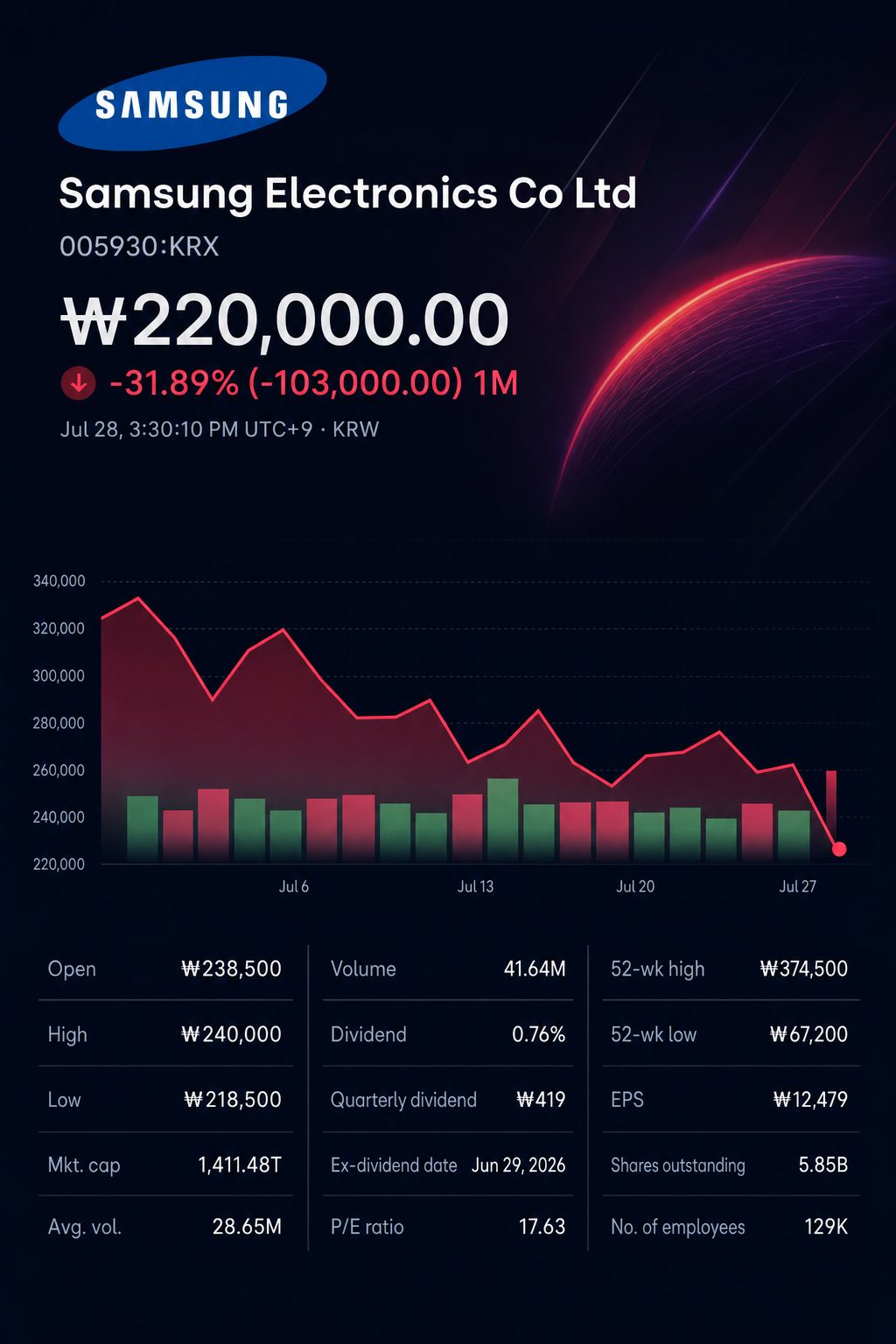
Seoul had closed. Samsung ended 13.4% lower at 220,000 won, its worst session in almost two decades.
New York remained open. Broadcom traded 1.6% lower at $377.02 at 10:43 a.m. EDT.
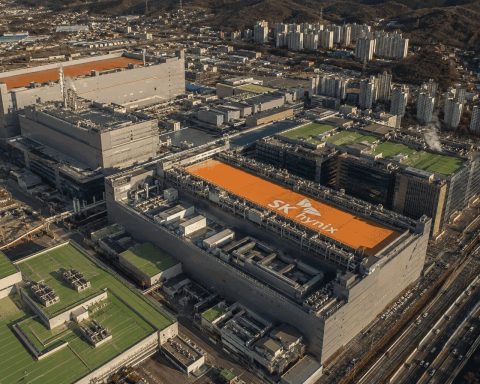
Samsung shares closed 13.4% lower on Tuesday. The decline overwhelmed the initial promise of its $200 billion Broadcom partnership. The stock recorded its worst one-day fall in almost two decades.
The central investor issue is the deal’s mix. JPMorgan Chase NYSE:JPM analyst Harlan Sur estimates memory will represent 90% to 95% of Broadcom’s purchases. Foundry wafers would account for only 5% to 10%.
That changes the headline economics. At a $200 billion base, foundry work would total roughly $10 billion to $20 billion. Spread across five years, that implies $2 billion to $4 billion annually.
The larger prize is memory.
Samsung’s release described the arrangement as a memorandum of understanding. The companies estimated collaboration above $200 billion through 2030. They did not disclose annual volumes, pricing or minimum purchase commitments.
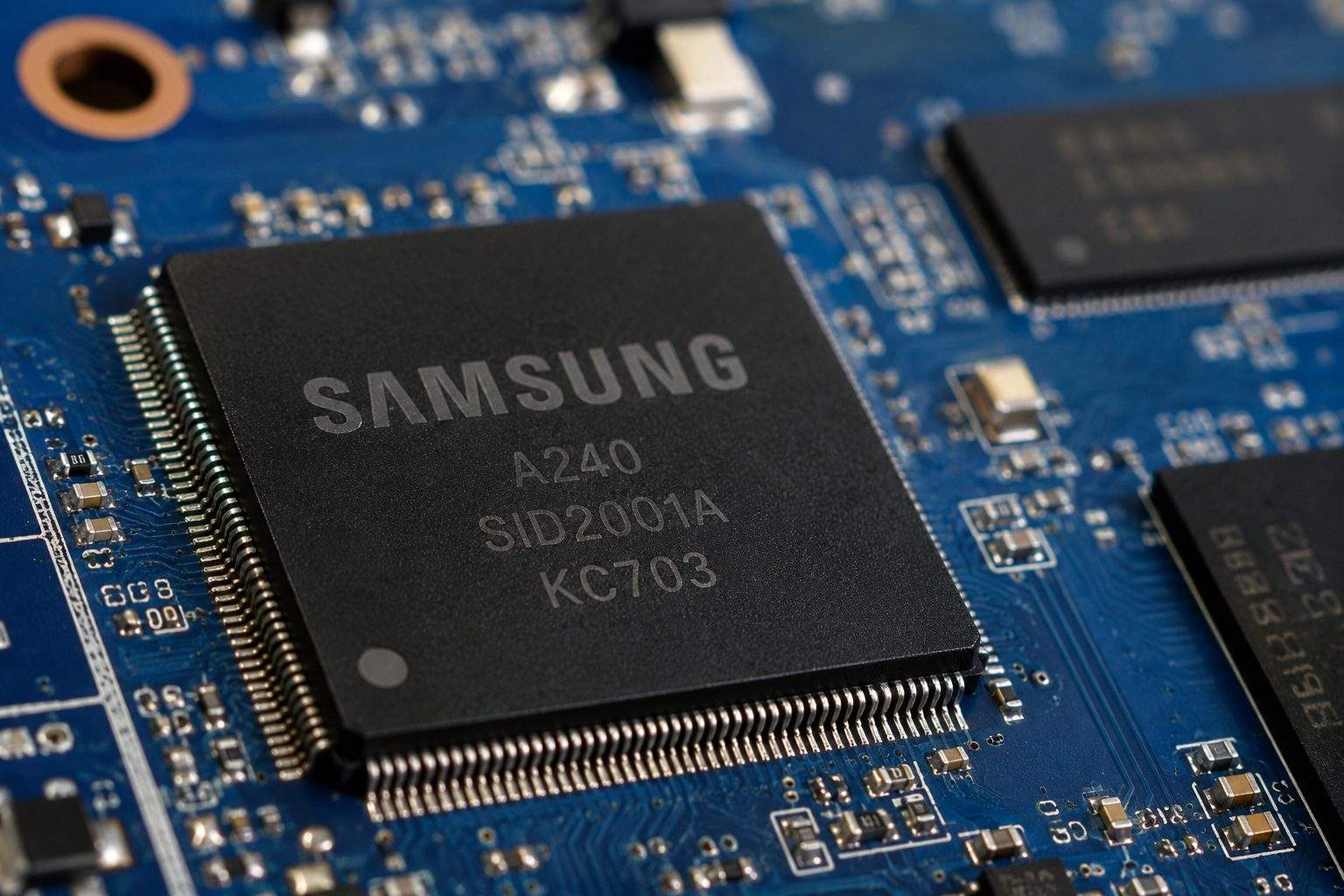
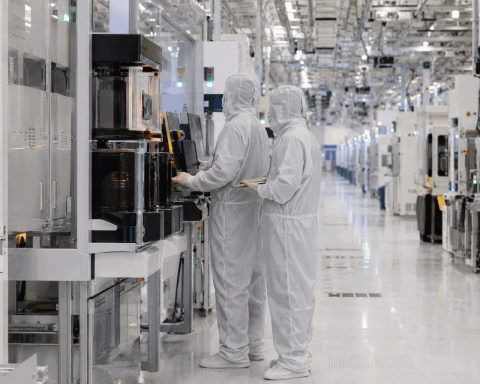
The scope includes high-bandwidth memory, or HBM, used beside AI processors. It also covers contract chip manufacturing on Samsung’s two-nanometre and smaller processes. Advanced packaging would connect memory and logic more closely.
Measure
Disclosed or estimated basis
Preliminary investor calculation
Total collaboration
More than $200 billion through 2030
At least $40 billion yearly; roughly $10 billion quarterly
Memory purchases
Sur estimate: 90%-95%
About $180-$190 billion at a $200 billion base
Foundry wafers
Sur estimate: 5%-10%
About $10-$20 billion total; $2-$4 billion yearly
Broadcom’s latest quarterly AI revenue
$10.8 billion in fiscal Q2
Implied quarterly collaboration value equals about 93%
Implied Broadcom foundry slice equals about 0.6-1.2 times that contract
The calculations are preliminary and illustrative. They use the $200 billion floor, a straight five-year spread and JPMorgan’s estimated mix. Actual purchases could be higher, unevenly timed or priced differently.
The comparison suggests Samsung secured a memory supply agreement first. The foundry element remains material. However, it is closer in scale to Samsung’s $16.5 billion Tesla contract than the full headline value.
That distinction matters in Samsung’s contest with Taiwan Semiconductor Manufacturing NYSE:TSM. The Broadcom work can support factory utilisation and customer qualification. It does not yet show a $200 billion transfer of advanced foundry demand from TSMC. TSMC’s U.S. shares were down 3.9% during Tuesday trading.
For Broadcom, the scale is still large. It reported $10.8 billion of AI semiconductor revenue in fiscal Q2. Total quarterly revenue reached $22.2 billion. A straight-line $10 billion collaboration value would equal 93% of AI revenue and 45% of total revenue. The figures are not directly comparable, but they show the supply requirement’s size.
“AI is driving unprecedented demand for tightly integrated semiconductor technologies,” Samsung chip chief Young Hyun Jun said. He cited memory, logic and advanced packaging as linked parts of future AI systems. Samsung Global Newsroom
Tuesday’s market move reflected a wider concern. SK Hynix KRX:000660 fell 14.7%, while the KOSPI lost 10.8%. Investors focused on AI financing risks and faster Chinese memory expansion. The selloff showed that long-term supply deals cannot offset falling sector valuations.
Samsung will publish detailed second-quarter results at 10:00 a.m. KST on July 30. Its preliminary guidance showed sales near 171 trillion won. Preliminary operating profit was estimated at 89.4 trillion won. Investors will seek foundry losses, HBM shipment details and any Broadcom purchase timetable.
Risks: The $200 billion figure remains an estimated MOU value, not a disclosed shipment schedule. Pricing and minimum volumes remain unknown. Weaker AI spending or faster Chinese capacity growth could also reduce memory margins.
For now, the cleaner investment read-through is Samsung’s memory franchise. A broader foundry re-rating requires firm wafer volumes, stable yields and evidence of profitable two-nanometre production.
Why is AVGO falling today, and is the move company-specific?
AVGO traded at $376.72 around 10:43 a.m. ET on July 28, down 1.70%. The stock ranged from $371.63 to $380.12 on 5.6 million shares. The SOXX semiconductor ETF fell 5.51%, while QQQ lost 1.52%. That relative strength points to a broad chip selloff, not just Broadcom. Investors are reassessing AI spending, financing, and Chinese competition today.
How far has AVGO fallen from its record high?
At $376.72, AVGO stands 23.9% below its June 3 record of $495. It remains 33.8% above its 52-week low of $281.61, however. Based on Monday’s close, the stock had gained 10.73% during 2026. Today’s decline reduces that gain to roughly 8.9%. The pullback is substantial, but it has not erased the year’s advance.
What could move AVGO most during the coming week?
Amazon, Meta, Apple, and Microsoft report results later this week. Their capital-spending plans can reset custom-silicon and networking expectations quickly. The Federal Reserve decides Wednesday; markets assigned a 37% probability to a rate increase. Broadcom’s fiscal third quarter ends August 2, sharpening estimate revisions. Its official calendar still lacks a Q3 earnings date. September 3 appears on third-party calendars, but remains unconfirmed.
What numbers must Broadcom deliver for fiscal Q3?
Broadcom guides for roughly $29.4 billion of Q3 revenue, up 84%. AI semiconductor revenue should reach about $16 billion, exceeding 200% growth. Management targets 67% non-GAAP operating margin and 68% adjusted EBITDA margin. Wall Street’s prior AI estimate was $16.36 billion, slightly above guidance. The bar is high. Execution will matter more than another large headline growth rate.
Was Broadcom’s latest quarter strong enough to support the AI thesis?
Q2 revenue reached $22.19 billion, rising 48% from last year. Non-GAAP earnings per share climbed 54% year over year, reaching $2.44. AI semiconductor revenue jumped 143% year over year, reaching $10.8 billion. Free cash flow was $10.26 billion, equal to 46% of revenue. Yet reported revenue missed the consensus estimate by roughly $80 million. That small miss mattered because expectations had become unusually demanding.
Does the $200 billion Samsung agreement materially change Broadcom’s outlook?
The Samsung framework envisions more than $200 billion of cooperation through 2030. It spans HBM, foundry capacity, advanced packaging, and next-generation communications chips. Samsung also plans sub-two-nanometer manufacturing for future Broadcom products. But this is not $200 billion of booked Broadcom revenue. The announcement did not quantify incremental sales or near-term earnings. Its immediate financial impact therefore remains uncertain.
How concentrated is Broadcom’s revenue among major customers?
One semiconductor distributor generated 42% of Broadcom’s Q2 revenue. The five largest end customers represented about 45% of total revenue. Those figures were 29% and 40%, respectively, one year earlier. Large AI and wireless orders can therefore shift quarterly results sharply. This week’s hyperscaler guidance matters more than usual.
How large is Broadcom’s exposure to customer AI financing?
In June, Broadcom backstopped certain customer lease obligations for AI racks. Maximum contractual exposure is $29 billion across five-year lease terms. That figure is a ceiling, not a current cash loss. Exposure rises as racks deploy, then falls as customers make payments. Broadcom can assume leases or sell racks after specified defaults. Counterparty quality now deserves close attention.
Can software, cash flow, and capital returns cushion AVGO?
Infrastructure software produced $7.18 billion of Q2 revenue, up 9%. Segment operating income rose 13% to $5.65 billion. Free cash flow reached $10.26 billion, providing substantial financial flexibility. Cash totaled $19.63 billion, versus $64.91 billion of debt. Broadcom had $10.1 billion of buyback authority remaining on May 3. The $0.65 quarterly dividend yields roughly 0.69% at today’s price. European VMware complaints remain unresolved, and Broadcom disputes their claims.
What does Wall Street currently expect from AVGO stock?
Reuters’ July 20 consensus showed an Outperform rating from 50 analysts. After Q2, LSEG’s median price target stood at $500. That implies approximately 32.7% upside from today’s $376.72 quote. However, that target snapshot predates today’s selloff and may include stale estimates. Management still forecasts $100 billion of fiscal 2027 AI chip revenue. That forecast remains the central valuation test.
Leokadia Głogulska is a financial and technology journalist at TS2.tech. Her coverage ranges from stocks and artificial intelligence to space technology and developments across global markets. She graduated from Wrocław University of Economics and Business and worked in financial analysis before becoming a business journalist.
A figure above or below the 12.0 consensus could impact Treasury yields, the dollar, and cyclical stocks by influencing short-term growth outlooks.
#2
NAHB Housing Sentiment
A reading above or below 33 will influence expectations for housing demand, mortgage rate trends, and homebuilder stocks.
#3
Fabrinet After the Close
Investors are focusing on revenue, margins, and comments on datacom as key factors for companies involved in optical networking and AI infrastructure supply chains.