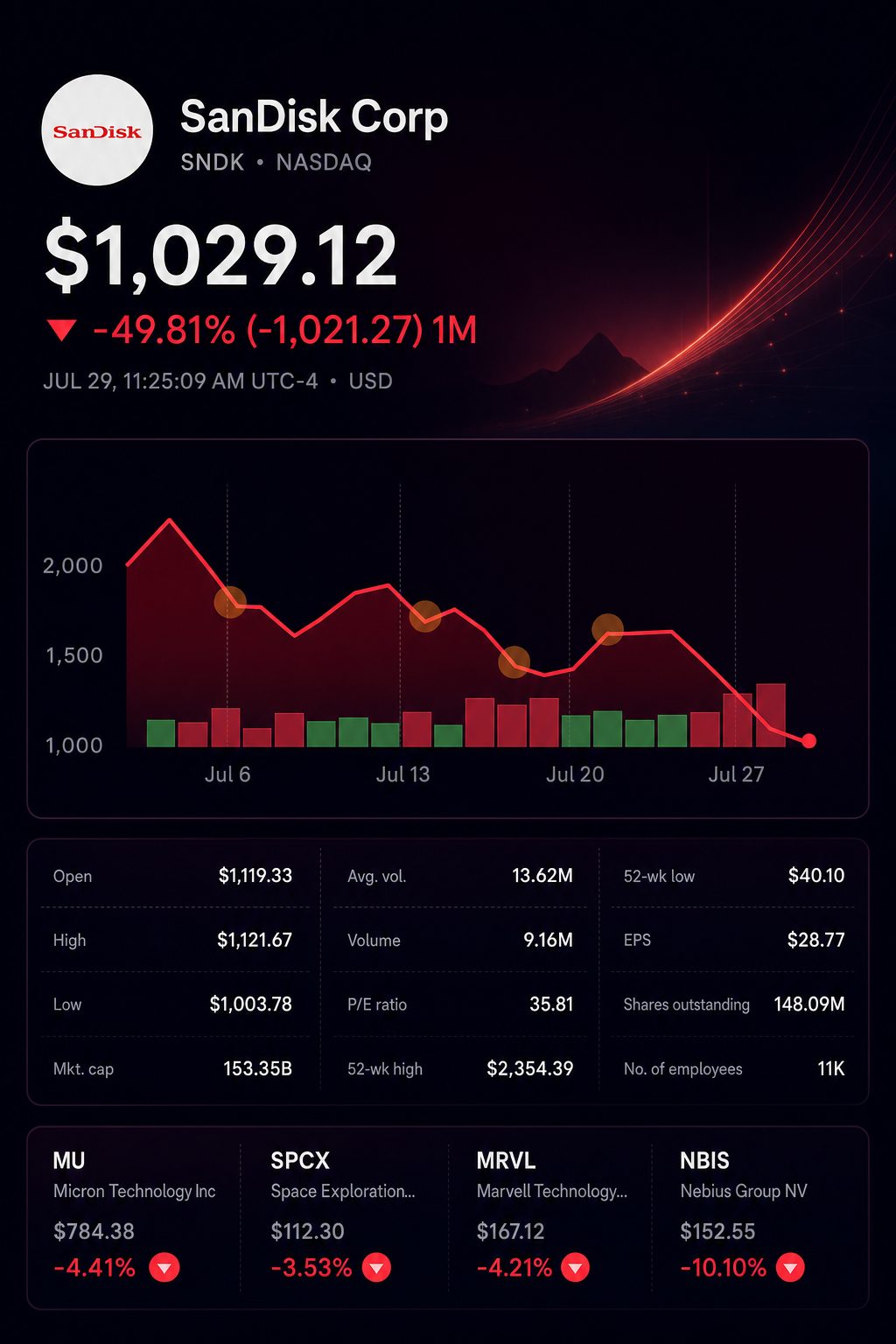
NEW YORK, July 29, 2026, 11:07 a.m. EDT — Sandisk shares have tumbled 55% this July, leaving the stock trading at what appears to be a discount, but the outlook hinges on whether the company’s 80% margins remain intact.
Sandisk dropped 6.4% to $1,026.08, pushing its loss in July to 54.9%.
As of Tuesday, three straight double-digit declines had wiped out 31.9%.
Initial sensitivity analysis indicates annualized earnings multiples range from 8 to 35 times.
Sandisk Corporation NASDAQ:SNDK declined 6.4% to $1,026.08 during late-morning trade on Wednesday. The stock reached a low of $1,004.15 as its selloff extended into a fourth consecutive session.
Sandisk’s drop in July has reached 54.9% from its closing price on June 30. Three straight double-digit losses have wiped away 31.9% as of Tuesday.
The drop leaves the stock appearing inexpensive based on projected run-rate earnings. However, the valuation is not attractive if existing margins decline.
Sandisk’s shares closed Wednesday at a trailing price-to-earnings ratio of 35.7. Applying the $31.50 fourth-quarter adjusted earnings guidance midpoint on an annualized basis results in a multiple of 8.1.
Margins account for nearly all of the difference. Adjusted gross margin for the third quarter was 78.4%, up from 51.1% the previous quarter and 22.7% in the same period last year. The company expects a gross margin between 79% and 81% in the fourth quarter.
Initial estimate: The sensitivity shown uses $8 billion as the quarterly revenue. It applies $490 million in adjusted operating costs and assumes 158 million diluted shares. The 13.9% tax rate follows guidance. This does not represent a forecast.
Adjusted gross margin scenario
Projected quarterly EPS
Annualized P/E at $1,026.08
80.0% — midpoint of guidance
$32.3
7.9x
60.0%
$23.6
10.9x
40.0%
$14.9
17.2x
22.7% — same period last year
$7.3
35.0x
With the stock at its current level, Sandisk trades at nearly eight times annualized earnings assuming margins remain at 80%. If last year’s margin is used instead, the price-to-earnings multiple increases to roughly 35 times.
This is the fundamental investor play. Investors are wagering that a remarkable profit division is now permanent. Their bets go beyond just an increase in flash-memory demand.
Chief Executive David Goeckeler described the most recent quarter as a “fundamental inflection point.” He noted that multiyear customer agreements are expected to provide “more durable earnings power.” SanDisk Investor Relations
By April 30, Sandisk had entered into five similar agreements. Revenue from data centers jumped 233% compared to the prior quarter.
SanDisk will report fiscal fourth-quarter earnings after markets close on August 5. The company’s Investor Day is scheduled for August 13.
Micron Technology, Inc. NASDAQ:MU dropped 4.4% on Wednesday. Western Digital Corporation NASDAQ:WDC rose 0.2%. Both showed considerably less volatility than Sandisk in morning trading.
Investors in memory chips are considering whether unprecedented AI-driven demand can be sustained amid potential new supply. Concerns about expanded production in China and a possible slowdown in AI investment have prompted questions over how long current prices can hold.
Options market pricing suggests low expectations for a muted reaction post-earnings. Bloomberg figures referenced on Wednesday indicate an anticipated 12% swing after the August 5 results. In four out of the previous five quarters, Sandisk’s actual share movement outpaced the implied options move.
Trefis placed one-year implied volatility at 115%, nearly matching the 111% realized volatility. The figure was derived using Monday’s reference price of $1,278.23, prior to the most recent drop.
Risks: Acceleration in NAND flash-memory supply, reduced AI expenditure, or a return to typical margins could eliminate the currently low run-rate multiple. Conversely, robust contract pricing or another positive earnings surprise could lead to a pronounced recovery.
The August 5 test is more limited in scope than a simple revenue beat. Investors require proof that margins close to 80% are sustainable through the cycle.
What is SNDK's current trading level, and how significant is the decline?
SNDK shares were last down roughly 6.3% at $1,027 by 10:52 a.m. EDT. The stock traded between $1,004 and $1,124 during the session, after closing at $1,096.10 on Tuesday. Volume hit 8.45 million, with a market capitalisation near $161 billion. The stock was still about 56% below its 52-week peak of $2,354.39. SNDK was the top monthly decliner on the S&P 500, with July losses nearing 54%.
Is the decline today unique to the company, or does it reflect a wider selloff in semiconductor stocks?
By late morning, the Philadelphia Semiconductor Index slipped 3.36%. The Nasdaq Composite lost roughly 1.09% during the same timeframe. SNDK’s drop of 6.3% substantially underperformed both indices. Memory stocks faced increased concerns about Chinese competition in capacity and pricing. Sandisk’s investor relations page did not show any company statement dated July 29. This suggests that sector pressures and investors managing risk ahead of earnings are the most likely immediate factors.
What does Sandisk need to show in its August 5 earnings release?
Management projected fourth-quarter revenue in a range of $7.75 billion to $8.25 billion. The company also forecast adjusted EPS between $30 and $33, and gross margin within 79% to 81%. Public.com’s estimate feed listed EPS at $33.38, with the WSJ showing $34.67—both figures marginally higher than the management's prior EPS guidance range. A performance that only meets guidance may not please investors following earlier advances. Most focus will be on pricing, unit shipments, customer agreements, and the outlook for fiscal 2027.
How solid were Sandisk’s most recently disclosed fundamentals?
Sandisk posted fiscal third-quarter revenue of $5.95 billion, up 97% from the previous quarter and 251% from a year earlier. GAAP net income reached $3.62 billion, with diluted earnings per share at $23.03. Adjusted earnings per share were $23.41, and gross margin improved to 78.4%. Operating cash flow for the quarter was $3.04 billion. Sandisk closed April 3 holding $3.74 billion in cash and reported zero debt. The quarter was notably strong, setting a higher benchmark for future comparisons.
Is Sandisk’s growth truly being fueled by AI datacenter demand?
Datacenter revenue reached $1.47 billion, up 233% from the previous quarter and 645% compared to the same period a year ago. Datacenter exabytes grew by 160%, with the average selling price per gigabyte jumping 186%. This reflects genuine volume expansion in addition to higher pricing. Across the company, exabyte shipments were unchanged, while average selling prices increased 248%. Edge revenue totalled $3.66 billion. Consumer revenue declined 10% from the previous quarter. The AI investment case remains strong. Earnings remain closely linked to NAND pricing.
Is SNDK undervalued following its decline in July?
The reported trailing P/E stood at about 35.7 times with a share price near $1,027. Using the $31.50 adjusted guidance midpoint on an annualized basis gives $126 per share, which equates to a straightforward 8.2-times multiple, though this is not a GAAP P/E. According to WSJ, consensus EPS for fiscal 2027 is around $206, suggesting a multiple of about five times. These forward-looking multiples depend on adjusted earnings projections and positive memory pricing trends. Rapid shifts in supply and demand can quickly reduce NAND earnings. SNDK appears undervalued only if strong profits persist.
How are analysts predicting SNDK shares will perform?
Out of 26 analysts tracked by MarketBeat, 20 recommend SNDK as buy or strong buy. One provider lists an average price target of $1,811, while another reports $2,218. Newest targets include Morningstar’s $1,000, contrasted by Evercore’s $3,100. Morningstar labels the stock’s uncertainty as “Very High.” Given shares at $1,027, this range signals around 3% possible downside to 202% upside. The range among estimates is notably wide. Price targets reflect scenario analysis and are not reliable 12-month forecasts. MarketBeat
What short-term price range is indicated by the options market?
Options pricing points to an expected move of about 12% surrounding the August 5 results. Based on a price of $1,027, the implied range stretches from around $904 to $1,150. This projection reflects the size of the move, not its direction. Today’s low at $1,004 sets $1,000 as the first technical support zone. A climb above $1,124, the day's high, would strengthen the chart's near-term outlook. However, earnings could shift both levels in an instant.
Which catalysts might offset the decline seen in July?
Revenue surpassing management’s $8.25 billion upper limit would signal further acceleration. Adjusted EPS exceeding the estimated $33.38–$34.67 range would surpass current projections. Sandisk’s investor day is set for August 13, taking place eight days after its earnings release. The board has approved $6 billion in share buybacks, representing about 3.7% of market capitalization. Sandisk has no obligation to use the full repurchase authorization. BiCS10 sampling has begun, with the company reporting density and speed improvements of 59% and 33%. Execution takes on greater importance now.
What factors could disrupt the positive SNDK outlook?
The primary threat is a potential reversal in NAND prices. Total exabytes companywide were unchanged, but average selling prices increased 248% compared to the previous year. This makes current profit levels highly exposed to supply shifts and competition. Concerns about Chinese production capacity are already weighing on sentiment around memory stocks. Sandisk disclosed $12.79 billion in commitments, despite holding no debt. Extended contracts offer greater certainty but introduce risks related to order fulfillment, penalties, and cancellations. A quarter that meets expectations but comes with cautious outlook could add to declines.
Michał Rogucki is a senior markets reporter at TS2.tech. His coverage ranges from stocks and technology to economic developments affecting global markets. He graduated from Humboldt University of Berlin and worked in investment research and market analysis before becoming a financial journalist.
Surprising starts and permits data can impact homebuilders, mortgage-sensitive stocks, Treasury yields, and the dollar if results deviate significantly from consensus estimates.
#02
Home Depot Q2
The results and outlook provide key insights into housing turnover, renovation demand, professional customer activity, and U.S. discretionary spending.
#03
09:15 ET industrial production
A robust or disappointing factory or utilities report can shift expectations for economic growth, cyclical stocks, bond yields, and the Federal Reserve’s policy direction.