NEW YORK, July 28, 2026, 06:12 EDT — U.S. premarket trade.
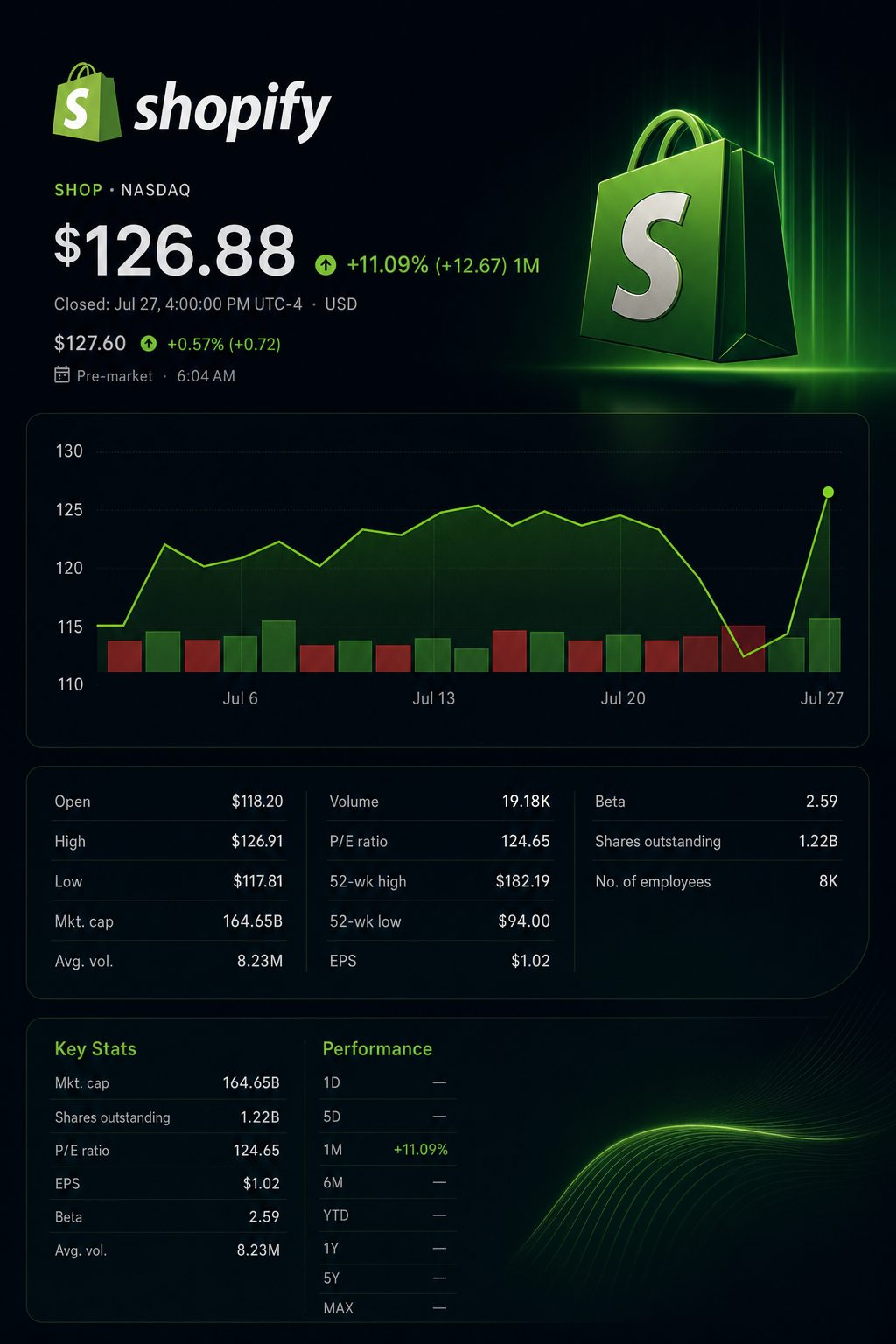
- U.S. shares ended Monday at $126.88, rising 11.5%, and gained another 0.6% in premarket trading.
- RBC listed Shopify as one of the top five software firms with the most robust AI defensibility.
- According to a filing-based estimate, payments accounted for roughly 84% of merchant-solutions growth in the first quarter.
Shares of Shopify surged 11.5% on Monday after investors reassessed the company’s involvement with artificial intelligence. RBC Capital Markets’ updated cost model placed the commerce platform among the most resilient software companies.
The shift is significant as discussion last week centered on the opposite view. Market participants considered if AI might drive down the cost of storefront software and make it easy to swap out.
First-quarter results indicate a shift toward payment and transaction infrastructure as a competitive edge. Merchant solutions expanded by 39%, outpacing the 21% growth in subscription solutions.
The change could be quantified.
| Metric | Q1 2026 | Q1 2025 | Change |
|---|---|---|---|
| Total revenue | $3.17 billion | $2.36 billion | +34% |
| Merchant solutions | $2.42 billion | $1.74 billion | +39% |
| Subscription solutions | $750 million | $620 million | +21% |
| Merchant share of revenue | 76% | 74% | +2 points |
| Shopify Payments GMV | $67.1 billion | $47.5 billion | +41% |
| Transaction and loan losses | $116 million | $75 million | +55% |
Shopify Payments delivered a $572 million increase in revenue. Altogether, merchant solutions grew by $680 million. As a result, payments accounted for roughly 84% of the segment’s total revenue gain.
Payments GMV climbed 41% to $67.1 billion. Penetration increased to 67%, up from 64% in the prior year.
This indicates Shopify presents a greater challenge to duplicate compared to just a store-design platform. Competitors would also need to replicate checkout systems, fraud management, currency exchange, and payment processing.
RBC analyzed build, operating, maintenance, risk, and quality expenses among 14 firms. Shopify was placed in the group it identified as most defensible.
The surge did not stem entirely from individual companies. Wix.com Ltd. NASDAQ:WIX advanced 9.6%, and Toronto’s technology sector climbed 6.9%. Shopify, however, led both.
The prior week saw a strong opposing view as Rothschild Redburn’s Dominic Ball downgraded Shopify to Neutral and reduced his price target to $130 from $160.
Ball referenced a potential small-business offering from Meta Platforms NASDAQ:META, and suggested that up to 50% of Shopify’s U.S. operations might be at risk. The product is still speculative and has not been officially announced.
At Monday’s close, Shopify was only 2.5% under Ball’s revised price target. The stock also moved back above the $123.37 mark hit on the day he issued his downgrade.
Executives state that AI is broadening the market. In May, President Harley Finkelstein commented, “AI is making entrepreneurship dramatically more accessible.” Traffic from AI tools to stores increased by a factor of eight, and orders from AI-powered search climbed almost thirteen times. Reuters
Costs continue to be a limiting factor. D.A. Davidson analyst Gil Luria described increased guidance on expenses as investors’ “only hesitation” following the first quarter. Shopify forecast second-quarter operating expenses at 35%-36% of revenue. Reuters
The upcoming week features a Federal Reserve decision set for Wednesday, July 29. Shopify will report its results prior to the market opening on August 5.
Initial projections from Google Finance anticipate revenue of $3.44 billion and earnings of 40 cents per share. The company’s leadership forecasts revenue growth in the high twenties percent range, with a free-cash-flow margin in the mid-teens.
Payments penetration, merchant addition, and transaction losses are key metrics for investors to monitor. Transaction losses increased 55%, reaching $116 million in the first quarter. Gross margin fell to 49%, down from 50%.
Risks persist. An accelerated Meta launch may pressure merchant onboarding and pricing power. Increased losses or higher AI expenses could weaken the payments-focused strategy.
There is limited tolerance for disappointment given Shopify’s valuation, with shares trading at about 125 times past earnings. Monday shifted perceptions about the company’s competitive edge; August 5 will need to reinforce that stance.
Related articles: E-Commerce