
NEW YORK, August 6, 2026, 04:08 EDT — Nasdaq premarket was in progress ahead of the regular session starting at 09:30 EDT.
- On Wednesday, shares settled at $108.27, declining by 13.6% and trading 19.8% under the $135 IPO price.
- As of Thursday, as many as 912 million shares will be unlocked, with a value estimated at $98.7 billion based on Wednesday’s closing price.
- Capital expenditures for the second quarter totaled $18.37 billion, with 86% allocated to AI infrastructure.
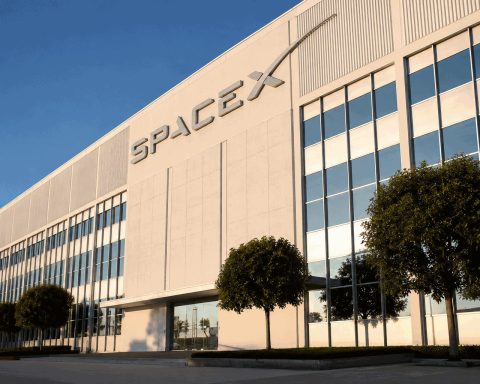
Space Exploration Technologies Corp. faces its initial key float test on Thursday. Up to 912 million additional shares held by staff and early backers become available for sale. The move has the potential to more than double the present public float.
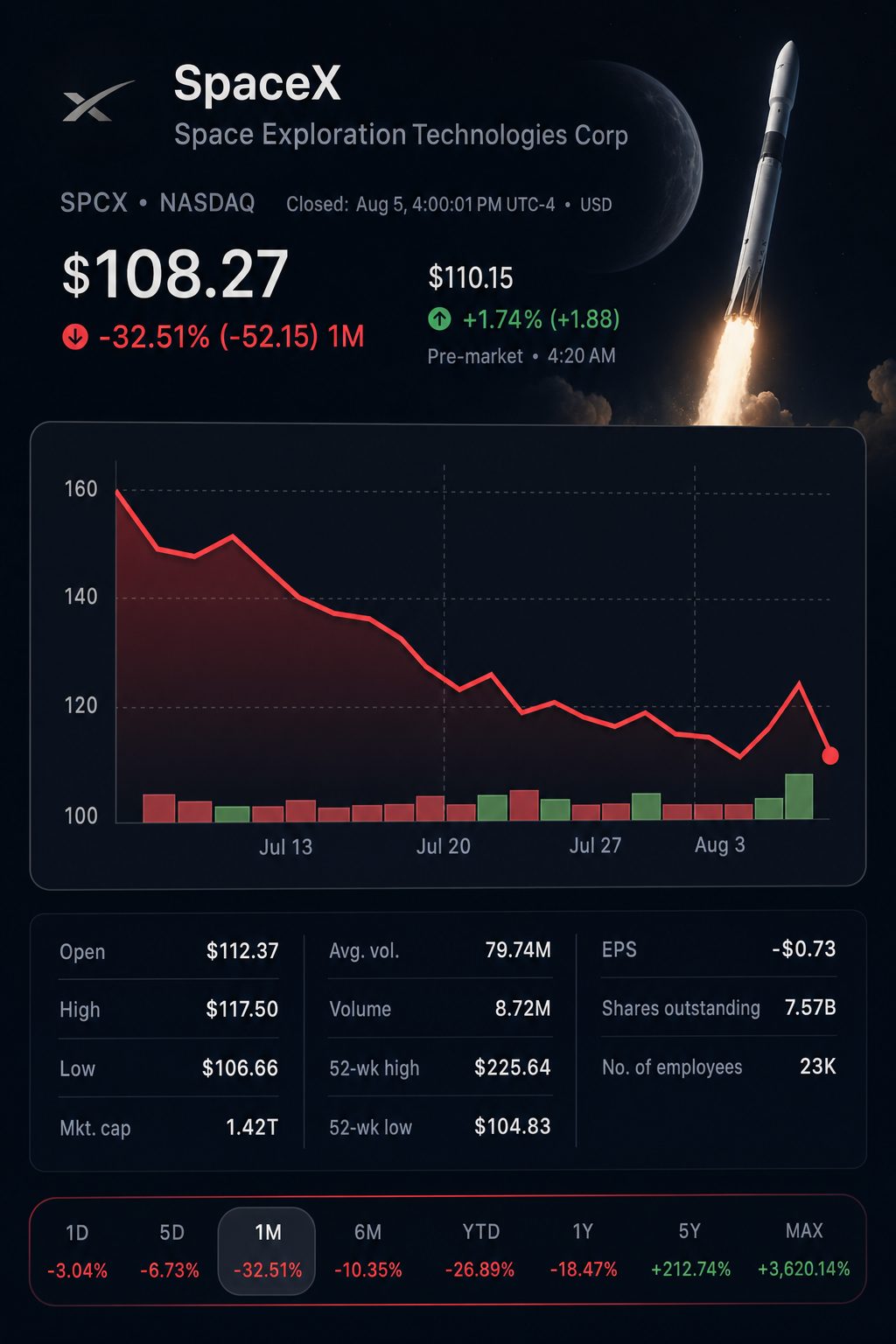
The value of the block at the close on Wednesday was roughly $98.7 billion. This represented 4.4 times the day’s trading volume of 208.5 million shares. Some eligible shares will not be sold.
The delivery comes following a significant drop in valuation. Shares declined by 13.6% on Wednesday and are down 3.8% over the past five sessions. They are currently trading 52.0% lower than their intraday peak in June.
Figures below are based on Wednesday’s closing price and the latest reported number of shares outstanding.
| Stock and supply measure | Latest | Comparison |
|---|---|---|
| Wednesday closing price | $108.27 | Dropped 13.6% |
| Five-day movement | -3.8% | July 29-August 5 |
| Change since $135 IPO | -19.8% | Debut was June 12 |
| Change from $225.64 peak | -52.0% | Intraday high in June |
| Initial lockup expiration | Up to 912 million shares | 6.7% of outstanding stock |
| Potential value available | $98.7 billion | Equals 4.4 times Wednesday trading volume |
The company faced additional strain following its earnings announcement. Revenue for the second quarter increased 92% to $7.81 billion. Adjusted EBITDA came in at $3.54 billion, and the net loss totaled $541 million.
Capital expenditure saw a substantial increase. SpaceX invested $18.37 billion, totaling 5.2 times its adjusted EBITDA. Spending on AI infrastructure accounted for $15.83 billion, or 86% of overall capital outlays.
The segment breakdown indicates the allocation of cash. Adjusted EBITDA refers to a non-GAAP metric.
| Q2 segment, $ billions | Revenue | Operating result | Adjusted EBITDA | Capex |
|---|---|---|---|---|
| Space | 0.962 | -0.542 | -0.205 | 1.174 |
| Connectivity | 4.291 | 1.656 | 2.597 | 1.367 |
| AI | 2.561 | -1.257 | 1.146 | 15.828 |
| Total | 7.814 | -0.143 | 3.538 | 18.369 |
Chief Financial Officer Bret Johnsen stated that compute deployments delivered a “less than one-year payback.” Following the close of the quarter, SpaceX secured an additional $6.7 billion in cloud contracts. Management projects compute capacity will surpass two gigawatts by the end of the year. Reuters
Funds are spent upfront, while contract conversion and usage follow afterwards. Carolane de Palmas, an analyst at ActivTrades, cautioned about “significant volatility” regarding both valuation and cash outflow. Reuters
Starlink continues to act as the stabilizing force. The subscriber base surged to 12 million, but monthly ARPU declined by 22% to $66. Connectivity activities generated $2.60 billion in adjusted EBITDA from capital expenditures totaling $1.37 billion.
Limiting launches also shields the franchise. Starlink accounts for 79% of Falcon 9 launches, up from 54% in 2020. No fewer than seven clients have been informed there is no availability until at least 2028 or 2029.
Rocket Lab USA NASDAQ:RKLB is the closest publicly traded company matching that launch frequency. The company is still working on its bigger Neutron rocket. SpaceX continues to lead in terms of rocket reusability and how often it launches.
Wall Street analysts’ post-earnings price targets are significantly higher than where shares finished on Wednesday. The following seven calls have an average target of $235, suggesting an upside of 117%. These figures reflect projections and not actual results.
| Research firm | Recommendation | Price target | Upside versus $108.27 |
|---|---|---|---|
| Morgan Stanley NYSE:MS | Overweight | $300 | 177% |
| Oppenheimer Holdings (NYSE:OPY) | Outperform | $250 | 131% |
| Cantor Fitzgerald | Overweight | $246 | 127% |
| Bernstein / AllianceBernstein NYSE:AB | Outperform | $239 | 121% |
| Bank of America NYSE:BAC | Buy | $235 | 117% |
| Deutsche Bank NYSE:DB | Buy | $235 | 117% |
| Piper Sandler NYSE:PIPR | Neutral | $140 | 29% |
The range carries greater significance than the average. Piper’s $140 price target offers little cushion from additional declines. Morgan Stanley’s $300 scenario is contingent on continued AI revenue gains and improved cash conversion.
Over the coming week, the lockup test is set alongside two Starlink launches. These mission dates are still tentative and subject to change.
| Date | Scheduled event | Investor variable |
|---|---|---|
| August 6 | Initial lockup expires | Real insider sales and trading levels |
| August 10 | Starlink liftoff from Florida; aiming for 29 satellites | Frequency of launches and size of network |
| August 11 | Starlink launch set for California | Performance and refurbishment of Falcon 9 |
| Late August, preliminary | Starship Flight 14 | Deployment of V3 Starlink and tower catch trial |
Looking ahead, SpaceX has provisionally scheduled Starship Flight 14 for late August, though it is still awaiting regulatory clearance. This mission is planned to deploy V3 Starlink satellites and aims to make the inaugural upper-stage tower catch attempt.
Risks: Being eligible for lockup expiration does not guarantee that sales will occur. The quarterly reports have not been audited, and adjusted EBITDA reflects a non-GAAP metric. Launch schedules may shift due to weather conditions, operational preparedness, or regulatory assessments. AI deals still need to translate into reliable cash flows.
On Thursday, trading volume is expected to offer the most definitive indication. If volume is absorbed without disruption, focus is likely to shift back to compute payback and Starlink margins. In contrast, significant selling activity would keep supply worries at the forefront, outweighing operational advancements.
Related articles: Space Industry