
NEW YORK, August 5, 2026, 04:19 EDT
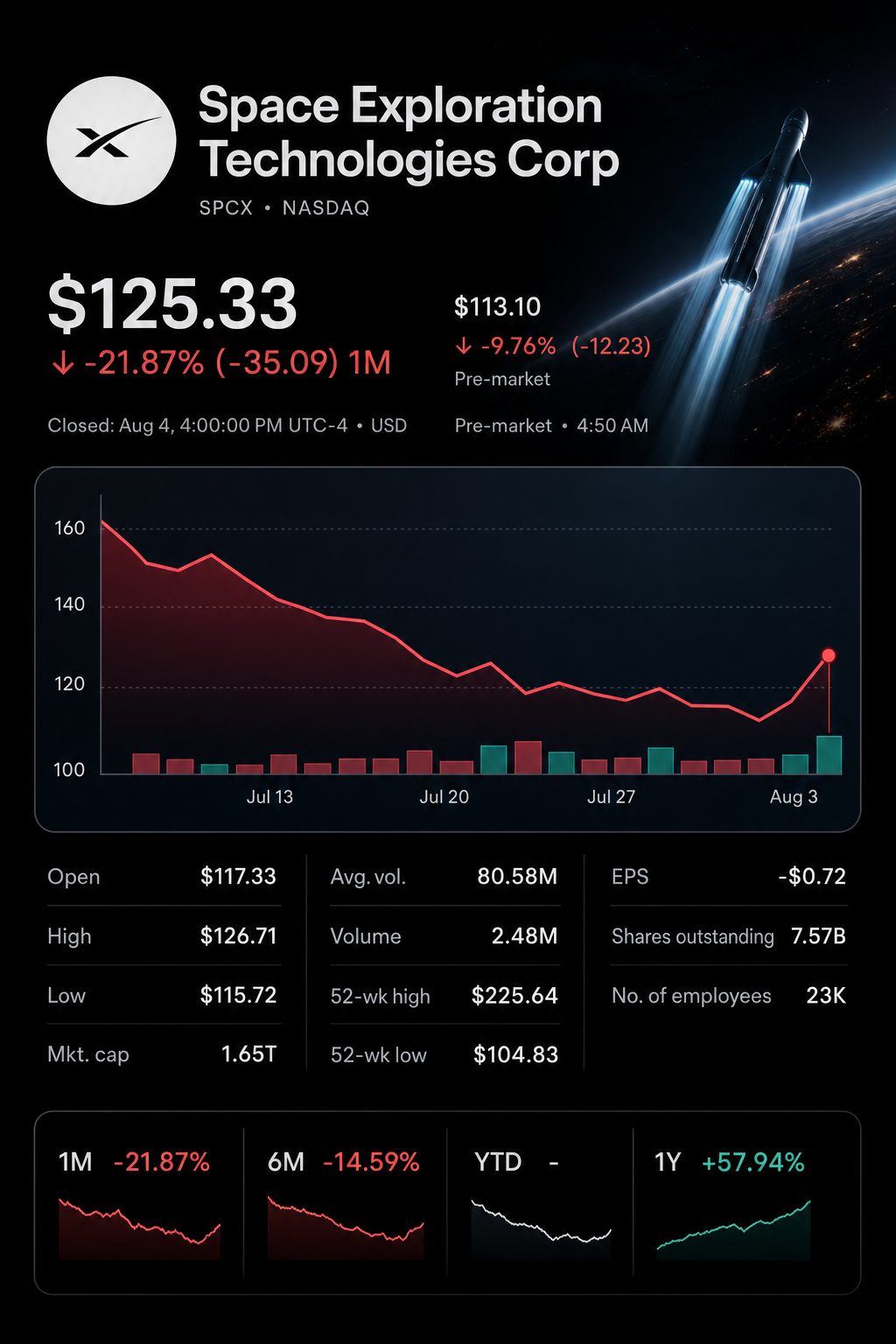
- SpaceX shares dropped up to 9.8% to $113.01 during premarket hours.
- Revenue for the quarter increased by 92%, and capital expenditures totaled $18.37 billion.
- AI accounted for $15.83 billion, representing 86% of total quarterly capital expenditure.
Space Exploration Technologies Corp. NASDAQ:SPCX dropped by up to 9.8% in early trading on Wednesday. Premarket trade on Nasdaq was brisk, though regular market hours had not yet begun.
Revenue increased significantly. AI accounted for 33% of sales and represented 86% of capital expenditures. Market reports highlighted expectations for future spending.
Space and Connectivity jointly spent $2.54 billion. Their combined adjusted EBITDA reached $2.39 billion, offsetting 94% of those costs. AI incurred a significantly larger capital burden.
Second-quarter financial performance, $ billions
| Metric | Q2 2026 | Q1 2026 | Q2 2025 | Quarter-on-quarter | Year-on-year |
|---|---|---|---|---|---|
| Revenue | $7.81 | $4.69 | $4.07 | up 66.5% | up 91.9% |
| Operating loss | ($0.14) | ($1.94) | ($0.97) | loss reduced 92.6% | loss narrowed 85.3% |
| Adjusted EBITDA | $3.54 | $1.13 | $1.21 | rose 213.9% | increased 191.4% |
| Capital expenditure | $18.37 | $10.11 | $2.83 | up 81.7% | up 550.2% |
Adjusted EBITDA is a non-GAAP metric defined by the company. Percentages derive from reported data.
SpaceX disclosed that its revenue almost doubled in its initial public quarter, while it significantly narrowed its operating loss. Capital expenditures surged even more rapidly, increasing by 550% compared with the previous year.
Connectivity continued to drive profits, contributing 73% of the group’s adjusted EBITDA while making up 55% of total revenue.
Capital requirements by business segment, Q2 2026
| Business grouping | Revenue | Adjusted EBITDA | Capex | Capex/revenue | Capex/adjusted EBITDA | Share of group capex |
|---|---|---|---|---|---|---|
| Space and Connectivity | $5.25B | $2.39B | $2.54B | 48% | 1.1 times | 13.8% |
| AI | $2.56B | $1.15B | $15.83B | 618% | 13.8 times | 86.2% |
| Total | $7.81B | $3.54B | $18.37B | 235% | 5.2 times | 100% |
Figures are based on segment data provided by the company. Adjusted EBITDA refers to a non-GAAP metric.
Starlink’s subscriber base reached 12 million, doubling in size. Average monthly revenue per user declined by 22% to $66, reflecting the rollout of lower-priced international plans.
Revenue from enterprise and government sectors increased by 108%, compared with a 44% rise in consumer revenue. This shift contributed to a 79% gain in Connectivity operating income, bringing it to $1.66 billion.
Connectivity performance comparison
| Metric | Q2 2026 | Q2 2025 | Change |
|---|---|---|---|
| Starlink subscribers | 12.0M | 6.0M | +100% |
| Monthly ARPU | $66 | $85 | -22.4% |
| Consumer revenue | $2.49B | $1.72B | +44.4% |
| Enterprise and government revenue | $1.81B | $0.87B | +108.3% |
| Operating income | $1.66B | $0.92B | +79.4% |
Company data is used to determine percentages.
AI revenue totaled $2.56 billion, with infrastructure and solutions contributing $2.19 billion. The segment recorded adjusted EBITDA of $1.15 billion but reported a GAAP loss of $1.26 billion.
AI capital expenditures amounted to 6.2 times revenue and 13.8 times adjusted EBITDA. Executives anticipate overall capex will remain at around existing levels for another two quarters. Musk said, “We’re building AI compute capacity at scale faster than anyone else.”
Brian Mulberry of Zacks Investment Management described the early monetization as a “tremendous upside surprise.” Reuters
At the end of June, SpaceX reported cash and marketable securities totaling $100 billion. Operations for the first half provided $3.47 billion. Investing activities accounted for a use of $34.49 billion, while financing contributed $100.29 billion.
SpaceX could conduct its next Starship test as soon as the end of the month, subject to regulatory clearance. The company aims to launch V3 Starlink satellites and try catching the upper stage with a tower. Musk stated that these satellites are expected to deliver tenfold the broadband capacity of the existing ones.
The supply of shares could become a factor in the near term. As of Thursday, as many as 912 million insider shares will be available for sale, representing 141% of the existing 646 million shares in public float. By mid-2027, a further 12.9 billion shares are expected to become unlocked.
Equity valuation at various share price points
| Price reference | Share price | Approximate equity value | Annualized Q2 revenue multiple |
|---|---|---|---|
| Premarket, August 5 | $113.01 | $1.49T | 47.7 times |
| Close on August 4 | $125.33 | $1.65T | 52.9 times |
| IPO offer price | $135.00 | $1.78T | 56.9 times |
| Intraday high in June | $225.64 | $2.97T | 95.2 times |
Initial estimates are based on 13.18 billion total shares, including both Class A and Class B. Annualized revenue is calculated as four times the disclosed Q2 revenue.
Risks: Continued investment in AI may push back free-cash-flow prospects. Delays to Starship, decreased Starlink ARPU, regulatory challenges and lockup share sales may increase volatility.
Following the selloff, SpaceX remained valued at close to 48 times its annualized revenue for the second quarter. Expectations for rapid capital returns are still reflected in this valuation.
Related articles: NASDAQ:SPCX