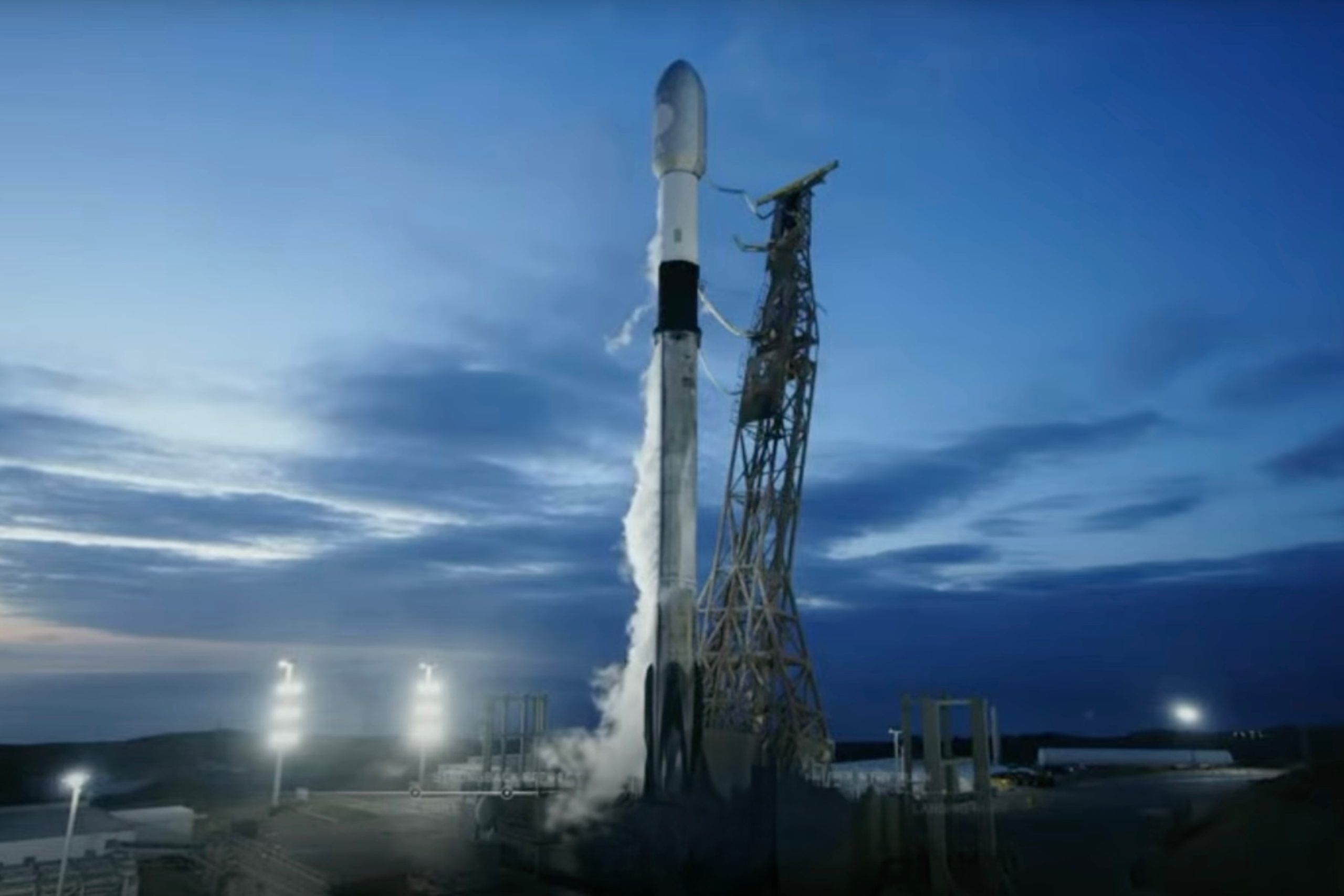

- Launch Highlights: On Sept. 28, 2025 (7:04 p.m. PDT), SpaceX’s Falcon 9 lifted off from Vandenberg Space Force Base carrying 28 Starlink Group 11-20 satellites spaceflightnow.com thenews.com.pk. The mission deployed all 28 Internet-beaming satellites about one hour after liftoff spaceflightnow.com economictimes.indiatimes.com. SpaceX confirmed on its X (Twitter) account that “Falcon 9 launches 28 @Starlink satellites from California” latestly.com.
- Booster Reusability: The first stage (Booster B1063) flew its 28th mission, then successfully landed on the droneship “Of Course I Still Love You” 8½ minutes after launch spaceflightnow.com thenews.com.pk. This ties or breaks SpaceX’s record for booster reuse. (The company celebrated the landing as “tied a company record for the number of times a single booster has been flown” thenews.com.pk.)
- Starlink Constellation: This launch adds 28 satellites to the Starlink megaconstellation. Spaceflight analysts note that Starlink is now the largest network of spacecraft ever assembled – nearly 8,500 active satellites in orbit space.com space.com. (Astronomer Jonathan McDowell counted about 8,475 Starlink birds in orbit as of Sept. 25, 2025 space.com.) Each new Starlink launch further extends global broadband coverage.
- Record Cadence: The September 28 flight was SpaceX’s 16th orbital launch of the month, tying its previous monthly record (May 2025) for most launches in a month spaceflightnow.com economictimes.indiatimes.com. It was also Falcon 9’s 124th mission of 2025. In fact, over 70% of SpaceX’s Falcon 9 missions this year have lofted Starlink satellites space.com. As The Economic Times observed, this Vandenberg launch “marked the company’s 16th mission of the month – tying its record” economictimes.indiatimes.com.
Falcon 9 Launch Details and Milestones
On Sept. 28, SpaceX executed a textbook launch from Vandenberg’s Space Launch Complex 4E. The Falcon 9 booster B1063, standing vertically on the pad, ignited and soared away at 7:04 p.m. PDT spaceflightnow.com. After clearing the pad, it flew on a south-easterly trajectory toward orbit. About 8½ minutes later the first stage used its grid fins and engines to steer back to Earth, touching down cleanly on the drone ship Of Course I Still Love You in the Pacific Ocean spaceflightnow.com thenews.com.pk. The second stage continued upwards and deployed the 28 Starlink satellites roughly an hour after liftoff, inserting them into low Earth orbit as planned spaceflightnow.com economictimes.indiatimes.com.
This mission, called Starlink 11-20, used a booster that has now flown 28 times. Spaceflight Now notes that B1063 previously supported key missions like NASA’s DART and the Sentinel-6 oceanography satellite, and that its 28th flight ties the record for any single Falcon 9 booster thenews.com.pk. SpaceX publicly “celebrated the successful completion of the mission,” pointing out the booster’s record use thenews.com.pk. Such reuse underscores SpaceX’s focus on reusability: the company routinely refurbishes and reflies Falcon 9 first stages, dramatically cutting launch costs. In this case, the veteran booster executed a “flawless propulsive landing” on the droneship, proving once again that rockets can fly many times spaceflightnow.com space.com.
The launch window for this mission was about two hours long (6:28–8:32 p.m. PDT), but SpaceX lifted off right near the start of the window. (Media observers noted that the nighttime launch was visible across Southern California thenews.com.pk, creating bright skyglow for local residents.) SpaceX also streamed the launch live on its webcast, a common practice that lets the public and press watch in real time. In a post-flight update, SpaceX confirmed that the payload – the 28 new Starlink sats – was successfully deployed into orbit spaceflightnow.com.
Starlink Constellation Growth and Purpose
Each launch like this one boosts Starlink’s size and coverage. Starlink is SpaceX’s megaconstellation of small satellites that beam high-speed internet to underserved areas on Earth. According to Space.com, “Starlink is by far the largest network of spacecraft ever assembled,” now comprising nearly 8,500 active satellites space.com space.com. (For comparison, all previous satellite missions in history number on the order of 14,000 total.) SpaceX plans thousands more Starlink sats, eventually deploying up to tens of thousands, to blanket the globe with low-latency internet.
The 28 satellites on this mission are the latest in SpaceX’s “V2 Mini” series thenews.com.pk (a lighter, more compact version of its newer V2 satellites). Space.com reports each V2 satellite weighs about 800 kg at launch, roughly three times heavier than the earlier gen-1 Starlinks space.com. After deployment, each satellite will raise itself to its final 550 km altitude, link up with SpaceX ground stations, and begin relaying broadband data. Over years of operations, older Starlinks are expected to deorbit to avoid space debris. With this latest flight, over 70% of SpaceX’s 2025 launches have supported Starlink deployments space.com, highlighting how critical the constellation is to the company’s mission.
Starlink’s impact is already being felt worldwide. Millions of users on farms, ships, and rural regions now rely on Starlink terminals for connectivity. Emergency responders use Starlink to restore communications after disasters. And SpaceX has even deployed Starlink terminals to aid Ukraine’s network during conflict. SpaceX publicly notes that Starlink is intended to “provide high-speed, low-latency broadband internet around the world,” especially in “remote and underserved areas” timesofindia.indiatimes.com space.com. This Vandenberg launch makes the network ever larger and more reliable.
Record Pace of Launches and Reusability
SpaceX’s September 28 launch was its 16th orbital mission of the month, matching a company record (set in May 2025) for most launches in a single month spaceflightnow.com economictimes.indiatimes.com. In aggregate, Falcon 9 launches have been almost non-stop: this was the 124th Falcon 9 flight of the year spaceflightnow.com. As Space.com noted back on Sept. 18, “more than 70%” of those Falcon 9 missions in 2025 have deployed Starlink satellites space.com. In other words, Starlink launches dominate SpaceX’s activity.
Economically, this launch cadence is unprecedented. SpaceX is launching almost daily, thanks in large part to its reusable booster technology. Falcon 9’s first stage routinely lands and is reflown within weeks. For example, B1063 landed just minutes after liftoff and will be inspected and prepared for a future mission. Each reuse saves the expense of building a new core stage. The New York Times (and other outlets) describe SpaceX’s goal: “fully reusing rockets to bring down launch costs”. The demonstrated reliability – 28 flights on one booster here – proves the concept.
SpaceX’s achievement is often contrasted with older launch providers. For decades, rockets were single-use and far more expensive. Now, by reusing Falcon 9 first stages hundreds of times, SpaceX has pushed launch costs down and enabled a breakneck launch schedule. As one industry analysis pointed out: this launch alone “underscores SpaceX’s continued advancements in reusable rocket technology” timesofindia.indiatimes.com. Each successful booster recovery is a milestone: SpaceX’s drone ships have now caught over 500 boosters at sea (this mission marked about the 513th booster landing overall spaceflightnow.com).
Competition: Amazon’s Project Kuiper and Other Constellations
SpaceX isn’t the only company racing to build satellite internet. Amazon’s Project Kuiper is a major competitor. Less than four days before the Sept. 28 launch, United Launch Alliance (ULA) sent 27 of Kuiper’s satellites into orbit from Cape Canaveral (an Atlas V rocket on Sept. 25) spaceflightnow.com. With that flight, Amazon has a total of 129 Kuiper satellites in orbit spaceflightnow.com (more than doubling its count). ULA reports that Kuiper will have “more than 200 satellites in orbit by the end of 2025,” according to Project Kuiper president Ricky Freeman spaceflightnow.com. Like Starlink, these satellites will form a network to bring internet to remote users.
However, Kuiper faces different challenges. It is launching on a mix of rockets – ULA’s Atlas V and in the future Vulcan, as well as a few SpaceX Falcon 9 flights – because Amazon does not build its own rockets. By comparison, SpaceX controls both the rockets and the satellites. Amazon’s plan calls for dozens of Atlas V and Vulcan launches (including a booked Falcon 9) to reach its constellation goals spaceflightnow.com. Industry observers note this diversified launch strategy is more complex. ULA even touts that its forthcoming Vulcan rocket can lift 45 Kuiper sats per launch, potentially speeding deployment spaceflightnow.com.
In the marketplace, competition is heating up. Just as SpaceX is expanding Starlink, Amazon has begun inroads: it recently announced JetBlue Airlines will use Kuiper internet on flights starting in 2027 spaceflightnow.com. OneWeb (a UK-backed rival) already has hundreds of LEO satellites providing coverage in parts of the world, though its network is smaller than Starlink’s. Other players (Telesat in Canada, regional constellations) are also developing services. But no one yet matches Starlink’s scale. As Space.com noted, Starlink’s ~8,400 satellites make it “by far the largest network” – a lead that Kuiper and others will need years to catch up space.com.
In short, this launch highlights the new space race for global broadband. SpaceX continues to pull ahead with rapid launches and reuse. But competitors are closing in with their own constellations and launch deals. Industry experts suggest that in the next few years we may see tens of thousands of small satellites regularly deployed – a far cry from the pace of past decades.
Global Connectivity Impact and Outlook
What does all this mean for the public? The expansion of megaconstellations like Starlink promises dramatically better internet in rural and remote areas. Starlink service is already active in over 50 countries, and growing with each launch. For consumers, this could mean reliable broadband in places that currently lack it (mountains, oceans, deserts, developing regions). Businesses and governments are watching closely: farmer cooperatives, maritime companies, emergency services, even governments have signed up for Starlink connectivity.
Analysts also note broader implications. By reducing the cost of access to space, SpaceX’s model is enabling new industries (Earth imaging, IoT, disaster response). However, scientists and regulators raise concerns about space traffic and astronomy: thousands of satellites increase collision risk and can interfere with telescopes. SpaceX has been working with astronomers to mitigate such issues. The long-term fate of these constellations – including deorbiting old satellites – will be key to their sustainability.
For now, SpaceX appears unconcerned with competition or skepticism. CEO Elon Musk has repeatedly said Starlink aims to “rebuild the internet in space,” even to fund his Mars ambitions. The press release tone is triumphal: SpaceX’s own posts celebrated each milestone (e.g. “Falcon 9 launches 28 @Starlink satellites from California” latestly.com). Financially, Starlink is also expected to become a major revenue source for SpaceX in the 2020s as it starts earning subscription fees.
In summary, the Sept. 28 launch was another piece in a massive puzzle. By deploying 28 more satellites with a single rocket, SpaceX cemented its lead in satellite Internet and reaffirmed its astonishing launch cadence. The mission hit technical milestones (booster reuse, landing) and operational records (16th launch of September). It also sharpened the contrast with rising rivals: Amazon’s Kuiper is growing too, but must build out from a smaller base. All signs point to a future where the sky is thick with small satellites beaming data – and where SpaceX’s Falcon 9 is likely to be a busy workhorse for years to come timesofindia.indiatimes.com space.com.
Sources: Contemporary coverage and expert analysis from Spaceflight Now, Space.com, The Economic Times, and others spaceflightnow.com economictimes.indiatimes.com spaceflightnow.com space.com, including official SpaceX announcements latestly.com. These reports detail the launch timeline, spacecraft payload, booster reuse, and broader context of the Starlink and Kuiper constellations.
Related articles: Space