
New York, July 4, 2026, 15:02 (EDT)
- U.S. equity markets did not open on Friday, July 3. NYSE and Nasdaq shut for the Independence Day holiday observed as part of the 2026 market calendar.
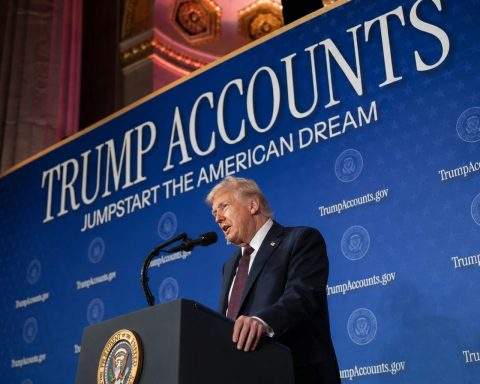
- State Street Corporation’s NYSE:STT State Street SPDR Portfolio S&P 500 ETF (NYSEARCA:SPYM), which used to go by the ticker SPLG, was chosen as the default ETF at launch for Trump Accounts.
- SPYM closed at $87.67 on Thursday, slipping 0.11%. Volume came in at 15.69 million shares. The ETF remains 2.2% higher since finishing June 26.
- State Street data has SPYM’s assets up about $18.3 billion since March 31. That’s more than what NAV gains alone account for.
State Street’s NYSE:STT cheap S&P 500 ETF could see new flows as a government program makes it the default pick. Parents using the savings plan will have their money parked in the State Street fund unless they actively choose a different provider.
State Street’s SPDR Portfolio S&P 500 ETF (NYSEARCA:SPYM), which carried the SPLG ticker until its switch set for Oct. 31, 2025, closed the short week at $87.67. U.S. markets were closed Friday for the Independence Day holiday and did not open on Saturday.
The Treasury Department said all new Trump Account contributions will be put into SPYM at launch. More choices are coming, like iShares Core S&P 500 ETF NYSEARCA:IVV, Vanguard Total Stock Market ETF NYSEARCA:VTI, SPDR Portfolio S&P 1500 Composite Stock Market ETF (NYSEARCA:SPTM), and iShares Core S&P Total U.S. Stock Market ETF (NYSEARCA:ITOT), but those won’t arrive for a few months. Treasury said with the election tool not ready yet, contributions will stay in the default fund for now.
That’s important because all the first money goes straight to a single ETF. State Street said a child born between Jan. 1, 2025 and Dec. 31, 2028, who’s a U.S. citizen, qualifies for a one-time $1,000 Treasury deposit. U.S. citizens under 18 can also get up to $5,000 per year in extra contributions.
Reuters reported that about 3.6 million children were born in the U.S. in 2025, using early CDC numbers. That would be 14.4 million births over four years. At $1,000 for each child, the initial total would be $14.4 billion, not counting eligibility, taxes, or participation. That’s about 9% of SPYM’s stated $154.86 billion in State Street assets as of July 1.
SPYM was seeing inflows before Trump Accounts launched. State Street listed SPYM with $119.09 billion in assets and a share price of $76.54 at March 31. By July 1, the fund’s page showed assets at $154.86 billion and NAV of $87.75.
| SPYM measure | March 31 | July 1 | Change |
|---|---|---|---|
| Assets under management | $119.09 bln | $154.86 bln | added $35.77 bln, or 30.0% |
| Share price / NAV | $76.54 | $87.75 | gained 14.6% |
| AUM gain explained by NAV move | — | — | about $17.4 bln |
| AUM gain beyond NAV move | — | — | around $18.3 bln |
The math here leaves out distributions and some minor cash changes, so it isn’t precise. Even so, more than half the asset growth since March 31 came from more than just price gains, which matters to investors.
State Street Investment Management CEO Yie-Hsin Hung said the firm is “thrilled that SPYM has been selected.” Hung said the accounts are set up to help families “start early and stay invested over time.” State Street
The other hook is the fund’s fee. State Street puts SPYM’s expense ratio at 0.02%, calling it the lowest of any of the four U.S.-listed, unlevered S&P 500 ETFs tracking the main index. The big brother, SPDR S&P 500 ETF Trust NYSEARCA:SPY, charges 0.0945%. SPY also sees much higher trading volume.
| ETF | Role | Expense ratio | AUM cited by State Street as of March 31 | 30-day average spread |
|---|---|---|---|---|
| SPDR S&P 500 ETF Trust NYSEARCA:SPY | mostly used by traders | 0.0945% | $648.53 bln | 0.0021% |
| State Street SPDR Portfolio S&P 500 ETF (NYSEARCA:SPYM) | targeted as a low-cost core holding | 0.02% | $119.09 bln | 0.0127% |
SPYM’s net assets stood at $153.92 billion as of Thursday, according to MarketWatch, with 1.76 billion shares outstanding and a 0.02% net expense ratio. Volume reached 15.69 million shares, running about 21% above the recent 65-day average.
The risk is pretty direct. SPYM tracks the S&P 500 by market cap, with State Street giving tech a 36.87% weight in the fund as of July 2. Its biggest positions are Nvidia Corp NASDAQ:NVDA, Apple Inc NASDAQ:AAPL, Microsoft Corp NASDAQ:MSFT, Amazon.com Inc NASDAQ:AMZN, and Alphabet Inc Class A NASDAQ:GOOGL.
Stocks moved in tight ranges last week. The S&P 500 Index (INDEXSP:.INX) ended Thursday unchanged at 7,483.24. The Nasdaq Composite (INDEXNASDAQ:.IXIC) dropped 0.8% as chip names fell. The Dow Jones Industrial Average (INDEXDJX:.DJI) rose 1.1% to finish at a fresh record. Weekly, the S&P 500 was up 1.8%, Reuters said.
Apple finished up 4.8% Thursday, propping up the index. Nvidia fell 1.4%. Semiconductors lost ground too, with the index down 5.4%, per Reuters. Bruce Zaro, managing director at Granite Wealth Management, said investors were “taking profits in chip stocks” after this year’s strong run. Reuters
Traders have their focus on rate risk and the start of earnings season this week, leaving ETF flows on the sidelines. The Federal Reserve is set to release minutes from its June 16-17 meeting at 2 p.m. ET Wednesday, according to the Fed calendar. Reuters said investors are searching the minutes for direction on rates and signs of policy under new Fed Chair Kevin Warsh.
Large-cap funds caught a break before the holiday as June jobs numbers came in below forecast. The U.S. economy added 57,000 jobs, well under the 110,000 Reuters had projected. Adam Sarhan, CEO at 50 Park Investments, said this “takes the pressure off the Fed” to hike rates. Reuters
Flows could shift when Trump Accounts begin trading. Andy Blocker, policy and government relations head at Edward Jones, told Reuters the $1,000 minimum “removes the barrier of having nothing to start with.” Adam Michel, tax policy director at the Cato Institute, said the “real benefit lands” with families who are steadily employed and can save. Reuters
Related articles: NYSE:STT