After the market closed on Friday, previous holders were paid $72.50 in cash.
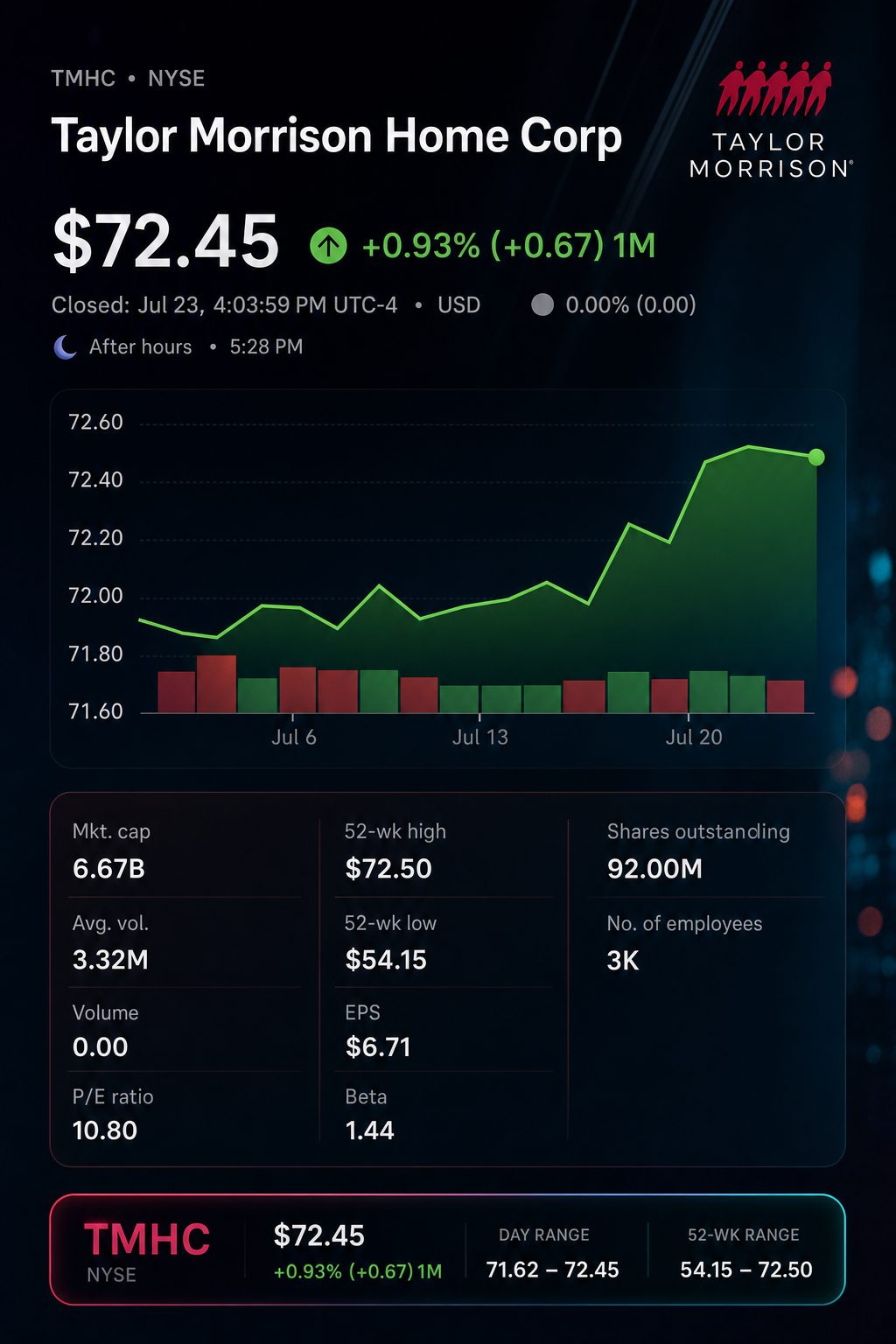
The transaction represents a trailing earnings multiple of 10.8, which is about 23% lower than that of three major peers.
NYSE delisting will officially occur on August 3, with independent reporting of the common stock expected to conclude after that date.
There was no real-time quote for Taylor Morrison Home Corp. on Tuesday. Berkshire Hathaway Inc. NYSE:BRK.B finalized the acquisition on Friday. Shareholders received $72.50 in cash for each qualifying share.
The buyout concludes Taylor Morrison’s 13 years as a publicly traded company, removing a direct housing-cycle exposure from investors’ holdings.
For investors, valuation is the key issue. Berkshire offered a 24% premium over the prior $58.50 closing price. The deal values the company at approximately 10.8 times its trailing earnings.
The multiple is about 23% less than the average among chosen peers. As a result, Berkshire secured control without paying the same valuations as public peers.
D.R. Horton Inc. NYSE:DHI, Lennar Corp. NYSE:LEN and PulteGroup Inc. NYSE:PHM, all listed, traded at higher multiples on Tuesday.
Initial intraday figures recorded up to roughly 9:50 EDT. Taylor Morrison’s ratio is based on the $72.50 offer and $6.71 in trailing earnings per share. The peer average is calculated arithmetically.
The most recent market-feed price was $72.45. The difference of five cents to cash represented only 0.07%. Merger risk had almost disappeared prior to the halt in trading.
Berkshire acquired Taylor Morrison’s equity for approximately $6.8 billion. The deal valued the company at an enterprise value of $8.5 billion.
Nearly 23,000 site-built homes were delivered by the combined platform in 2025. Operations cover 21 states, more than 700 communities, and 52 markets. Berkshire described it as the fourth-biggest homebuilding business in the United States.
Chief Executive Greg Abel stated that Taylor Morrison will “lead our vision for a unified site-built homebuilding operation.” Sheryl Palmer continues as the homebuilder’s chief executive. Taylor Morrison Investors
Berkshire maintains its exposure to the limited housing inventory. Prices for U.S. single-family homes climbed 0.3% in May and were up 2.2% compared to the same period a year ago.
Affordability continues to be a limiting factor. The typical 30-year mortgage rate climbed to 6.58% last week, marking the highest level in 11 months. Increased borrowing costs may lead builders to either boost incentives or lower prices.
Peer shares advanced in early Tuesday deals. Previous Taylor Morrison holders were excluded from the rally. Their returns remain locked at the agreed merger price.
Taylor Morrison shares were halted from trading on the NYSE after Friday’s session. The official delisting will take place on August 3. Following that, the company intends to deregister and end reporting of its common stock.
Risks: Berkshire faces integration, mortgage interest rate and incentive risks. Ex-Taylor Morrison shareholders forgo potential gains if the housing market recovers.
The key takeaway for public investors concerns valuation. Despite a 24% takeover premium, Berkshire acquired at earnings multiples lower than those of its peers.
Has trading continued for Taylor Morrison shares today?
No. Berkshire Hathaway finalized its purchase on July 24, resulting in Taylor Morrison becoming a wholly owned subsidiary. Trading in TMHC on the NYSE has been halted, so there is no active market price. The company will be formally delisted on August 3, 2026, per the closing statement. Any $72.45 share price shown now is outdated and not actionable.
How much cash will former TMHC shareholders be paid?
Holders of each qualifying share will receive $72.50 in cash, with no interest applied and subject to potential tax withholding. For 100 shares, that totals $7,250 prior to individual tax deductions. Those holding shares in book-entry form do not require paper certificates; payouts are issued after the agent's electronic notification. Owners with physical certificates may need to submit transmittal documents and surrender their certificates.
What caused TMHC's closing price to be $72.45 and not $72.50?
The five cent difference represented about 0.07% of Berkshire’s cash offer. This likely accounted for the timing of settlement and any remaining processing risk prior to completion. The gap closed economically when the merger exchanged all qualifying shares. With regular trading halted, there is no remaining spread available to the public.
What is the status of Taylor Morrison’s inclusion in the S&P MidCap 400?
S&P removed TMHC from the index prior to the start of U.S. trading on July 24. Krystal Biotech was added to the S&P MidCap 400 to take its place. Subsequently, Tutor Perini filled Krystal Biotech's former slot in the SmallCap 600. These index adjustments have already taken effect and are not upcoming for this week.
What is the outcome for outstanding TMHC listed options?
The cash deliverable per standard contract is now $7,250. For OCC settlement, this sum is reduced by the contract's extended strike value. Contracts set to expire after August 21 will now expire on August 21. American-style contracts can still be exercised before expiration and are settled in one business day. All outstanding contracts apply a one-cent exercise threshold.
Is Taylor Morrison scheduled to release its second-quarter earnings this week?
The company’s official events calendar shows no standalone release. TMHC shares lack a price-moving catalyst, as the stock is no longer listed. Taylor Morrison intends to discontinue periodic reports for common stock after deregistering. Upcoming performance could be included in Berkshire filings, though specific detail is unconfirmed.
What were the key findings from Taylor Morrison's most recent public operating results?
Total revenue for the first quarter decreased 26.8% from a year earlier to $1.387 billion. Home closings were down about 26% year on year to 2,268 units. The average price per closed home slipped roughly 4% to $578,000. Adjusted gross margin contracted by 420 basis points to 20.6%. Net orders declined 14%, but the backlog climbed 23% sequentially to 3,465 homes.
At what valuation did Berkshire acquire Taylor Morrison?
The transaction valued equity at around $6.8 billion, with an enterprise value of $8.5 billion. Based on trailing EPS of $6.71, the purchase price was close to 10.8 times earnings. The price represented about 1.13 times Taylor Morrison’s first-quarter book value of $64. The deal reflected a 24% premium over the May 29 closing share price. The premium to book value implied was around 13%.
What are the options for public-equity investors to maintain exposure to Taylor Morrison?
Access is currently provided primarily via Berkshire Hathaway’s BRK.A or BRK.B shares. Taylor Morrison is folding into Clayton Properties Group under Sheryl Palmer. Combined, they closed close to 23,000 site-built homes in 2025. The newly merged business now covers 21 states, 52 markets, and more than 700 communities. Berkshire calls it the nation’s fourth biggest homebuilder.
Will shareholders owe taxes on the $72.50 cash payment?
In most cases, for United States investors, this holds true according to the tax summary in the merger proxy. The capital gain or loss is the difference between the cash received and the adjusted tax basis, and this formula is applied to each separate share lot. Shares held for over a year are typically treated as long-term capital assets. Other jurisdictions, including state, local, and foreign tax authorities, may reach different results. Ultimately, tax consequences may vary by individual circumstance.
Khadija Saeed is a financial markets reporter at TS2.tech. Her coverage ranges from stocks and technology to emerging industries and developments across global markets. She studied economics and finance at the London School of Economics and worked in market research before becoming a financial journalist. Follow Khadija Saeed on Google News.
A figure above or below the 12.0 consensus could impact Treasury yields, the dollar, and cyclical stocks by influencing short-term growth outlooks.
#2
NAHB Housing Sentiment
A reading above or below 33 will influence expectations for housing demand, mortgage rate trends, and homebuilder stocks.
#3
Fabrinet After the Close
Investors are focusing on revenue, margins, and comments on datacom as key factors for companies involved in optical networking and AI infrastructure supply chains.