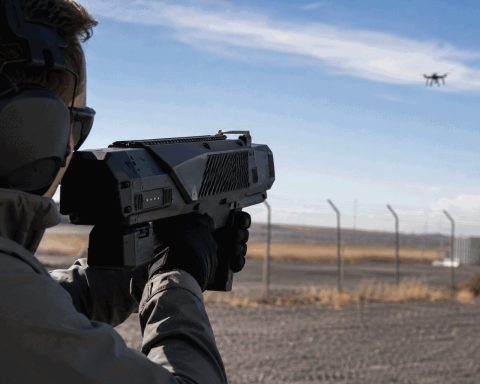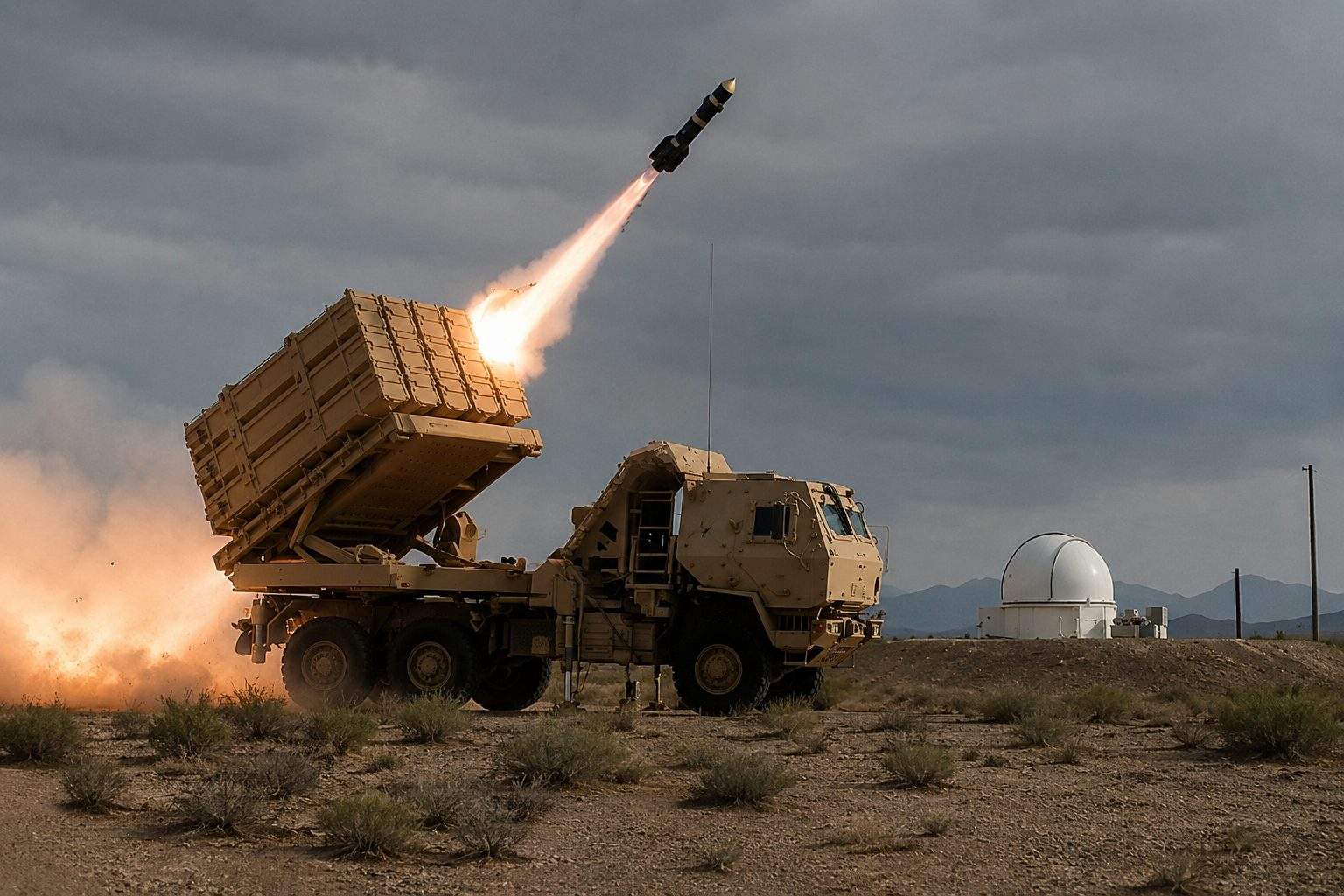

WASHINGTON, July 20, 2026, 13:08 EDT
- The launcher inquiry covers cruise missiles and UAS Groups 1–5. Responses are due Aug. 7.
- A separate low-cost radar inquiry suggests a modular supplier stack.
- Preliminary benchmark: an Army order implies about $11.3 million per launcher package.
The Air Force has opened separate inquiries for a ground launcher and low-cost fire-control radar. Their timing and adjacent notice numbers point toward a modular base-defense plan.
If retained, that structure could spread spending across launchers, sensors, missiles and command systems. It would reduce the odds of one supplier taking the whole program.
The launcher inquiry seeks protection against cruise missiles and every UAS weight group. Suppliers must describe firing rate, magazine depth and integrated sensing.
Transportability, manpower, diagnostics and price are among 11 baseline attributes. The notice remains market research, not a procurement commitment.
The companion radar inquiry came from the same acquisition office. It carries the adjacent notice number and the same Aug. 7 deadline.
That pairing is the key investor signal. It suggests the Air Force may mix systems, although no architecture is fixed.
Operational pressure is rising. The U.S. military said a Friday Iranian strike killed two service members at a Jordanian air base.
Air Force modernization chief Lt. Gen. Christopher J. Niemi described a large capacity gap. “The capacity that will be required far outstrips what exists in the joint force today,” he said. Missile Defense Advocacy Alliance
The service initially prioritizes small UAS, one-way attack drones and subsonic cruise missiles.
The closest public cost benchmark comes from the Army’s Enduring Shield program. In 2024, the Army placed a $204 million order initially covering 18 launchers.
Preliminary benchmark: that equals roughly $11.3 million per launcher package. It is not a clean flyaway price because the order sits inside a broader production-and-support contract.
The same indefinite-delivery contract carried a $4.1 billion ceiling. That figure represents potential lifecycle scale, not guaranteed revenue.
Existing products show where listed-company exposure could sit. The Air Force has named no supplier.
| Listed exposure | Market value | Relevant reference | Potential economic lane |
|---|---|---|---|
| Leidos Holdings NYSE:LDOS | $13.5 billion | Enduring Shield | Mobile, multi-missile launcher for UAS and cruise missiles; closest listed launcher benchmark. Leidos |
| RTX Corp. NYSE:RTX | $264.8 billion | NASAMS and Coyote | Fire-control radar, several interceptor types and lower-cost counter-UAS effectors. RTX |
| L3Harris Technologies NYSE:LHX | $52.8 billion | VAMPIRE | Palletized mobility, two-person installation and laser-guided munitions; broader threat coverage remains unproven publicly. L3Harris® Fast. Forward. |
| Northrop Grumman NYSE:NOC | $75.6 billion | IBCS | Command-system integration across otherwise separate sensors and effectors. Northrop Grumman |
The economic lanes are inferred from existing products, not disclosed bids.
As a scale check, $204 million equals 1.5% of Leidos’ market value. It equals just 0.08% of RTX’s. Those ratios are not earnings estimates.
RTX, however, spans radar and expendable interceptor layers. That breadth could provide revenue without control of the launcher contract.
U.S. markets remained open at 13:08 EDT. Leidos rose 0.7%, RTX 1.6%, L3Harris 0.4% and Northrop 1.7%. The notices established no winners.
The launcher RFI explicitly asks about munition types and magazine depth. If funded, that could favor recurring interceptor revenue over chassis-only sales.
A separate radar purchase could create a second hardware lane. Integration work may become a third.
Risks remain substantial. Both notices are non-binding and commit no funding. Full threat coverage could also raise cost-per-kill and integration risk.
The next hard signals are a funded budget line, prototype award and disclosed team structure. Until then, architecture matters more than one day’s share moves.