
IRVING, Texas, August 18, 2026, 06:15 EDT — U.S. cash markets remain shut as premarket activity continues.
- Vistra reported fleet availability of at least 97% during recent heat waves in Texas and PJM.
- Generation EBITDA for the second quarter jumped 67.6%, significantly outpacing growth in retail EBITDA.
- The analyst consensus target of $228.56 suggests potential upside of approximately 56% compared to Monday’s closing price.
Vistra Corp. NYSE:VST heads into another southern heat wave while maintaining a key edge: its commercial fleet achieved over 97% availability during the last run of extreme weather. This is more significant than a temporary spike in spot prices. Vistra’s hedging strategy and retail portfolio help turn high fleet reliability into stable margins.
Heat advisories were issued across portions of 12 states on Monday, with heat-index levels in Mississippi potentially nearing 115 degrees Fahrenheit. Around 100 million individuals were under heat-related warnings. The most recent Google Trends investor feed linked increased search volume to rising power usage and pressure on the grid.
| Heat and power indicator | Latest verified reading | Investor relevance |
|---|---|---|
| Population under heat alerts | About 100 million | Widespread demand for cooling |
| Maximum heat index | Up to 115°F | Increased use of air conditioning |
| PJM July peak | More than 168 GW | Sets new all-time summer high |
| ERCOT July peak | More than 91 GW | Establishes new all-time summer high |
| Vistra fleet availability | 97% or higher | Greater supply during peak strain |
The near-term investor assessment is functioning. Vistra wrapped up three nuclear refueling shutdowns and 92 scheduled gas and coal outages ahead of summer. CEO Jim Burke stated the efforts led to “strong, reliable performance” in the face of recent high temperatures. Company release
The figures back up the assertion. Generation adjusted EBITDA rose to $994 million in the second quarter, an increase of 67.6%. Retail EBITDA edged up 2.2% to $773 million. Beneficial hedging boosted the average realized generation prices by roughly 5% per megawatt-hour.
| Second-quarter measure | 2026 | 2025 | Change |
|---|---|---|---|
| Adjusted EBITDA | $1.767 billion | $1.349 billion | up 31.0% |
| Generation EBITDA | $994 million | $593 million | increased by 67.6% |
| Retail EBITDA | $773 million | $756 million | rose 2.2% |
| Net income | $305 million | $327 million | fell 6.7% |
This division represents the initial heat-wave focus. Vistra is more than merely a wager on increased temperatures. The generation segment benefited from elevated realized prices, and the retail unit managed customer-load risk. Vistra’s integrated model proves advantageous when electricity demand increases significantly.
Vistra reported $3.261 billion in adjusted EBITDA during the first half, amounting to 45.3% of its $7.2 billion guidance midpoint. Management anticipates full-year performance to reach or surpass the midpoint, underscoring the significance of results in the seasonal second half.
| 2026 outlook measure | Low | Midpoint | High | First-half progress |
|---|---|---|---|---|
| Adjusted EBITDA | $6.8 billion | $7.2 billion | $7.6 billion | 45.3% of midpoint reached |
| Adjusted free cash flow before growth | $3.925 billion | $4.325 billion | $4.725 billion | No equivalent disclosure available |
| 2027 EBITDA opportunity | $7.4 billion | $7.6 billion | $7.8 billion | Unchanged |
Over the longer term, demand is showing reduced dependence on weather patterns. The U.S. Energy Information Administration projects electricity consumption at 4,268 billion kilowatt-hours for 2026 and 4,391 billion for 2027. AI and cryptocurrency data centers are significant contributors.
Burke anticipates yearly load growth in ERCOT of 4%-6% and in PJM of 2%-3% through 2030. However, forward prices in Texas have softened. According to management, battery deployment curbed July scarcity pricing, indicating that even at record demand, extreme wholesale prices are not inevitable.
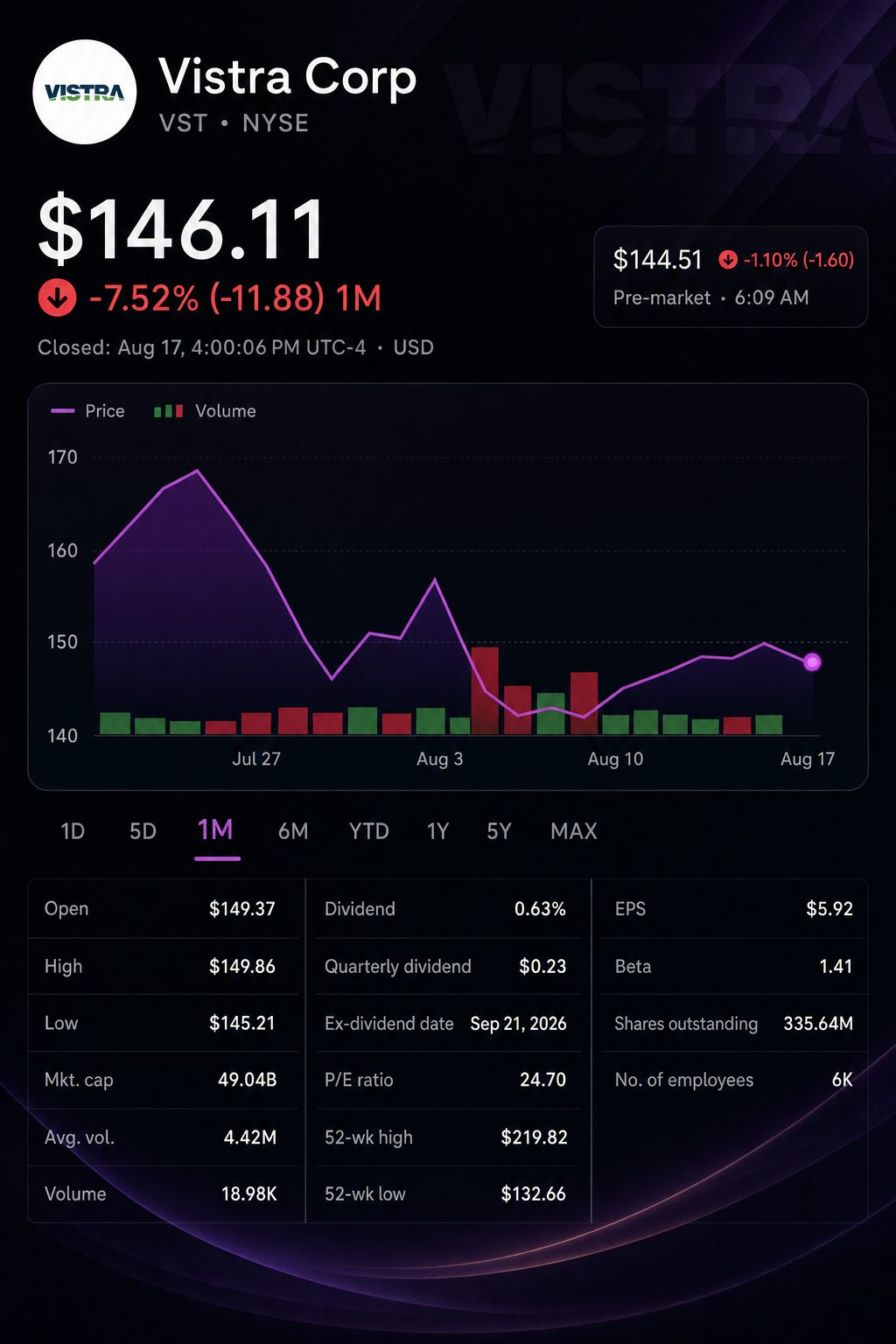
Vistra shares closed down 1.36% on Monday at $146.11. The stock is still trading 33.5% under its 52-week high, despite analysts maintaining a notably bullish consensus.
| Analyst or firm | Date | Recommendation | Target | Upside from $146.11 |
|---|---|---|---|---|
| Goldman Sachs | Aug. 12 | Target assigned | $206 | 41.0% |
| Wells Fargo | Aug. 10 | Overweight | $212 | 45.1% |
| Morgan Stanley / Stephen Byrd | July 28 | Overweight | $212 | 45.1% |
| TD Cowen / Shelby Tucker | July 27 | Buy | $222 | 51.9% |
| 17-analyst consensus | Aug. 18 | Buy | $228.56 | 56.4% |
Out of 17 analysts, 16 have buy or strong-buy recommendations. The average price target is $228.56, with estimates ranging from $187 to $298. Latest projections continue to expect that increased structural demand and prudent capital allocation will offset any weakness in ERCOT curves.
Risks: Facility outages in periods of intense heat may negate the benefit of higher availability. Margins may be limited by mild temperatures, battery inventory, and softer ERCOT pricing. Execution and capital allocation challenges may arise from ongoing deals and data-centre investment plans.
The heat wave effectively serves as an ongoing operational test. Should availability remain close to 97%, Vistra supports the rationale for its guidance. Any shortfall would highlight how much of the valuation relies on perfect execution.