
NEW YORK, June 23, 2026, 14:04 EDT
- Quantinuum shares were recently up about 14.6% at $78.21 in Nasdaq trading, extending their gain above this month’s $60 IPO price.
- The move followed White House orders aimed at speeding U.S. quantum-computing development and migration to post-quantum cryptography, encryption built to withstand future quantum attacks.
- Quantinuum also announced a collaboration with HPE to link quantum machines with high-performance computing, or large-scale supercomputing systems used by companies and researchers.
Quantinuum Inc. shares jumped in afternoon trading on Tuesday as investors bought into quantum-computing names after Washington set a 2028 target for a powerful research-grade quantum computer and the newly public company added a fresh enterprise-computing tie-up.
The stock was recently at $78.21, up $9.94 from its prior close, after trading as high as $81.09. That puts QNT about 30% above the $60 price in its June initial public offering, when a company first sells shares to the public.
The timing matters. Quantum shares have been volatile since several companies came to market, and investors are looking for signs that the technology is moving from lab budgets toward government and corporate demand.
President Donald Trump signed two executive orders on Monday aimed at speeding quantum development and protecting government systems from future quantum cyber threats. Michael Kratsios, director of the White House Office of Science and Technology Policy, told reporters of the quantum-computer target: “We believe this can happen by 2028.” Reuters
The White House said one order calls for work on a quantum computer powerful enough to support scientific discovery, and for plans to deploy quantum-enabled sensors and networks over five years. A second order pushes agencies to move sensitive systems to post-quantum cryptography by 2030 and 2031, depending on use.
Quantinuum, based in Broomfield, Colorado, also said it had struck a strategic collaboration with Hewlett Packard Enterprise focused on joining quantum computing with high-performance computing and AI infrastructure. Quantinuum CEO Rajeeb Hazra said the company is working toward “practical, hybrid solutions,” while Masoud Mohseni, HPE’s quantum director, called the effort a “deeply integrated, hybrid approach.” Quantinuum
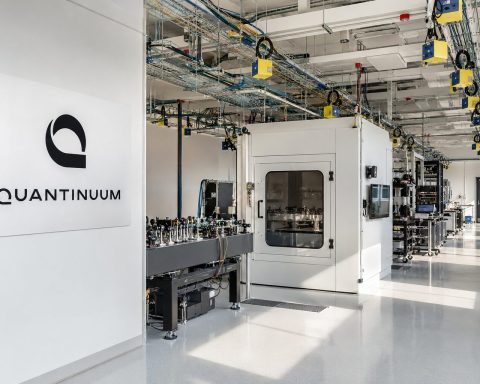
The company uses trapped-ion quantum systems, which use charged atoms controlled by lasers to process information. Reuters reported at its debut that CEO Raj Hazra said “commercialization has started,” while IPOX Schuster analyst Kat Liu said the investment case rests on the technology’s “long-term potential.” Reuters
The trade was not isolated. D-Wave Quantum rose 3.8% and Rigetti Computing was little changed, while IonQ slipped about 1.0%, showing a sector bid but not a clean sweep. HPE, Quantinuum’s new partner, rose 2.6%.
Federal money remains part of the backdrop. The Commerce Department said in May it had signed letters of intent for $2.013 billion in CHIPS Act incentives across nine quantum companies, including $100 million planned for Quantinuum to address manufacturing bottlenecks in fault-tolerant trapped-ion computers. Fault-tolerant means systems designed to keep working reliably even when errors occur.
But the risks are still plain. Quantinuum had 2025 sales of $30.9 million and a net loss of $192.6 million, Reuters reported, while Japan’s RIKEN research institute accounted for roughly 60% of 2025 revenue. Edward Best, a partner at Willkie Farr & Gallagher, said investors should watch whether the company broadens its customer base and lifts the number and value of commercial contracts.
That makes Tuesday’s rally a policy-and-positioning trade as much as an earnings trade. The government has put a date on the race, and Quantinuum has a new listed stock through which investors can express it. The harder test will be whether federal support and partnerships turn into repeatable revenue before development costs dilute the excitement.