
New York, June 5, 2026, 07:04 (EDT)
- QNT traded at $58.86 before the bell, 2.52% under Thursday’s $60.38 finish and below the $60 IPO price.
- Nasdaq hadn’t started regular trading. The exchange says normal hours are 9:30 a.m. to 4 p.m. ET, and June 5 isn’t on the 2026 market holiday calendar.
- Quantinuum priced its upsized IPO at $60 per share, selling 28 million Class A shares for $1.68 billion.
Quantinuum Inc. shares dropped in premarket action Friday, putting pressure on the Honeywell-backed quantum firm’s IPO price just a day after a jumpy debut. QNT was last changing hands at $58.86 before the open, down 2.52% from Thursday’s $60.38 close.
Quantinuum’s debut has drawn attention as the company is now seen as a price signal for investor interest in quantum computing—an area with big research costs and not much predictable revenue. Shares started Thursday at $68, up from the $60 IPO price, giving Quantinuum a quick valuation near $17.6 billion. Gains didn’t stick.
Nasdaq and S&P 500 futures slipped in early trade, dragged down by chip stocks. U.S. stock futures stayed soft before the open ahead of the May payrolls data.
Quantinuum sold 28 million Class A shares at $60 in an upsized deal, the company said. Underwriters can buy up to 4.2 million more shares in the next 30 days. Shares will list on Nasdaq as “QNT.” Closing is set for June 5, pending usual conditions. Quantinuum
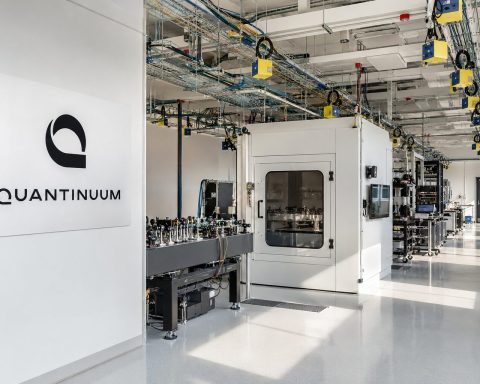
Quantinuum calls itself a full-stack quantum computing platform and says it handles hardware, software tools, and application layers for quantum workloads. The platform has hardware systems, developer tools, application libraries, and IP meant to help move quantum computing out of research and into real use.
Quantinuum CEO Rajeeb Hazra told Reuters quantum’s “commercialization has started — started small, but exhilarating,” adding the company thinks it’s ready for public markets. In a letter in its prospectus, Hazra said Quantinuum is pushing ahead on a roadmap to Apollo, which it calls its first commercial-scale, fully fault-tolerant quantum computer expected by decade’s end. Fault-tolerant here refers to a system able to fix errors during long calculations. Reuters
IPOX Schuster analyst Kat Liu told Reuters the pitch was about the “long-term potential of quantum computing.” Liu said government support has weight here, with the technology labeled as strategic for national security, AI, communications and advanced computing. Reuters
The bull case is one side. But the financials are at an early stage. Quantinuum posted first-quarter revenue of $5.2 million with a net loss of $136.6 million. That’s down from $19.1 million in revenue and a $30.5 million loss in the same period a year ago. For 2025, revenue totaled $30.9 million with a net loss of $192.6 million.
Bookings, which measure the total dollar value of customer contracts in a given period, came in at $79.3 million for 2025 but just $1.3 million in the first quarter. The uneven flow has investors watching both lab milestones and whether Quantinuum can convert pilot deals into bigger, repeat business.
The field remains tight, with Quantinuum and IonQ both running trapped-ion systems. These use charged atoms for data processing. Rigetti sticks with superconducting qubits—very cold, small electrical circuits. Quantinuum’s filing lists IonQ and Rigetti as peers and compares them on two-qubit gate fidelity, which gauges how well a base quantum operation performs.
The risk is investors may think the market is getting ahead of itself on revenue. Quantinuum said commercially viable fault tolerance faces “substantial scientific and engineering uncertainty,” its roadmaps could run late or fall short, and it expects to post operating losses soon. If QNT can’t clear the $60 issue price, first take from public investors looks like a test of patience, not belief in quantum promise. SEC