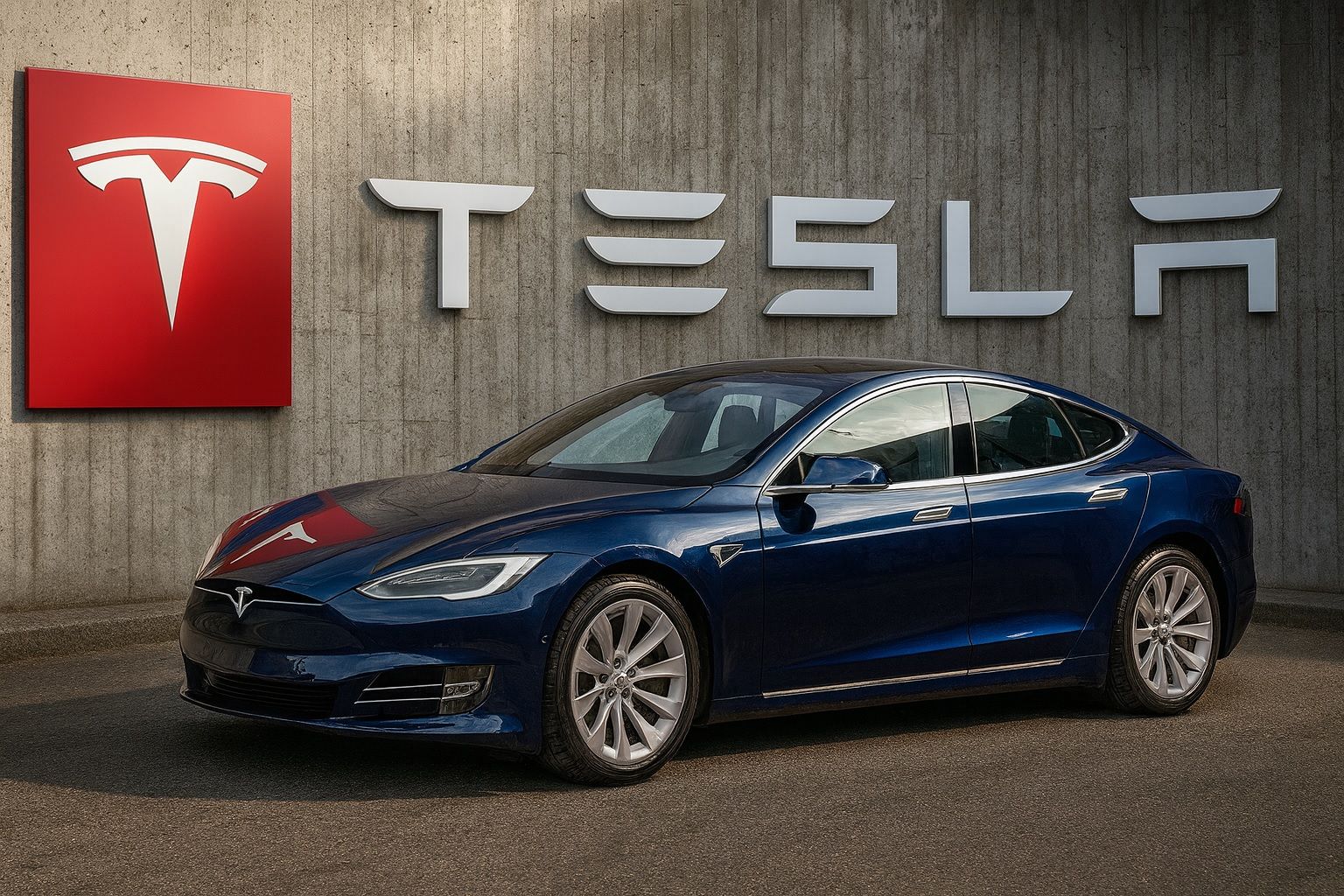

- Stock Volatility & Latest Price: Tesla’s stock has seesawed sharply in recent sessions. TSLA jumped over 5% on Monday (Oct. 13) to $435.90, then dipped ~1.5% on Tuesday (Oct. 14) to close at $429.24investing.com. This whiplash followed a 5% plunge last Friday and mirrors Tesla’s broader October volatility – the stock spiked to ~$453 on Oct. 6 (near its 52-week high) before a “sell the news” pullback mid-monthts2.techinvesting.com. Despite the swings, TSLA remains elevated – up roughly 80% year-on-year (vastly outpacing the S&P 500’s ~17% gain)ts2.tech. Its market cap hovers around $1.5 trillion, placing Tesla among the world’s top companiests2.tech, though valuation metrics are stretched (~250× earnings).
- Record Q3 Sales & Tax-Credit Rush: Tesla shattered records with 497,099 vehicle deliveries in Q3 2025, beating Wall Street’s ~443k estimatets2.tech. Production was ~447k, meaning Tesla sold more cars than it built by drawing down inventoryts2.tech. This 7% year-over-year jump came from a late-quarter demand surge as U.S. buyers raced to beat a $7,500 EV tax credit expiry on Sept. 30ts2.tech. Tesla’s aggressive end-of-quarter discounts and financing deals “pulled forward” demandts2.tech. While investors cheered the record sales, analysts cautioned it may cannibalize Q4: “The $7,500 credit definitely…pulled forward demand this quarter,” noted Tesla shareholder Ken Mahoney, warning the expiry could leave a “demand gap” in the fourth quarterreuters.com. Indeed, TSLA initially dipped ~3–4% when the delivery data hit as the market digested the risk of a post-incentive sales slowdownts2.tech.
- “Affordable” Models Launch – Reaction Mixed: On Oct. 7, Tesla unveiled new lower-priced Standard Range versions of the Model Y SUV and Model 3 sedan, starting at $39,990 and $36,990ts2.tech. These trims offer >300 miles of range but cut some features (smaller batteries, no Autopilot “Autosteer,” fewer amenities) to reduce coststs2.techreuters.com. CEO Elon Musk pitched the move as a bid to reach more buyers, acknowledging many people “don’t have enough money” for current EVsts2.techreuters.com. However, the market was underwhelmed – Tesla’s stock tumbled ~4–4.5% after the announcementts2.techreuters.com. Even bullish Wedbush analyst Dan Ives said he was “disappointed” the new models are only ~$5k cheaper than existing trimsts2.techreuters.com. “It’s basically a pricing lever and not much of a product catalyst,” added one strategist, doubting the cheaper versions will unlock significant new demandts2.techreuters.com. Many experts believe Tesla “needs a sub-$30k EV” to truly expand its market long-termts2.techreuters.com.
- Wall Street’s Split Verdict:Analysts remain deeply divided on TSLA. Big-name bulls are raising targets – for example, Morgan Stanley recently reiterated an Overweight rating with a $410 price target, Piper Sandler hiked its target to $500, and Wedbush’s Dan Ives is all the way up at $600ts2.tech. They cite Tesla’s momentum in EVs, software, and energy as justification for premium valuation multiplests2.tech. Indeed, Tesla’s energy storage business just had a record quarter (12.5 GWh deployed) and the company is pushing into AI/robotaxis, providing new revenue streamsts2.tech. Bears, however, point to Tesla’s lofty valuation and competitive risks. The average 12-month analyst target is only ~$351 – implying the stock is overvalued at current levelsts2.tech. Roughly half of analysts rate Tesla Hold or Sell, flagging its 250× earnings multiple and slowing growth as red flagsts2.tech. Notably, HSBC recently reaffirmed a “Reduce” (Sell) rating with a mere $127 target (about 70% below the current price)ts2.tech. This stark bull-bear gap reflects Tesla’s polarizing status as a high-growth tech play and automaker. As one advisor put it, “I just don’t know that this is enough… In my opinion, Tesla needs a sub-$30k EV” to fend off lower-cost rivals in the long runreuters.com.
- Near-Term Catalysts & Risks: All eyes are now on Tesla’s Q3 earnings report due Oct. 22. Investors will scrutinize whether the record deliveries translated into solid financials – or if profit margins got squeezed by the heavy price cuts and incentives. (Automotive gross margin was already down to mid-single digits last quarter amid repeated price reductionsts2.tech.) Beyond earnings, Tesla’s stock is swayed by broader market currents. Macroeconomic jitters have fueled big swings this week: a relief rally on Oct. 13 (S&P 500 +1.6%) reversed into a selloff on Oct. 14 (S&P –1.3%) as U.S.–China trade headlines flipped sentimentts2.techts2.tech. Similarly, rising bond yields and Fed policy loom large – traders are betting on possible Federal Reserve rate cuts by year-endts2.tech, which could bolster growth stocks like Tesla. On the regulatory front, Tesla faces new scrutiny: U.S. safety officials opened an investigation into 2.9 million Tesla vehicles over reports that its Full Self-Driving (FSD) software may run red lights and cause accidentsreuters.comreuters.com. The probe – covering virtually all Teslas with FSD – is a preliminary step that could lead to recalls if safety defects are found. News of the inquiry knocked TSLA shares about 2% when it brokereuters.com, underscoring how regulatory and legal issues (from Autopilot safety to CEO Elon Musk’s antics) remain wild cards for the stock.
- EV Industry Trends & Competition: The electric vehicle market as a whole is surging, but Tesla’s dominance is being tested. Global EV sales hit a record 2.1 million units in September (+26% year-on-year) on booming demand in China and a last-minute U.S. incentive rushreuters.comreuters.com. Europe also notched all-time high EV sales, aided by subsidies in key marketsreuters.com. Tesla contributed to the volume jump – yet in some regions its market share is eroding as new rivals proliferate. In Europe, Tesla’s sales fell ~22% in August (YoY), shrinking its EV market share there to only ~1.5%reuters.com. Buyers are flocking to a growing lineup of alternatives, from legacy automakers’ plug-in hybrids to aggressive Chinese brands, forcing Tesla into defensive price cutsreuters.com. The newly introduced Model Y/3 Standard versions are part of Tesla’s response, and their rollout in Europe is expected to intensify the competitive climate furtherreuters.com. In the U.S., Tesla still leads EV sales by far, but competition is heating up as well – General Motors, Ford, Hyundai, BYD, and others are vying for a slice of the EV boom. Many competitors are offering discounts or tapping dealer inventories to offset the loss of U.S. tax creditsreuters.com. This race is a double-edged sword: it validates the EV market’s growth (benefiting Tesla’s volume), but also pressures Tesla to innovate and cut prices to stay ahead.
In-Depth Analysis
Stock Price Rollercoaster in October
Tesla’s stock has lived up to its volatile reputation in October 2025, with dramatic daily swings keeping investors on edge. After starting the month in the low $400s, TSLA went on a rollercoaster ride: it surged ~5.4% on Oct. 6 to $453.25 (adding over $70 billion to Tesla’s market cap in one day)ts2.tech, then plunged 4.5% on Oct. 7 as traders abruptly reversed coursets2.techinvesting.com. These whipsaw moves were tied to Tesla’s news cycle – optimism about record sales and a teased product launch drove the early October rally, only for profit-taking to hit once details of the new “affordable” models emerged (a classic “buy the rumor, sell the news” pattern)ts2.tech. By mid-month, the volatility only intensified. Last Friday (Oct. 10), TSLA sank over 5% amid a broader tech selloffinvesting.com, then by Monday Oct. 13 it roared back with a +5.4% gain to ~$436 as the entire market ralliedinvesting.com. The very next day (Oct. 14) saw another U-turn, with Tesla slipping ~1.5% to $429investing.com alongside a global equity pullback. Seven of the first ten trading days in October were actually positive for Teslats2.tech, but the price action has been far from steady – 4–5% daily swings have become common in recent weeksts2.tech.
From a technical standpoint, such rapid gains pushed Tesla into “overbought” territory by early October, according to some chart indicators like RSI (Relative Strength Index)ts2.tech. It wasn’t surprising to see a short-term consolidation after the stock’s RSI hit levels that often precede a breatherts2.tech. Indeed, technicians pegged initial support around $410 and resistance near $530 for TSLAts2.tech – ranges that imply traders expected back-and-forth consolidation unless a major catalyst drove a breakout. This appears to be playing out: the stock’s momentum is strong, but each surge has met quick profit-taking. Year-to-date, Tesla is up around the mid-teens percentage-wise (roughly +12% as of early October, trailing the S&P’s ~17% gain)ts2.tech. However, zooming out to a one-year view, TSLA has soared ~80% – a massive run that far eclipses the broader marketts2.tech. That rally has elevated Tesla’s market capitalization back near $1.5 trillionts2.tech, bringing it within ~6–10% of its all-time highsts2.tech.
This lofty stock price means high expectations are baked in. Tesla now trades at valuations more typical of a high-growth tech firm than a car manufacturer – for instance, its price-to-earnings multiple is in the hundreds, and its price-to-sales far exceeds legacy auto peersts2.tech. Such rich pricing leaves little room for error; any sign of growth faltering or margins compressing can trigger outsize stock reactions. In short, Tesla’s October swings encapsulate its perennial story: euphoria and caution in rapid cycles. Bulls jump in on exciting headlines (record sales, product launches), while skeptics swiftly sell any rally, citing the company’s enormous valuation and execution risks. It’s a reminder that Tesla’s stock, perhaps more than any other mega-cap, trades as much on narrative and sentiment as on quarterly fundamentals.
Record Q3 Deliveries Boost – and the Shadow of a Q4 Slowdown
The early October rally in TSLA was fueled in large part by Tesla’s blowout delivery numbers for Q3 2025. On October 2, Tesla reported it had delivered 497,099 vehicles globally in the quarterts2.tech – an all-time high, and well above analyst forecasts, which were in the mid-440k rangets2.tech. This marked a ~7.4% increase over the same quarter last yearts2.tech, a striking rebound considering Tesla’s deliveries had actually declined year-over-year in the first half of 2025 amid economic headwindsts2.tech. The Q3 production figure came in at ~447,450 vehiclesir.tesla.comir.tesla.com, meaning Tesla sold more cars than it built – tapping into existing inventory to satisfy the surge in demandts2.tech. Notably, the Model 3 sedan and Model Y crossover remained the workhorses, accounting for over 481k of the deliveries, while higher-priced Models S/X and the newly launched Cybertruck made up the rest.
What drove this record quarter? In a word: incentives. Tesla’s Q3 ended with a perfect storm of expiring subsidies that sent buyers flocking to close deals. In the United States, a $7,500 federal EV tax credit for Tesla vehicles was set to expire on Sept. 30 due to volume and sourcing thresholds being hitts2.tech. Knowing this, Tesla went all-out in Q3 – cutting prices, offering special financing, and even advertising on social media – to entice consumers to “buy before the credit disappears.” The strategy worked. Many buyers who might have waited until Q4 or later rushed to take delivery in September, eager to lock in the soon-to-vanish tax breakts2.tech. An ETF manager described it plainly as Tesla “pulling forward” demand – essentially borrowing sales from the future to pad the current quarterts2.tech.
The result was a end-of-quarter sales frenzy that blew past expectations. But it also raises a critical question: Did Tesla simply steal from Q4’s sales? Analysts widely believe Q3’s triumph came at the expense of the next quarter. “The $7,500 credit definitely should have some effect that pulled forward demand this quarter,” observed Ken Mahoney, CEO of Mahoney Asset Management, adding that the incentive’s expiry could leave a void in U.S. demand in Q4reuters.com. In Europe too, September saw a rush before certain regional EV subsidies were reducedreuters.com – again possibly leaving a lull afterward. Tesla’s own CEO Elon Musk has been upfront about this dynamic; back in July he cautioned that Tesla might face “a few rough quarters” as EV subsidies wane, before the company’s software and services revenue (e.g. self-driving features) can ramp up later next yearreuters.com.
The market’s reaction to the huge Q3 delivery headline was telling. Initially, Tesla’s stock popped on the headline of nearly half a million deliveries. But as investors digested the fine print – including the fact that production trailed deliveries, implying inventory drawdown, and that a one-time tax-credit boost was a major contributor – sentiment turned cautious. Tesla’s shares actually dipped ~3–4% in the trading sessions after the reportts2.tech. It appears traders were locking in profits, wary that the Q3 numbers, while impressive, might be a high-water mark for a while. After all, with the U.S. credit now gone and Tesla having to rely on its own price cuts moving forward, demand in the fourth quarter could cool off considerably. Some auto market watchers, like ETF investment officer Elliot Johnson, have warned “we could see a soft couple of quarters” ahead for Teslats2.tech.
On the positive side, Tesla proved in Q3 that underlying demand for its vehicles remains robust when the price is right. Nearly half a million people took delivery of a Tesla in three months – a feat no other EV maker has yet achieved in a single quarter. The company also demonstrated agility in adjusting pricing and promotions to hit volume targets. Additionally, Tesla notched a record quarter in its energy division, deploying 12.5 GWh of battery storage (Powerwalls, Megapacks, etc.) in Q3 – more than all of 2024’s deployments combinedts2.tech. This indicates Tesla’s strategy to diversify beyond cars (into energy storage and solar) is gaining traction, providing an extra buffer of revenue.
The key for Tesla now is sustaining momentum without the crutch of subsidies. In Q4 and early 2026, the company will have to rely on its ongoing pricing adjustments, new product offerings, and global market balance to keep sales growing. There’s some optimism that China could help soften the blow in Q4: Tesla launched a new long-wheelbase Model Y “L” in China in September, tailored for that market’s tastests2.tech, and Chinese demand for Tesla’s refreshed models has been strongts2.tech. This might partially offset a U.S. slowdown. Moreover, some macro factors could aid Tesla – for instance, if interest rates start falling (making auto loans cheaper) or if competing automakers pull back on EV production due to their own challenges, Tesla might capture spillover demand.
Still, no one expects another blockbuster quarter like Q3 right on its heels. The consensus is that Tesla’s Q4 deliveries will dip sequentially. Visible Alpha projections put Tesla’s full-year 2025 deliveries around 1.6 millionreuters.com, which implies a weaker Q4 relative to Q3. Tesla’s upcoming Q3 earnings call (on Oct. 22) will be crucial for management to address these demand timing issues. Investors will want to know: Has the post-tax-credit drop-off begun? How is October demand trending? Is Tesla planning further price cuts to stimulate orders? And importantly, how are these moves impacting profit margins? The company’s commentary and outlook could determine whether Tesla’s stock continues its wild ride or finds more stable footing into year-end.
New “Affordable” Models – A Price Cut Dressed as a Product
Amid the delivery rush hoopla, Tesla added another big headline in October: the debut of new “affordable” versions of its two top-selling vehicles. On October 7, with much fanfare, Tesla rolled out Standard Range trims for the Model Y crossover and Model 3 sedan. The starting prices – $39,990 for Model Y and $36,990 for Model 3 – are about $5,000 lower than the previous entry-level versions of these carsreuters.com. Tesla achieved the lower price points by removing or downgrading certain features. Both Standard Range models have slightly smaller battery packs (yet still manage an impressive ~320–321 miles of range)reuters.com. They also have slower acceleration and omit premium touches: for example, no Autopilot “Autosteer” capability, no heated rear seats, a basic audio system, manual side mirrors, and standard textile (cloth) upholstery unless one pays extrats2.techreuters.com. Essentially, Tesla trimmed some frills to shave costs, aiming to broaden its addressable market.
Elon Musk has long talked about making Tesla vehicles more accessible in price. As Reuters notes, he has said a price under $30,000 (with incentives) is the “key” to tapping a huge new swath of buyersreuters.com. However, Tesla canceled its originally planned $25k compact car (sometimes dubbed the “Model 2”) last year, pivoting to this strategy of creating cheaper variants of existing models insteadreuters.com. The Standard Range Model Y/3 are the fruits of that plan. They can be ordered immediately, with initial deliveries slated for December 2025 and January 2026 in many regionsreuters.comreuters.com. For Tesla, this move is partly about stimulating demand at a time when its sales growth has been slowing and competition is heating up. It’s also a defensive move against the loss of the U.S. tax credit – the new base prices, while not under $30k, at least come closer to what consumers were paying a few weeks ago when the $7,500 credit effectively discounted Tesla’s cars. As Reuters pointed out, the Standard Range prices are actually higher than what some buyers paid in September when the expiring credit was applied, meaning Tesla hasn’t truly lowered the total cost of ownership from a buyer’s perspective post-incentivereuters.com.
Investor reaction to the “affordable” Teslas was swift – and not entirely positive. Going into the Oct. 7 announcement, speculation was rampant that Tesla might reveal something more groundbreaking (the teaser tweets had some hoping for an all-new model). When it turned out to be essentially slightly cheaper Model 3 and Y variants, the stock market yawned and then soured. Tesla’s stock fell about 4% on Oct. 7 (and another ~0.5% on Oct. 8)ts2.techinvesting.com, erasing the prior day’s rally. In other words, traders “sold the news.” The consensus was that Tesla’s Standard Range launch, while sensible, was not a game-changer. A Wall Street analyst described it bluntly: “It’s basically a pricing lever and not much of a product catalyst.”reuters.com In other words, Tesla effectively gave the market a price cut dressed up as a new model – useful, perhaps necessary, but not enough to dramatically change the company’s growth trajectory overnight.
Even Tesla’s staunch supporters voiced reservations. Wedbush’s Dan Ives – a notably bullish Tesla analyst – said he was “disappointed” that the new “affordable” models are only about $5,000 cheaper than the existing versionsreuters.com. Ives and others had hoped for a more aggressive slash in price, considering rivals are pushing out EVs well below $40k. An investment advisor, Shawn Campbell of Camelthorn Investments, echoed this view and went further, saying: “I just don’t know that this is enough… Tesla needs a sub-$30k EV” to truly confront the onslaught of lower-cost competition, especially from Chinese automakersreuters.comreuters.com.
That said, not everyone sees the Standard Range launch as a flop. Some investors noted that by bringing the Model 3 and Y into the high-$30k range, Tesla has widened its price umbrella and could entice some new buyers who previously couldn’t stretch to ~$45k+. The absence of certain features might even allow Tesla to upsell customers on software upgrades later (for instance, paying to unlock Autopilot features or other options), potentially creating a new stream of post-purchase revenue. Additionally, the move might ward off some would-be buyers from defecting to upcoming rivals like GM’s Chevrolet Equinox EV (expected around $30,000 starting price), Hyundai’s Ioniq 5, or Kia’s EV4 – all of which were mentioned by analysts as imminent competition in that ~$30k–$40k crossover segmentreuters.com. In fact, Tesla’s brand strength could still sway buyers to pay a few thousand more for a “Standard” Model Y over a non-Tesla alternative, assuming the gap isn’t huge.
Crucially, Tesla is betting this approach (trimming features to cut cost) is preferable to launching an all-new budget model from scratch. Developing a brand-new $25k vehicle would take years and significant investment, whereas spinning off cheaper trims of the Model 3/Y leverages existing production lines and technology. It’s a pragmatic short-term fix to boost volumes. However, long-term, the pressure remains on Tesla to eventually introduce a truly mass-market car. Musk has hinted that a next-generation platform is in the works (often dubbed the “$25k car” in media) – but timelines are unclear and Tesla has a history of delays on new models (the Cybertruck, unveiled in 2019, only began deliveries in late 2025). For now, the Standard Range Model 3 and Y are Tesla’s answer to affordability concerns. They represent Tesla’s most affordable offerings in years, yet the mixed market reception suggests investors wanted more. How well these models sell in the coming quarters – and whether they meaningfully boost Tesla’s growth – will be a key storyline to watch. If they simply cannibalize sales of the higher trims (i.e., people opt for the $40k version instead of the $45k version, without bringing many new buyers into the fold), then Tesla hasn’t expanded its market – it’s just lowered its average selling price and profit per car. That scenario would hurt earnings. Tesla will be aiming for the opposite outcome: that these lower-cost versions bring in incremental demand from new customers, cushioning the blow of lost tax credits and fending off rivals in 2024.
Wall Street: Bulls vs. Bears – A Polarized Outlook
If one thing is clear about Tesla, it’s that Wall Street’s opinion spectrum is unusually broad. Tesla is a stock that inspires both fervent believers and staunch skeptics, and their conflicting views are evident in analyst forecasts and ratings. As of mid-October 2025, Tesla has one of the widest dispersion of price targets among big-cap stocks. On the bullish end, we have analysts like Dan Ives of Wedbush, who recently reaffirmed his $600 price target – one of the highest on the Streetts2.tech. Ives argues that Tesla’s multiple growth levers (EV dominance, burgeoning energy storage business, and potential upside in AI/robotaxi development) justify a premium valuation. He sees Tesla not just as a car maker but as a technology platform company with opportunities to monetize software (like Full Self-Driving packages) and services over timets2.techts2.tech. Another bull, Adam Jonas at Morgan Stanley, put a $410 target and Overweight rating on Tesla, essentially telling clients that the recent pullback was a buying opportunityts2.tech. Piper Sandler’s team went further, raising their target from $400 to $500 after the Q3 delivery reportts2.tech, citing optimism that Tesla’s strategy of sacrificing margins for volume will pay off by extending its EV market share lead. In general, the bulls argue that Tesla is years ahead of competitors in key areas (battery tech, software, charging infrastructure, brand loyalty) and will continue to ride the EV wave to outsize growth. Some also highlight Tesla’s financial strength – despite heavy spending, Tesla has remained profitable and has a strong balance sheet that legacy automakers scrambling to electrify would envy.
On the bearish side, however, the critiques are manifold. A number of analysts see Tesla’s stock as significantly overvalued relative to its fundamentals. The average 12-month target among Wall Street analysts is only about $351ts2.tech, which is roughly 18% below the current trading price (around $430). In other words, consensus expectation is that Tesla’s stock will fall over the next year. As of this week, about half of analysts tracked have either “Hold,” “Underperform,” or “Sell” ratings on TSLAts2.tech. The core bear arguments: Tesla’s growth, while impressive, is slowing (vehicle deliveries rose just ~7% YoY in Q3 and full-year 2025 deliveries are on pace to be down around 10% vs. 2024 according to some estimatesreuters.com). Meanwhile, profit margins have been sliding due to price cuts – automotive gross margin ex-credits was only ~7–8% in Q2 2025, down from over 25% a year prior, as Tesla has slashed prices to stoke demand. If growth is decelerating and margins are eroding, bears argue, Tesla’s earnings prospects don’t support its sky-high valuation. The stock trades at ~250 times earnings and around 12 times salests2.tech, far richer than not just other automakers but even most tech giants. Critics say that leaves it vulnerable to a big correction if results disappoint.
Some of the most outspoken bears have extremely low targets. For instance, HSBC recently reiterated a $127 price target with a “Reduce” rating (which is effectively a Sell)ts2.tech. That implies they think Tesla could lose roughly two-thirds of its value. HSBC’s rationale: they see Tesla as fundamentally an automaker whose growth is coming back to earth, and they cite increased competition and Tesla’s own strategic U-turns (like endless price cuts signaling demand issues) as reasons the stock should be much lowerts2.tech. Other notable skeptics include some of the equity strategists who warn that rising interest rates and the end of the easy-money era make richly valued stocks like Tesla particularly risky. When the risk-free rate was near zero, investors were willing to pay 200× earnings for a growth company; with interest rates now much higher, that calculus is changing, and some argue Tesla’s valuation multiples could compress dramatically.
Interestingly, even many bulls concede that Tesla’s valuation is hard to defend on near-term earnings; their bullishness is often predicated on Tesla’s long-term potential. For example, bulls point to projects like Tesla’s plan for robotaxis – if Tesla’s Full Self-Driving software eventually enables a large-scale autonomous taxi network, the revenue could be enormous (Musk has hinted at SaaS-like revenue from autonomous ride-hailing). Tesla’s AI expertise and custom supercomputer (the Dojo platform) are often cited as underappreciated assets that could open new business verticals. Additionally, Tesla’s push into insurance, its Optimus humanoid robot development, and its energy division growth are cited as pieces of a puzzle that could make Tesla much more than a car company in a decade’s timets2.tech. Dan Ives, for one, thinks Tesla’s investments in AI and its data advantage (billions of miles of driving data from Autopilot) could translate to a meaningful lead in self-driving tech, which Wall Street isn’t fully valuing yet.
In summary, Tesla’s outlook in the eyes of experts is split. The optimists see transformational growth and argue you have to value Tesla on what it could become by 2030 – a dominant player in not just EVs but also in energy and autonomous tech. The pessimists focus on execution risk and current numbers, noting that Tesla is already the world’s most valuable automaker by far, yet sells a fraction of the cars of a Toyota or Volkswagen. They question whether Tesla can ever achieve the kind of volume and profits that would justify its valuation – and they point to the company’s polarizing CEO as a potential risk factor (Elon Musk’s personal brand and ventures, from running multiple companies to his sometimes controversial comments, could distract or alienate some customers).
For investors navigating these clashing narratives, it means volatility. When Tesla exceeds expectations or Musk unveils a bold vision, the bull case gains traction and the stock can rip higher. When Tesla stumbles on earnings or the macro environment turns, the bear case takes center stage and the stock corrects. Right now, the near-term debate seems to hinge on Tesla’s Q3 earnings and Q4 delivery trend (will margins rebound? will demand hold up without subsidies?). The long-term debate is about whether Tesla’s future – robotaxis, energy, maybe a $25k car – will materialize quickly enough and profitably enough to support the valuation. It’s a high-stakes wager on innovation versus competition.
EV Industry Trends: Tesla Leads, But Rivals Are Closing In
Tesla effectively created and still leads the global EV revolution, but it no longer stands alone. Industry trends in late 2025 show an EV market that is rapidly expanding – and increasingly crowded.
First, the good news for all EV makers: demand is surging worldwide. In September 2025, global sales of electric vehicles (including plug-in hybrids) hit a record 2.1 million units in a single monthreuters.com. That’s a 26% jump from a year ago, a remarkable growth rate for the auto industry. China continues to be the powerhouse, accounting for roughly two-thirds of those sales (about 1.3 million in September)reuters.com. China’s EV market benefits from a combination of consumer enthusiasm, a wide array of models (many from domestic brands), and policy support – though even there, some subsidies are winding down, which actually prompted a pull-forward bump similar to the U.S. The United States also set a record for EV sales in Q3, thanks again to the rush before federal credits expiredreuters.com. Even Europe hit new highs; countries like Germany and the UK saw strong EV uptake, aided by government incentives and the arrival of compelling new EV models.
For Tesla, this rising tide of EV adoption is generally positive – it means the overall addressable market is growing quickly. Tesla’s Q3 record deliveries underscore that it’s riding this wave. However, the company’s share of the EV pie is something to watch. In China, Tesla is a big player (its Shanghai-made Model 3 and Y sell very well), but it’s facing formidable Chinese competitors like BYD, Nio, Xpeng, Li Auto, and others. BYD in particular, which sells both pure electrics and plug-in hybrids, has surpassed Tesla in total “new energy vehicle” sales (if you count hybrids) and is neck-and-neck in pure EVs. Chinese brands often compete on price; many offer EVs that significantly undercut Tesla’s prices in China, which has led Tesla to repeatedly cut prices there to defend its market sharereuters.com. The launch of Tesla’s Model Y “L” (a long-wheelbase variant) in China is a case of Tesla adapting to local tastes (Chinese buyers appreciate the extra rear legroom)ts2.tech, and it shows Tesla is not standing still. But the competitive pressure in China is intense and margins are thinner due to price competition.
In Europe, Tesla’s position has been more challenged recently. As noted, Tesla’s sales in Europe were down over 22% in August year-on-yearreuters.com. Its market share in the EU EV market dropped to around 1.5%, which is surprisingly low given Tesla’s global prominencereuters.com. What’s happening? Europe has seen a flood of new EV models, from Volkswagen’s ID series to Stellantis (Peugeot, Fiat, etc.) offerings, to Hyundai/Kia, and also an entry of some Chinese models (like MG, owned by China’s SAIC). European consumers also show an appetite for plug-in hybrids (PHEVs) in addition to full BEVs, and Tesla doesn’t play in the PHEV space at all. Moreover, some analysts have speculated that Elon Musk’s polarizing image might be affecting Tesla in parts of Europe: Musk’s vocal political stances (such as perceived alignment with far-right viewpoints) may have hurt Tesla’s brand in more liberal consumer markets like Germany or Francereuters.com. Tesla’s response in Europe has been to cut prices and, as of October, to introduce the new cheaper Model Y/3 variants. Indeed, Reuters reported that Tesla’s rollout of a lower-cost Model Y in Europe is expected to intensify competition in the coming monthsreuters.com – implying Tesla is now joining, not just leading, the price war.
Meanwhile, legacy automakers like General Motors and Ford are grappling with their EV strategies. Both have launched new EV models (the Ford F-150 Lightning pickup, GM’s Cadillac Lyriq, Chevy Bolt EUV, etc.), but they have also faced challenges like production hiccups and the high cost of scaling EV manufacturing. Recently, GM even announced it was scaling back some EV production targets and cutting prices to boost sales (and reportedly took a $1.6 billion hit due to the U.S. credit expiry)aljazeera.com. Legacy automakers also have the burden of transitioning factories and workforces oriented around combustion engines – a complex and costly shift that Tesla, as a pure-play EV maker, doesn’t have to deal with. However, they do bring advantages like dealership networks and loyal customer bases in trucks or certain segments where Tesla doesn’t yet compete (e.g., pickup trucks – though the Cybertruck is Tesla’s answer – and lower-cost segments).
New entrants and startups add to the mix too. Rivian and Lucid in the U.S. are smaller scale but aiming at niche parts of the market (trucks/SUVs for Rivian, luxury sedans for Lucid). In Europe, brands like Polestar (from Volvo/Geely) and Renault are pushing EVs; in Asia, there are dozens of emerging EV brands. The competition is arguably fiercest in China, where Tesla still ranks high but local brands collectively command a majority of the EV market share.
For Tesla, one competitive advantage remains its profitability (per vehicle) and ability to adjust pricing. As Deutsche Bank analysts noted, Tesla’s gross margins per car, while down from highs, are still better than many competitors’, which “gives Tesla more room to play with pricing if needed”reuters.com. This means Tesla can afford to cut prices to spur demand and potentially still stay profitable, whereas some rivals might be selling EVs at a loss. We saw this in 2023–2025: Tesla’s series of price cuts pressured other automakers significantly. For example, Ford had to slash the Mustang Mach-E’s price and even then temporarily halted production to retool for cost savings. If an EV price war escalates, Tesla, with its strong margins and economies of scale, might better withstand it than others.
Another industry trend is supply chain and production: Tesla has been quite resilient on that front. It navigated chip shortages and logistics issues better than many peers in 2021–2022. By 2025, Tesla’s focus has been on ramping up its newer factories (Berlin and Austin) to increase capacity. Part of Tesla’s growth story ahead hinges on these factories hitting high utilization and unlocking more supply. Additionally, Tesla is making strides in battery production (the 4680 cells) which could lower costs in the future.
Regulatory trends also favor EVs generally (like the EU’s 2035 combustion car ban, and various states/provinces setting zero-emission vehicle mandates). Tesla, as the largest EV maker, stands to benefit from any regulatory push that expands EV adoption – though it also means Tesla will eventually face emissions standards and safety regulations that grow stricter (as seen with the NHTSA probes into Autopilot). Governments are also beginning to invest in charging infrastructure, which reduces one barrier for consumers and could indirectly help Tesla (even though Tesla has its own Supercharger network, a broader charging ecosystem makes EVs more appealing).
In summary, Tesla operates in an EV industry that is booming but brutally competitive. Tesla still has a lead in many areas: it has the highest volume in pure EVs (if excluding hybrids), strong brand recognition, and often better profitability on each car. But competitors are catching up in technology (many new EVs boast similar range and features now) and often undercut Tesla on price. To maintain its leadership, Tesla is leveraging its scale, cutting prices, introducing new variants, and accelerating innovation (e.g., investing in AI for self-driving). The next few years will be critical – as the EV pie grows, can Tesla keep a disproportionate share of it, or will its slice shrink amid the crowd? The answer will heavily influence Tesla’s growth trajectory and, by extension, its stock performance.
Macroeconomic and Regulatory Factors
Beyond company-specific news, Tesla’s stock is also being buffeted by larger macroeconomic winds and policy developments. As a high-valuation, growth-oriented stock, TSLA tends to be sensitive to interest rate moves, economic sentiment, and geopolitical events.
Interest Rates & the Fed: One major factor in 2025 has been the U.S. Federal Reserve’s policy. After aggressive rate hikes in 2022–2023, rates have remained elevated. High interest rates increase the cost of auto loans and can dampen car sales, especially big-ticket purchases like vehicles. For Tesla, which doesn’t rely on cheap financing like some automakers (it doesn’t have a captive finance arm doing subvented leases to the same extent), rate impacts are more on the consumer demand side. There is also a stock valuation angle: higher rates mean future earnings are worth less in today’s dollars (the discount rate effect), which tends to compress valuations of growth stocks. This year, whenever economic data comes in hot and raises the specter of further Fed tightening, stocks like TSLA have often pulled back. Conversely, signals that the Fed might ease have given Tesla shares a boost. Currently, the market is pricing in Fed rate cuts by late 2025 – in fact, traders see about a 100% chance of a 0.25% rate cut by Decemberts2.tech. This expectation of policy easing has helped support growth stocks in recent months. If the Fed indeed pivots to cutting rates (due to cooling inflation or a slowing economy), it could relieve some pressure on consumer financing and buoy high-P/E stocks like Tesla. However, if inflation surprises to the upside and the Fed stays hawkish longer, that’s a risk. Tesla’s own CFO has noted in the past that rising interest rates effectively increase the price of its cars (since most are bought on credit), so Tesla has to monitor this closely – it partly explains why Tesla cut prices in 2023-2024, to keep monthly payments affordable in a higher-rate environment.
Geopolitics & Trade: In mid-October, an unexpected macro catalyst arrived: a possible thaw (or at least a pause) in U.S.-China trade tensions. President Trump (in this scenario, presumably re-elected or in office in 2025) made a surprisingly conciliatory comment about China around Oct. 12, hinting at easing trade war pressurests2.tech. This sparked a broad market rally on Oct. 13, with tech stocks surging as investors hoped punitive tariffs might be delayed or reducedts2.tech. Tesla, which has significant ties to China (it has a huge factory in Shanghai and China is a key market), benefits from a stable trade environment. The Oct. 13 rally saw the Nasdaq up over 2%ts2.tech, and Tesla likely rode that wave (contributing to its 5% jump). However, the very next day (Oct. 14), news broke that China imposed sanctions on certain U.S.-linked firms (in a retaliatory move) and broader tensions resurfacedts2.tech. This triggered a market selloff – the Dow fell ~1%, Nasdaq nearly 2%ts2.tech – dragging Tesla down from its highs. This whipsaw shows how Tesla is not immune to macroeconomic mood swings. Trade policy is a big one: tariffs on Chinese-made goods or materials could affect Tesla’s supply chain or the pricing of its Shanghai exports. Conversely, if the U.S. and China reach trade truces, it removes a headwind. And beyond trade, any geopolitical flare (for instance, conflicts that raise oil prices can sometimes ironically boost EV stocks like Tesla, under the logic that expensive gasoline makes EVs more attractive, but severe conflicts that dent consumer confidence hurt all stocks).
Government Incentives & Policies: Policy support has been a major tailwind for EV adoption. The U.S. tax credit under the Inflation Reduction Act (IRA) fueled Tesla’s U.S. sales in early-to-mid 2025 until the cap was hit. Its expiration now is a headwind. There are discussions in Washington and elsewhere about extending or modifying EV incentives – any positive change (like a new credit for 2026 or incentives for cheaper EVs, etc.) could be a catalyst for Tesla. Similarly in Europe, countries periodically adjust EV subsidies (Germany reduced incentives in 2023 for some EVs, affecting Tesla). Policy developments in favor of EVs (like stricter emissions standards effectively forcing consumers toward EVs) act as an underlying structural tailwind for Tesla. At the same time, as EVs go mainstream, governments might become less generous with support, so Tesla will have to stand on its own more.
Another policy aspect is infrastructure: governments investing in charging infrastructure (the U.S. has a big program for this under the bipartisan infrastructure law) make EV ownership easier, indirectly benefitting Tesla by expanding the market. Tesla has also opened up its Supercharger network to other EVs in exchange for subsidies, which provides some extra revenue and government support.
Regulatory and Legal Risks: Tesla’s tech-forward approach often puts it under regulators’ microscopes. The NHTSA probe announced in October 2025 is a prime example. The U.S. auto safety regulator opened a formal investigation into nearly 2.9 million Teslas equipped with Full Self-Driving (FSD) beta softwarereuters.com. This was triggered by dozens of reports (58, including 14 crashes) of Tesla vehicles allegedly blowing past stop signs or stoplights and other traffic violations while FSD was engagedreuters.comreuters.com. The investigation will examine whether FSD’s software flaws pose a safety risk – if yes, it could potentially lead to a recall or forced software update. This isn’t the first time Tesla’s driver-assistance tech has faced scrutiny (NHTSA has ongoing probes into Autopilot for other issues like phantom braking and crashes into emergency vehicles). But the breadth of this new probe (covering effectively all FSD-equipped cars) is significant.
For Tesla’s stock, these safety issues inject uncertainty. When Reuters first reported the FSD probe, Tesla’s shares fell over 2% intradayreuters.com. Investors worry that a recall or limits on FSD could be costly and could slow Tesla’s rollout of self-driving features (which Musk touts as a future profit engine). Additionally, regulatory crackdowns could tarnish Tesla’s tech image. The company is walking a fine line – it sells FSD as a beta to consumers, effectively using public roads to test features that aren’t fully autonomous, which some safety advocates criticize. How regulators act (more strictly, as seems to be the trend) will affect Tesla’s ability to deploy these features freely.
Apart from FSD, Tesla also faces regulatory angles in other areas: environmental rules (though EVs are zero-emission, manufacturing and battery sourcing have compliance aspects), labor issues (its Fremont factory had past issues with safety citations, etc.), and even things like SEC scrutiny of Musk’s statements. Musk’s high-profile presence on social media and as Twitter’s (X’s) owner also means Tesla often gets tied into whatever controversy Musk is involved in. For example, if Musk’s comments about politics or other sensitive topics create backlash, that can indirectly impact Tesla’s brand and stock. In late 2023, Musk’s public feud with U.S. officials and controversial posts coincided with some pressure on Tesla stock, illustrating this unusual “key-man risk.” In October 2025, there’s mention of a “public feud between Musk and Trump” causing Tesla to slump 14% at one pointreuters.com – a reminder that unpredictable events can emanate from the CEO’s actions.
Economic Cycle & Consumer Health: Lastly, macroeconomic conditions like consumer confidence, employment, and gasoline prices also affect Tesla. In 2025, the U.S. had seen robust GDP growth with low unemployment (per Fed comments, “surging GDP vs soft jobs” paradox as noted by Fed Gov. Wallerts2.tech). Strong economic growth can support auto sales – Tesla has been benefiting from relatively resilient U.S. consumer spending. But there are headwinds on the horizon: student loan payments restarting, higher interest costs, etc. If a broader economic downturn hits (some forecasters worry the Fed’s prior hikes could cause a recession), big discretionary purchases like cars might be postponed by consumers, which would hurt Tesla’s growth in the short term. In Europe, high energy prices or other issues could also weigh on car demand. Tesla, with its premium pricing (even after cuts, a $40k car is not cheap for many households), does require a fairly confident consumer to keep growing sales.
In essence, Tesla’s fate is intertwined with the macro backdrop perhaps more than the most enthusiastic tech-stock investors would like to admit. Low rates, strong economies, and supportive policies create a golden path for Tesla to thrive. High rates, recessions, or regulatory clampdowns could throw wrenches in its gears. So far, Tesla has navigated these external factors adeptly – even turning some (like the EV credit expiry) to its advantage by spurring a sales rush. Going forward, watch for Fed signals, trade news, and regulatory developments as undercurrents that can sway Tesla’s stock in addition to the company’s own execution.
Outlook: Short-Term Drivers and Long-Term Vision
As we move past the mid-October mark, Tesla’s short-term outlook will be dominated by a few key factors: the Q3 earnings report, the trajectory of demand into Q4, and any guidance or commentary Tesla provides about pricing and margins. The earnings release on Oct. 22, 2025 will reveal how Tesla’s finances fared during the record delivery quarter. Analysts expect strong revenue given the delivery beat, but are wary of margin compression. If Tesla’s profit margins were squeezed too much by the aggressive pricing (remember, Tesla cut prices on various models multiple times earlier in 2025), then even record sales might not translate to record profits. On the flip side, if Tesla managed costs well and perhaps benefited from selling higher trim mixes or operating efficiencies, it could surprise to the upside on earnings. The stock’s recent run-up (Tesla is up about 7–8% over the first two weeks of Octoberts2.tech) suggests some optimism baked in. Any earnings miss or cautious outlook commentary could trigger a pullback – especially given the stock’s high valuation and the recent volatility.
Investors will listen carefully to Tesla’s commentary on Q4 demand. Will Tesla hint at whether orders have slowed after the tax credit expiration? Any mention of further price cuts or promotions needed would be telling. Conversely, if Tesla says demand remains robust or that the new Standard Range models are bringing in new orders, that could allay fears of a big Q4 slump. It’s possible Tesla might not give explicit guidance (Musk often eschews detailed short-term forecasts), but even qualitative comments or Musk’s tone can move the stock.
Another immediate factor is the ongoing UAW strikes/auto industry turmoil (in late 2025, the U.S. Big Three automakers were facing union strikes – Tesla, being non-union, isn’t directly affected, but a prolonged strike at competitors could tighten supply of other cars and potentially drive some customers toward Tesla or EVs in general if inventories of gas cars dwindle). It’s a nuanced point, but in the short term, any resolution or escalation in that labor situation could have minor impacts on Tesla’s competitive landscape in the U.S.
Looking further out, Tesla’s long-term vision is both its greatest allure and a source of uncertainty. Elon Musk is not shy about grand goals: he wants to eventually produce 20 million cars per year (a nearly 10× increase from current levels), deploy robo-taxis, expand the energy division to be as large as automotive, and even introduce humanoid robots for commercial use. Achieving even a fraction of this would mean Tesla’s business in 5–10 years could be much larger than today’s – which underpins the bull case that Tesla is still in early innings of growth.
In the next 1–2 years, key long-term drivers and milestones include:
- New Models: Tesla’s Cybertruck deliveries have just begun in late 2025 after years of delay. How the Cybertruck is received (in terms of demand, production ramp, any quality issues) will matter. If successful, it opens Tesla to the lucrative pickup truck segment in North America, which could be a significant new revenue source in 2026. Additionally, Tesla has hinted at a next-gen platform (commonly expected to be a smaller, cheaper car). If Tesla provides an update or timeline on a truly mass-market vehicle (the oft-rumored “Model 2”), that would be a game-changer for long-term volume – but also a challenge to margins if priced low.
- Autonomy and Software: Tesla’s Full Self-Driving (FSD) technology is continuously evolving. Musk has claimed Tesla could achieve level 4 or 5 autonomy eventually, enabling robotaxi usage. If Tesla makes meaningful progress – for instance, wide release of a truly hands-off driving system – it could unlock new business models (like operating a robotaxi fleet or selling self-driving software subscriptions). However, as discussed, regulatory and technical hurdles remain. In 2025, Tesla did launch a pilot robotaxi service in Austin using driverless Model Ys in a limited betats2.tech. Expansion of that program, or any data showing Tesla’s system is significantly ahead, could bolster the long-term story (and justify high valuation on future earnings).
- Energy & Storage: Tesla’s energy division (solar panels, Powerwall home batteries, and utility-scale Megapack batteries) is scaling up. Q3’s 12.5 GWh deployment was a milestonets2.tech. Tesla is building Megapack factories and this business could potentially become as large as the automotive segment over time, some bulls argue. Steady growth here diversifies Tesla’s revenue and leverages its battery expertise. Wall Street may start valuing Tesla not just as a car company but also as a clean energy company if this segment keeps doubling.
- Manufacturing & Efficiency: Tesla has been pioneering new manufacturing techniques (like the Giga Press for large cast parts) and aiming to drastically cut production costs. The long-term target is to increase production volumes while reducing costs per vehicle, thereby widening margins at scale. Any updates on manufacturing breakthroughs or cost reductions (perhaps at the next Tesla Investor Day) will feed into models forecasting Tesla’s profitability when it’s producing millions of cars annually.
- Competition’s Evolution: Over the long haul, one question is: do competitors catch up or even overtake Tesla in some areas? For example, if a rival launches a compelling $25k EV before Tesla does, that could cap Tesla’s growth in some emerging markets or lower-end segments. On the flip side, if some competitors falter (we’ve seen some EV startups struggle or legacy OEMs pull back on EV investments due to profitability issues), Tesla could grab even more market share. The industry likely won’t be winner-take-all, but Tesla wants to be the clear winner-take-most.
Given all these factors, forecasting Tesla’s future is a complex mix of near-term execution and long-term potential. Many financial experts actually provide scenario-based forecasts: a bullish scenario where Tesla achieves robotaxis, margins improve, and it dominates EVs (justifying the $600+ targets), and a bearish scenario where growth plateaus, margins stay slim, and competition erodes its edge (justifying sub-$200 prices perhaps).
For the average investor or general reader, it’s important to note that Tesla embodies both high promise and high risk. In the short term, expect continued stock volatility – swings on each earnings report, each economic data point that rattles markets, and each Elon Musk tweet or new product tease. Over the longer term, Tesla’s trajectory will be determined by how well it can maintain its innovative lead and manage the transition from a high-growth disruptor to a more mature manufacturing powerhouse. It’s a balancing act of pursuing growth (sometimes at the expense of margins, via price cuts) while eventually delivering the kind of profits that can support a near trillion-dollar valuation.
For now, as of October 14, 2025, Tesla’s story is still one of rapid growth tempered by growing pains. The company is selling more cars than ever, entering new product segments, and expanding globally – yet facing questions about demand sustainability, tougher competition, and regulatory oversight. In the coming weeks, the Q3 financial results and any hints of Q4 performance will likely set the tone for Tesla’s stock into the end of the year. Longer term, the debate between Tesla’s bulls and bears will rage on, but one thing is clear: Tesla has firmly established itself at the center of not just the EV industry, but the entire stock market conversation. As such, every move it makes – and every external factor from interest rates to innovation – will continue to be closely watched by both Wall Street and Main Street.
Sources:
- Tesla Q3 2025 production & delivery reportir.tesla.comir.tesla.com; Reuters coverage of record deliveries and tax-credit effectsreuters.com.
- TS² TechStock analysis of Tesla’s October stock swings, sales results and product launchts2.techts2.techts2.tech.
- Investing.com – Tesla daily price history (Oct. 6–14, 2025).
- Reuters – Tesla debuts “affordable” Model Y/3, analyst reactions (Dan Ives, Shay Boloor, Shawn Campbell quotes)reuters.comreuters.comreuters.com.
- Reuters – NHTSA probe into Tesla FSD (details of reports, crashes, stock reaction)reuters.com.
- Reuters – Global EV sales record in Sept 2025, impact of expiring incentives and competitionreuters.com.
- TS² TechStock market commentary – tech stocks rally/selloff on trade news, and analyst price target comparisonsts2.techts2.tech.
- Tesla investor communications – Q3 earnings schedule and outlook remarks.
- Wall Street analyst sentiment data compiled in TS² TechStock piece (average price target, valuation concerns).
- Additional context from Yahoo Finance/TheStreet on Tesla delivery figuresfinance.yahoo.com and Reuters/MarketBeat on Tesla’s 52-week range and market capts2.tech.
Related articles: NASDAQ:TSLA