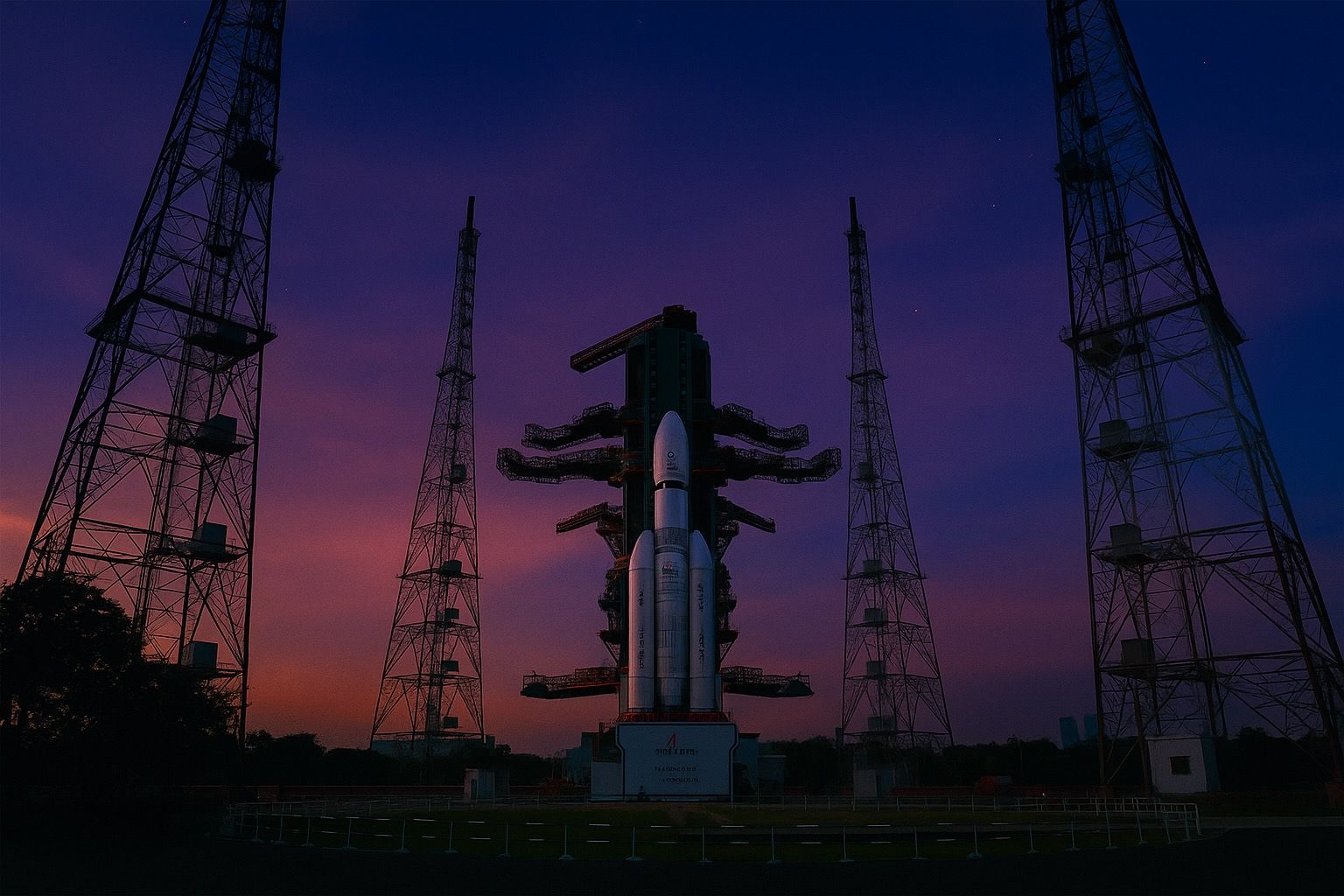

- Launch Date & Vehicle: India’s heavy-lift LVM3-M5 rocket (nicknamed “Bahubali”) is set to liftoff on Nov 2, 2025 at about 5:26 PM IST (11:56 UTC) from Sriharikota, carrying the CMS-03 (GSAT-7R) satellitemoneycontrol.comspace.com. The 43.5-meter-tall LVM3 is India’s most powerful rocket, with a flawless 7/7 launch record to datendtv.commoneycontrol.com.
- Record Weight: CMS-03 is a multiband communications satellite for the Indian Navy. Weighing roughly 4,400–4,410 kg, it will be the heaviest communications satellite ever launched to a geostationary transfer orbit (GTO) from Indian soilmoneycontrol.comtribuneindia.com. (By comparison, ISRO’s heaviest-built satellite was GSAT-11 at 5,854 kg, but that was lofted abroad.)
- Mission & Payload: Also called GSAT-7R, CMS-03 carries state-of-the-art C-, extended C- and Ku-band transponders. It will replace the older GSAT-7 (“Rukmini”) satellite of 2013, providing robust, secure voice, data and video links across the Indian Ocean Region and surrounding landmassgovernment.economictimes.indiatimes.comspace.com. Defence sources note it is “the most advanced communications satellite developed for the Indian Navy to date,” built indigenously to meet specific naval requirementsgovernment.economictimes.indiatimes.comenglish.mathrubhumi.com.
- Strategic Impact: Once deployed (~16 minutes after liftoff), CMS-03 will “provide comprehensive telecommunication coverage across the Indian Ocean Region,” linking ships, submarines, aircraft and shore centers in real timegovernment.economictimes.indiatimes.comgovernment.economictimes.indiatimes.com. In practice this means secure command-and-control over a wide maritime front. During a past operation (“Sindoor”) the predecessor GSAT-7 helped keep adversarial navies at bay through network-centric opsndtv.com, and CMS-03 is expected to greatly enhance such “network-centric” warfare capabilities. As one analyst notes, military SATCOMs like CMS-03 act as “relay stations in orbit, carrying voice, data, and video between far-flung command centers, troops, ships, and aircraft”, ensuring connectivity even under jammingts2.techgovernment.economictimes.indiatimes.com.
- Countdown & Status: ISRO reports that “final preparations [are] complete and all systems are GO” for the liftoffmoneycontrol.com. The rocket and spacecraft were fully assembled on the pad (moved there Oct 26) and have begun the 24-hour countdowntribuneindia.commoneycontrol.com. ISRO will stream live coverage of the launch on its official channels.
Mission Overview
On Nov 2 evening, ISRO will attempt a landmark mission by launching CMS-03 – also known as GSAT-7R – atop its powerful LVM3-M5 launcher. The satellite, dedicated to the Indian Navy, aims to bolster India’s maritime communications and domain awareness. At liftoff, the 43.5 m-tall “Bahubali” rocket will carry CMS-03 into a geostationary transfer orbit (GTO) (about 36,000 km high), from which the spacecraft will later circularize to geostationary orbit. Weighing roughly 9,700 lbs (4,400 kg), CMS-03 will become the heaviest communications satellite launched by an Indian rocketspace.commoneycontrol.com. ISRO itself calls this a record: it will be the first time a satellite over 4 tonnes is put into distant orbit from Indian soil. (Previously ISRO had sent heavier payloads to low Earth orbit, and heavier sats abroad, but not to GTO.)
“The CMS-03 satellite will be injected into a Geosynchronous Transfer Orbit by ISRO’s Launch Vehicle Mark-3 (LVM3),” according to ISRO’s announcements. In practice, once CMS-03 reaches the transfer orbit (~29,970 km apogeeindianexpress.com) it will fire its own engine to reach a circular geostationary orbit ~35,786 km above Earth, hovering over a fixed longitude. As Space.com explains, at that altitude the satellite’s orbital speed matches Earth’s rotation so it can “hover” over one region continuouslyspace.com.
CMS-03 Satellite: Features and Role
CMS-03 is a multi-band military communications satellite built for the Indian Navy. Its payload includes advanced C‑band, extended C‑band and Ku‑band transponders that will handle voice, data and video traffictribuneindia.comenglish.mathrubhumi.com. The Defence Ministry describes GSAT-7R as “the most advanced communication satellite developed for the Indian Navy to date,” and notes it is fully indigenous. Weighing about 4,400 kg, it surpasses all previous Indian commsats in massgovernment.economictimes.indiatimes.commoneycontrol.com.
Engineers designed CMS-03 to vastly expand India’s naval “communication grid.” It will replace GSAT-7 (Rukmini) which since 2013 has provided secure links out to about 2,000 km from the coast. The new satellite’s extra capacity and range will allow global-coverage, high-bandwidth links between warships, submarines, aircraft and shore headquarters. In the words of the Defence Ministry, GSAT-7R’s “sophisticated payload carries multi-band transponders that support high-speed voice, data, and video communication links,” enabling “secure and uninterrupted connectivity between the Navy’s ships, submarines, aircraft, and Maritime Operations Centres”government.economictimes.indiatimes.comgovernment.economictimes.indiatimes.com. In short, it acts as a force multiplier for the Navy’s C3 (command, control, communications) network in the Indian Ocean.
US defense analysts point out that modern militaries rely on satcom as an “information high ground.” Communication satellites “enable secure, long-distance connectivity for military forces across the globe” by relaying signals between far-flung unitsts2.tech. CMS-03, orbiting over the ocean, will ensure that even in contested scenarios India’s navy can remain networked and responsive. One press report notes that Operation Sindoor (India’s 2019 anti-piracy campaign) was enabled by the predecessor GSAT-7, which “helped keep Pakistan’s navy at bay through network centric operations”ndtv.com. With CMS-03’s enhanced bandwidth and coverage, analysts expect an even stronger strategic deterrent.
Launch Vehicle – The LVM3 “Bahubali” Rocket
The LVM3 (Launch Vehicle Mark-3) is a three-stage heavy rocket, colloquially called “Bahubali” for its lifting power. It uses two large solid boosters (S200) strapped to a liquid-fueled core (L110), and a cryogenic upper stage (C25)hindustantimes.commoneycontrol.com. All these stages – from the S200 solids to the cryo stage – are indigenously built by ISRO, reflecting India’s self-reliance. The 43.5‑m rocket stands as India’s tallest and strongest launch vehicle. In fact, NDTV reports that all seven previous LVM3 launches have succeeded (a 100% record)ndtv.com. Notably, LVM3 powered Chandrayaan-3 to the lunar south pole in 2023, making India the first country to land near that regionspace.comndtv.com.
For this mission the variant LVM3-M5 (5th operational flight) has been fully assembled and stacked with CMS-03 atop it. The rocket weighs about 642 tonnes at launch (roughly 150 elephants!)ndtv.com. When flying, it produces enormous thrust: Space.com notes LVM3 can haul ~17,600 lbs (8,000 kg) to low Earth orbitspace.com. (Its geostationary transfer orbit capacity is lower, about 4,000 kg by design; pushing that to 4,400+ kg is a new challenge.) ISRO engineers have upgraded the cryogenic stage to generate more thrust and are studying a semi‑cryogenic second stage (liquid oxygen + kerosene) to boost future capacityindianexpress.comindianexpress.com. In coming years, these improvements aim to raise LVM3’s payload to ~10 tonnes in LEO and eventually pave the way for a new super-heavy launcher (Lunar Module Launch Vehicle) capable of 80 tonnesindianexpress.comindianexpress.com.
Countdown and Live Coverage
As of Nov 1 evening, ISRO confirmed that “all systems are GO” and the final countdown for LVM3-M5/CMS-03 has begunmoneycontrol.com. The rocket has sat on the Second Launch Pad at Sriharikota since Oct 26 undergoing checks and fueling. On launch day, ISRO plans to broadcast live coverage online (including on its YouTube channel), starting about 30 minutes before the 5:26 PM IST liftoffspace.com. Weather and technical teams have given a green signal for Sunday’s window.
If successful, about 16 minutes after ignition LVM3’s final stage will release CMS-03 into the planned transfer orbithindustantimes.com. From there the satellite will raise its own orbit over the next weeks. The mission marks LVM3’s 8th flight and 5th commercial mission, continuing its unbeaten streakmoneycontrol.com. Following liftoff, ISRO and navy officials will monitor the telemetry closely as CMS-03’s solar panels deploy and payloads power on.
Strategic Importance and Expert Views
Defense analysts agree that CMS-03 will be a game-changer for India’s navy. By greatly expanding bandwidth and reach, it will enhance maritime surveillance, force projection and joint operations with air and ground forces. The Ministry of Defence put it succinctly: “In an era of complex security challenges, GSAT-7R symbolises the Indian Navy’s resolve to safeguard the nation’s maritime interests through advanced, indigenously developed technology,” highlighting the satellite’s role in national securityenglish.mathrubhumi.com.
The launch also underscores India’s Aatmanirbhar (self-reliant) defense policy. As an ET Government report notes, GSAT-7R’s all-Indian design and production “reaffirms the Government’s commitment to advancing indigenous space and defence technologies”government.economictimes.indiatimes.com. Once in orbit, GSAT-7R will integrate with India’s existing satellite-based network (including the GPS/NavIC navigation sats and other surveillance sensors) to form a more resilient maritime awareness grid. It will “act as a force multiplier by providing the Navy with real-time situational awareness,” the government notesgovernment.economictimes.indiatimes.com.
From a broader perspective, CMS-03’s mission comes amid a global surge in satellite networking. Commercial constellations like SpaceX’s Starlink have already demonstrated the power of satellite links for remote connectivity, while militaries worldwide rely increasingly on secure SATCOM for command and control. As TechStock² analyst Marcin Frąckiewicz explains, communication satellites essentially function as “orbiting relay stations, carrying voice, data, and video” between dispersed forcests2.tech. India’s leap into heavier commsats shows it is keeping pace.
Looking Ahead: Crew and Beyond
Beyond the immediate mission, CMS-03’s launch ties into India’s future ambitions. ISRO is developing a human-rated version of the LVM3 (LVM3-HRLV) to carry its first astronauts on the Gaganyaan mission (targeted for the coming years)ndtv.com. The experience gained from launching and operating heavy satellites like CMS-03 will feed into that crewed program. Separately, ISRO is advancing new technologies – from semi-cryogenic engines to next-generation cryogenic stages – to further boost payloadsindianexpress.comindianexpress.com.
In summary, Sunday’s launch is not just a one-off event but a milestone in India’s growing space and defense capabilities. It demonstrates India’s heavy-lift prowess and strengthens its naval communications grid, all while paving the way for the ambitious Gaganyaan crewed flight and other future space endeavors. As ISRO itself tweeted, “Final preparations complete and all systems are GO as we move closer to liftoff!”moneycontrol.com.
Sources: Reports from The Hindu, Hindustan Times, The Tribune, NDTV, The Indian Express, Moneycontrol, Mathrubhumi, Space.com and others provided details of the CMS-03 missiontribuneindia.comspace.comndtv.commoneycontrol.com. Official statements (ISRO and Defense Ministry) and tech analyses were also citedgovernment.economictimes.indiatimes.comts2.tech. All figures and quotes are from these sources.
Related articles: Space