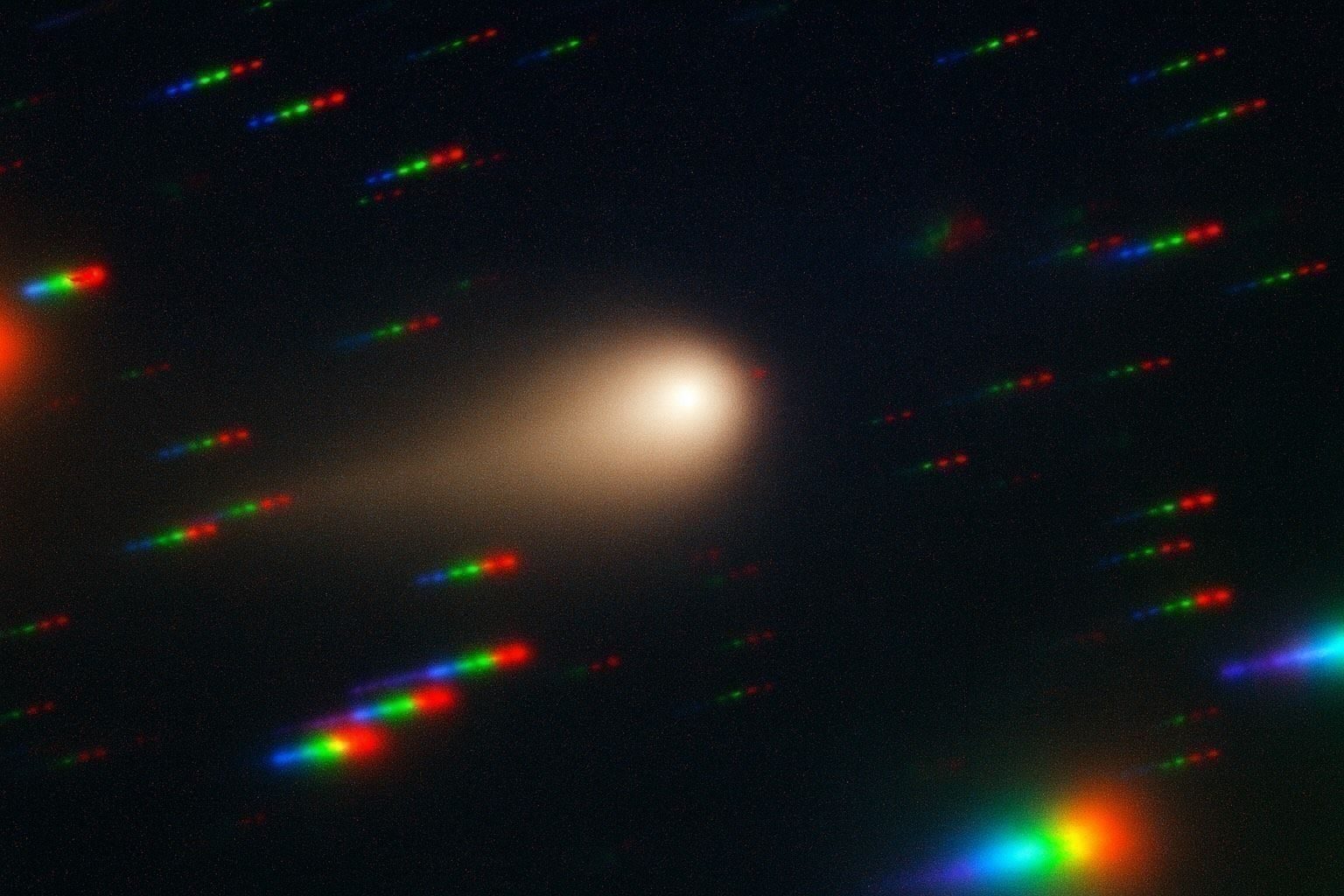

The interstellar comet 3I/ATLAS—also known by its comet designation C/2025 N1 (ATLAS)—is already on its way out of our solar system. But in the final weeks of 2025, it’s still delivering surprises: a rare “anti-tail” that appears to point toward the Sun, jets that wobble with a clock-like rhythm, and a fresh wave of results from some of humanity’s most sensitive searches for unusual signals.
3I/ATLAS is only the third confirmed interstellar object ever observed passing through our celestial neighborhood—after ‘Oumuamua (2017) and 2I/Borisov (2019)—and it’s giving scientists an unprecedented chance to study material forged around another star.
Below is what’s new, what it means, and where this comet is headed next.
What is Comet 3I/ATLAS—and why astronomers won’t stop talking about it
Comet 3I/ATLAS was first reported to the Minor Planet Center on 1 July 2025 by the NASA-funded ATLAS survey telescope in Río Hurtado, Chile. Follow-up work and “pre-discovery” detections pushed the observation timeline earlier—back into mid-June—helping researchers quickly confirm something extraordinary: the comet is traveling on a hyperbolic path, meaning it’s moving too fast to be gravitationally bound to the Sun and is simply passing through. NASA Science+1
NASA emphasizes two core points that matter to everyone, not just astronomers:
- No danger to Earth: even at its closest, 3I/ATLAS remained far away.
- Huge scientific value: interstellar comets are physical samples from beyond our solar system—rare chances to test how other planetary systems build icy bodies.
The comet’s key 2025 milestones are now well established:
- Perihelion (closest to the Sun): around 30 October 2025, at about 1.4 AU (roughly 130 million miles / 210 million km)—just inside Mars’ orbit.
- Closest approach to Earth: 19 December 2025, about 1.8 AU (roughly 170 million miles / 270 million km).
Now, the spotlight is on what scientists learned during the comet’s inbound leg—and what they can still learn as it fades outward.
The biggest late-December headline: wobbling jets in a rare sun-facing “anti-tail”
A tail that points the “wrong” way
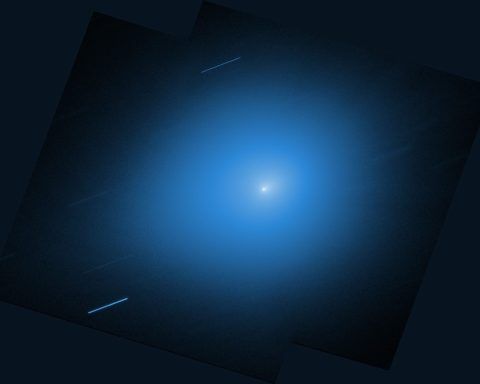
Most comets develop tails that stream away from the Sun, pushed by sunlight and the solar wind. But 3I/ATLAS displayed an anti-tail—a rare feature that can appear to point sunward, often because of viewing geometry and how dust is distributed along the comet’s orbit.
In recent coverage and reporting, the anti-tail of 3I/ATLAS has been described as stretching up to roughly 620,000 miles (about 1 million km) in some observations—an unusually prominent example for such a distant, fast-moving visitor.
The wobble: a repeating rhythm that hints at rotation
The most attention-getting detail isn’t just the anti-tail itself—it’s what researchers saw inside it.
Observations reported in late December describe jet-like structures in the sun-facing tail that shift position over time, “wobbling” with a repeating cycle of about 7 hours and 45 minutes. Interpreting that motion suggests the nucleus rotates on the order of ~15–17 hours (roughly “one full turn” about every 15.5 hours, with some uncertainty depending on jet geometry). Space+2The Indian Express+2
This behavior was drawn from an intensive campaign—37 nights of observation between July and September 2025—using the Two-meter Twin Telescope (TTT) at Spain’s Teide Observatory in Tenerife.
Why that matters scientifically
The important takeaway is not “mystery,” but mechanism.
A periodic wobble points toward a rotating nucleus with localized active regions—patches that vent gas and dust when they rotate into sunlight. That’s familiar territory for solar-system comets, but what makes 3I/ATLAS special is that it’s likely experiencing this kind of solar heating for the first time in our system, offering a direct comparison between “homegrown” comets and an outsider. Instituto de Astrofísica de Canarias+1
The Instituto de Astrofísica de Canarias (IAC) described the object as an “extraordinarily normal interstellar comet,” underscoring that the most valuable discoveries here may be how normal it is—and what “normal comet physics” looks like when the raw material formed around a different star. Instituto de Astrofísica de Canarias
SETI and Breakthrough Listen: the most sensitive “signal check” yet found nothing artificial
Whenever a rare interstellar object appears, public speculation follows. In 2025, that speculation got louder—but what’s striking about the latest reporting is how directly researchers addressed it with data.
On 19 December 2025, the SETI Institute posted a detailed summary of Breakthrough Listen observations of 3I/ATLAS and made the headline conclusion plain: there is currently no evidence that 3I/ATLAS is anything other than a natural astrophysical object, and no technosignatures were detected in their searches.
A related arXiv preprint describes one of the most sensitive targeted checks: on 18 December 2025, Breakthrough Listen used the 100-meter Green Bank Telescope to search at 1–12 GHz, reporting no candidate signals down to about the 100 mW level.
The SETI Institute also notes that in addition to Green Bank, the program has used multiple facilities and methods, including:
- Allen Telescope Array observations within days of discovery (July 2025)
- MeerKAT observations that detected hydroxyl, a natural product expected as sunlight breaks down water-related molecules, alongside technosignature searches
In short: the most comprehensive “is it transmitting?” question has been asked—and, so far, the answer is no.
NASA’s multi-mission “comet watch”: why 3I/ATLAS was observed across the solar system
One reason 3I/ATLAS has generated such a deep scientific record is that it wasn’t watched by just one observatory. NASA has assembled a sweeping list of assets that collected observations of 3I/ATLAS, including Hubble, Webb, TESS, Swift, SPHEREx, and multiple missions operating at Mars and beyond—plus heliophysics spacecraft and joint NASA/ESA assets.
NASA’s 3I/ATLAS overview page also documents how observation windows shifted as the comet moved:
- It remained visible to ground-based telescopes into September 2025
- It then became difficult to observe when it passed too close to the Sun
- It reappeared for renewed observation opportunities in early December 2025
NASA also notes specific mission snapshots along the way—for example, Europa Clipper observed 3I/ATLAS on 6 November from a distance of about 102 million miles, highlighting how interplanetary spacecraft can provide unique geometry compared with Earth-based telescopes.
This “many eyes” approach matters because comets change quickly. If one telescope sees a dust feature at a strange angle, another viewpoint can help separate true structure from optical effects—especially in rare features like anti-tails.
Is Comet 3I/ATLAS visible right now, and is it safe?
Safety: it never came close
Both NASA and ESA have been consistent: 3I/ATLAS posed no threat to Earth and remained extremely distant even at closest approach. ESA notes it was on the other side of the Sun during its closest approach and still around 270 million km away.
Visibility: telescope-only, but still trackable
If you’re hoping for a naked-eye spectacle, this isn’t that kind of comet. NASA says 3I/ATLAS can be observed with a small telescope in the pre-dawn sky and is expected to remain observable until spring 2026 (with brightness and conditions depending heavily on location, light pollution, and equipment).
NASA also points readers to its online “Eyes on the Solar System” tool for tracking the comet’s position and path. NASA Science
What happens next: the outbound journey and a Jupiter pass in March 2026
The “end of 2025” story of 3I/ATLAS is really the beginning of its exit.
NASA’s official FAQ notes that the comet is on course to venture past Jupiter in March 2026 on its way out of the solar system.
Meanwhile, mainstream coverage from The Associated Press adds detail on the scale of that encounter, reporting that 3I/ATLAS is expected to come significantly closer to Jupiter than it did to Earth—on the order of tens of millions of miles.
That upcoming geometry matters for two reasons:
- Science opportunity: Jupiter’s neighborhood may offer new observing angles and potential spacecraft vantage points.
- A clean finale: With each week outbound, the comet fades and becomes harder to study; Jupiter represents one of the last major “checkpoints” while it’s still within reach of powerful instruments.
The bottom line on 3I/ATLAS in late December 2025
In the final stretch of 2025, Comet 3I/ATLAS is delivering a rare combination: headline-worthy visuals (a sun-facing anti-tail), measurable physical behavior (wobbling jets tied to rotation), and hard constraints against extraordinary claims (deep technosignature searches with no detections).
The most important thing about 3I/ATLAS may not be that it’s strange—but that it’s a mostly “normal” comet, built somewhere else, reacting to our Sun in ways that let scientists compare planetary systems across the galaxy. Instituto de Astrofísica de Canarias+2NASA…
Related articles: Space Exploration