
LONDON, May 7, 2026, 10:18 BST
- HSBC shares held their ground in London, following a strong bounce on Wednesday.
- Investors are juggling a $400 million fraud-related charge with the company’s raised income outlook.
- The losses have put a spotlight on banks’ connections to private credit, a lending sector ballooning quickly beyond the boundaries of conventional banking.
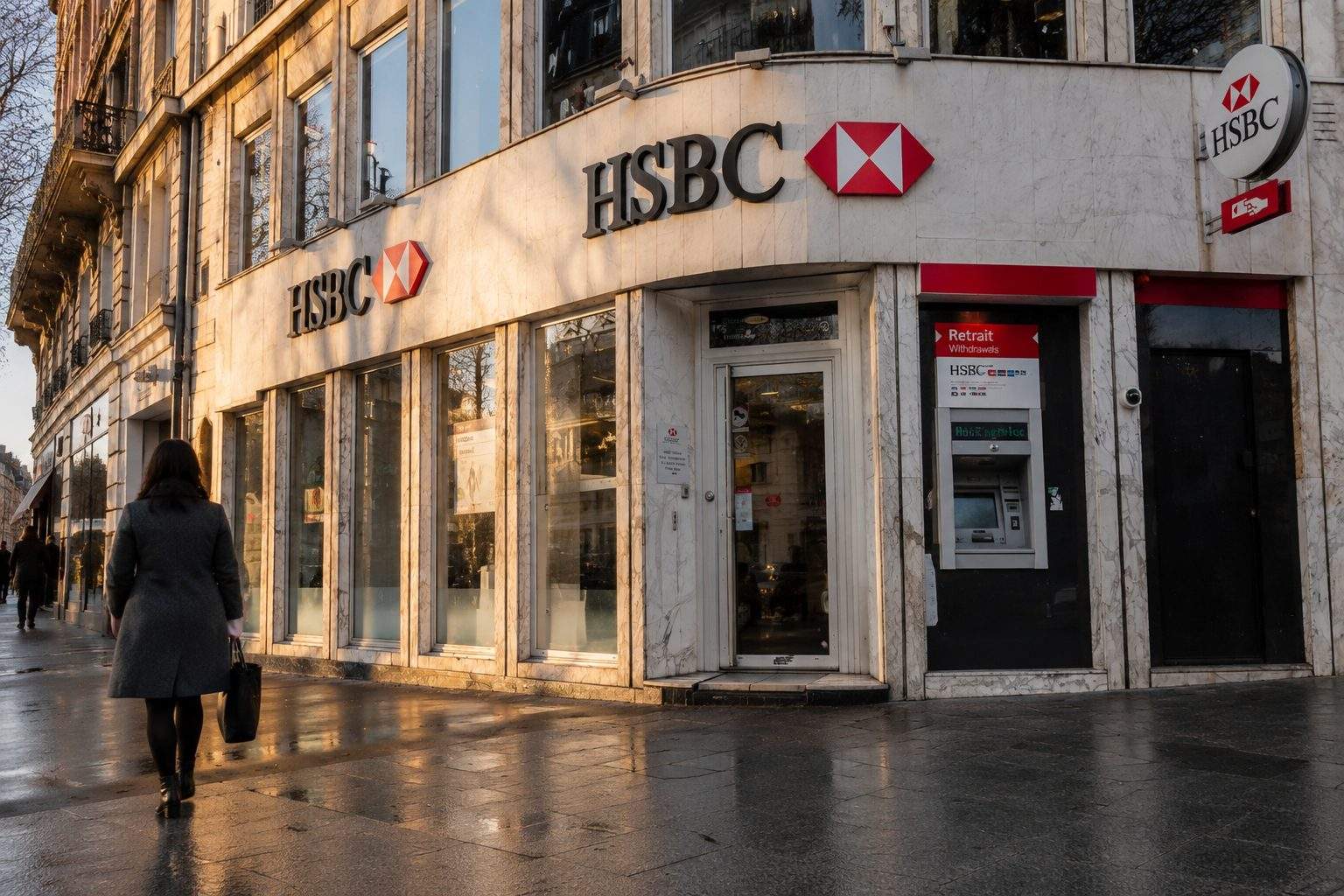
HSBC Holdings shares hovered near flat in London on Thursday, the stock steady after clawing back much of its losses tied to a $400 million private-credit-linked hit that earlier sliced nearly 6% off its value. Around mid-morning, shares traded at about 1,343 pence, right by Wednesday’s close of 1,343.40 pence, which had marked a 4.97% rebound.
This isn’t some minor blip—HSBC, Europe’s biggest bank by market value, just watched its stock give back part of a 52% rally over the last year after Tuesday’s drop. All it took was one charge linked to a failed UK mortgage lender to put a spotlight on how thoroughly large banks grasp their indirect risks in private credit, those loans sitting outside the usual bank channels.
Concerns ramped up on Wednesday after the Financial Stability Board flagged risks tied to private credit’s growing web with banks, insurers and asset managers. “Deepening interconnections,” was how FSB Secretary General John Schindler put it. As for FSB Chair Andrew Bailey, he described the indirect ties as “extensive.” Reuters
HSBC’s first-quarter pretax profit landed at $9.4 billion, slipping $0.1 billion from the same period last year and missing the $9.59 billion consensus the bank had gathered. Revenue, however, came in at $18.6 billion—a 6% lift—boosted by wealth-related fees and stronger net interest income from banking. Expected credit losses ticked up to $1.3 billion.
The credit charge, according to the bank, factored in a $0.4 billion fraud-related hit on a secondary securitisation exposure involving a UK financial sponsor, along with a $0.3 billion allowance linked to ongoing uncertainty stemming from the Middle East conflict. Securitisation refers to bundling loans or assets into tradable securities; a secondary exposure here indicates HSBC wasn’t the original lender to the underlying borrower.
Pam Kaur, HSBC’s Chief Financial Officer, told analysts the fraud-related charge was “idiosyncratic” and didn’t reflect broader issues in the bank’s portfolio. After reviewing the riskiest exposures, she said, HSBC found no similar fraud problems and is now stepping up its due diligence. HSBC
Reuters said the loss stemmed from HSBC’s loans to Atlas SP, which is backed by Apollo, and from its financing of Market Financial Solutions—a UK mortgage lender that went into administration following fraud claims. HSBC kept the firms’ names under wraps; Kaur told reporters only that the exposure was tied to “private credit-related loans.” Reuters
Apollo said Wednesday it will start giving daily pricing on its credit funds by late September, with Chief Executive Marc Rowan describing the shift as aimed at increasing transparency. The firm also reported a loss in its asset-backed finance portfolio, pointing to a weaker contribution from Atlas SP—Atlas had previously financed Market Financial Solutions.
Competitive signals were all over the map. Barclays had already taken a £228 million hit tied to MFS. Over at Standard Chartered, wealth income jumped 32% in Q1, outpacing HSBC’s reported wealth revenue growth, according to Citi analysts. For KBW’s Ed Firth, HSBC’s numbers came off as underwhelming versus other British and European banks.
HSBC tossed investors a bone by bumping up its 2026 banking net interest income target to about $46 billion, up from the previous floor of $45 billion. The bank pointed to a better interest-rate environment for the move, and also cleared a first interim dividend at $0.10 a share. Net interest income—what banks pocket from loans and securities after covering the cost of deposits and funding—remains a closely watched metric.
HSBC’s Group Chief Executive Georges Elhedery pointed to ongoing progress toward what he called “a simple, more agile, growing HSBC,” highlighting that all four business units posted annualised return on tangible equity above 17%, not counting notable items. Return on tangible equity strips out intangible assets when measuring profit against shareholder capital. HSBC
The rebound looks shaky. HSBC bumped its 2026 expected credit loss estimate up to about 45 basis points on average gross loans, compared with its earlier 40 basis point forecast. Kaur pointed out the bank is holding extra reserves this year, citing the Middle East conflict and the unsettled Hong Kong commercial property market. One basis point equals one-hundredth of a percentage point.
Right now, the question for HSBC isn’t simply if it hit its quarterly target. Investors are weighing whether that $400 million charge reflects a one-off misstep—or if it points to deeper, less visible trouble brewing in private credit.
Related articles: Stock Market