NEW YORK, July 14, 2026, 16:10 EDT
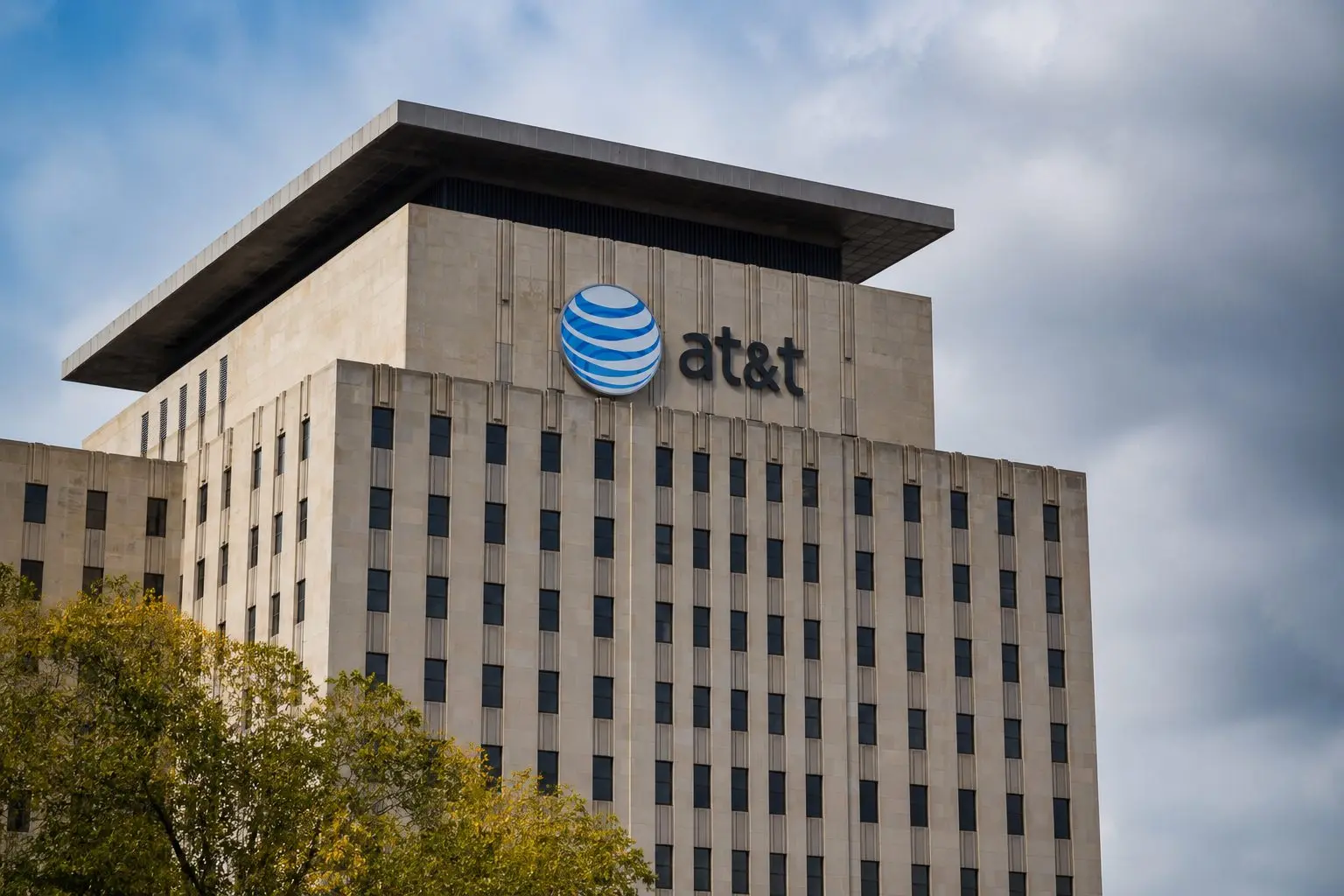
AT&T Inc. NYSE:T closed at $21.30 Tuesday. Shares are up 0.8% over two days, even as Bernstein cut its price target 17% on Starlink risks. The company has a market cap close to $150 billion. AT&T’s latest outlook calls for at least $18 billion in free cash flow in 2026, which works out to about a 12% free-cash-flow yield and covers the current dividend around 2.3 times. Most of that is from the discount.
AT&T saw nearly all of its outperformance on Monday, jumping 2.0% as the S&P 500 dropped 0.8%. On Tuesday, shares dipped 1.2% while the benchmark index gained 0.4%. Between Friday’s close and Tuesday, Verizon Communications Inc. NYSE:VZ added 0.5%. T-Mobile US Inc. NASDAQ:TMUS fell 0.2%, and the S&P 500 declined 0.4% over the same stretch. The relative strength in telecom wasn’t even. MarketWatch
| From July 10 close to July 14 close | Return |
|---|---|
| AT&T | up 0.8% |
| Verizon | up 0.5% |
| T-Mobile US | down 0.2% |
| S&P 500 | down 0.4% |
AT&T is set to report second-quarter earnings on July 22. On Monday, Bernstein’s Laurent Yoon dropped his price target to $25 from $30 but kept his Outperform rating — that target is still 17% above where AT&T closed Tuesday. Yoon wrote that Space Exploration Technologies Corp. NASDAQ:SPCX’s Starlink is another player in a broadband market that’s already packed, but he sees AT&T as the least exposed big carrier since it relies more heavily on fiber for internet. The market is making a distinction between current cash flow and future threats.
Look at valuation and the difference is clear. AT&T goes for roughly 7.1 times trailing earnings, putting it 31% below Verizon and 64% under T-Mobile on that metric. The 5.2% yield lands in the middle. Investors give AT&T less slack on price.
| Latest quoted valuation | AT&T | Verizon | T-Mobile US |
|---|---|---|---|
| Trailing price/earnings | 7.1x | 10.4x | 19.9x |
| Dividend yield | 5.2% | 6.7% | 2.2% |
The short-term story is about carrier pricing. AT&T is raising rates on some retired unlimited plans, adding $10 a month for single-line users and $20 per account for customers with more than one line. Some subscribers saw the hike in April, while others get hit in August. A market note out Monday called the change a follow-up to price bumps at Verizon and T-Mobile, quoting analysts who called it “a further signal that wireless competition could be moderating.” The real test is price. AT&T
AT&T’s first quarter numbers put it in position to try out pricing moves. The company picked up 294,000 postpaid phone customers and 584,000 new high-speed internet connections. Revenue went up 2.9% to $31.5 billion. Adjusted EPS rose to $0.57 from $0.51. CEO John Stankey said it was “our best first quarter ever” for new internet customers. The network is pulling in more users.
Cash has not kept up with the customer numbers. Free cash flow for the first quarter came in at $2.5 billion, down from $3.1 billion, as capital investment climbed. With 6.95 billion shares, the $1.11 dividend means about $7.7 billion in payouts. AT&T’s full-year target would leave about $10.3 billion before $8 billion in planned buybacks and other uses. The math works, but it isn’t a lock.
Satellite risk isn’t a universal call on Wall Street. Morgan Stanley’s Sean Diffley wrote last week that the market thinks Starlink is a bigger short-term risk to U.S. wireless than it really is in the next year or two, even though he lowered AT&T’s target price to $25 from $30. The risk is there in valuations, not yet in company numbers.
The story can flip fast. Bigger bills may push customers to switch, and another big fiber build could slow down the cash bounce. AT&T finished March sitting on $126.4 billion in debt after cash. Starlink doesn’t have to take the city wireless market to squeeze rural broadband or drive up acquisition costs. Maybe AT&T’s discount is warranted.
AT&T’s report next week matters for two things: whether higher prices help boost service revenue without hurting customer gains, and if free cash flow starts tracking with its latest investment push. The stock at $21.30 throws off a 5.2% dividend, but the 12% cash yield suggests investors aren’t sure of the trajectory. The Street wants to see evidence.
Related articles: NYSE:T