S&P 500 Sees Modest Gain Despite Oil’s 7.5% Drop Amid Ongoing Fed Rate Concerns
28 July 2026
2 mins read

S&P 500 Sees Modest Gain Despite Oil’s 7.5% Drop Amid Ongoing Fed Rate Concerns

NEW YORK, July 27, 2026, 19:19 EDT — U.S. cash equities finished trading.

  • WTI closed at $82.61, a decline of 7.5%. The S&P 500 finished 0.02% higher.
  • Chances of a Fed rate increase climbed to 38%, compared to about 10% two weeks ago.
  • The chip index dropped 2.2% and now stands 21% beneath its June peak.

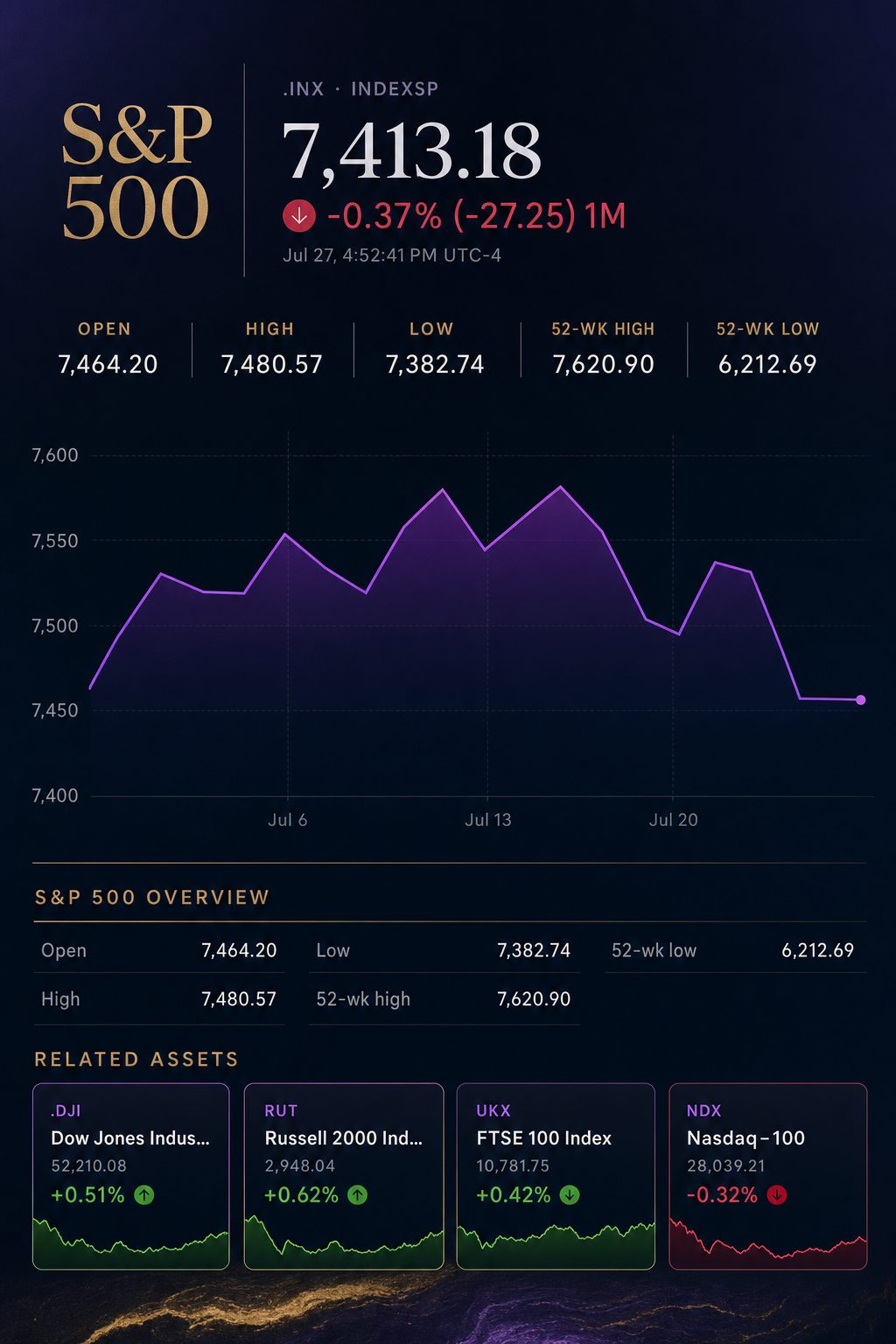
The S&P 500 edged up 0.02% on Monday, while U.S. crude slumped 7.5%. The yield on the 10-year Treasury slipped four basis points. The drop in oil prices provided little boost to risk assets.

Fed funds futures closed suggesting a 38% probability of a 25-basis-point increase on Wednesday, up 28 percentage points from about 10% two weeks prior. The likelihood has almost quadrupled.
S&P 500 Sees Modest Gain Despite Oil’s 7.5% Drop Amid Ongoing Fed Rate Concerns
IndicatorMonday close or settlementEarlier comparison
S&P 5007,413.18; up 0.02%fell 0.6% over the past week
Nasdaq Composite24,932.08; down 0.18%declined 2.0% over the last week
WTI crude, September$82.61; down 7.5%climbed 9.2% last week
10-year Treasury yield4.65%4.69% at the Friday close
July Fed hike probability38%Roughly 10% two weeks prior

The previous week created the setup. The S&P 500 declined by 0.6%, and the Nasdaq Composite dropped 2.0%. WTI climbed 9.2%, with Brent momentarily surpassing $100.

Crude oil’s rally was undone on Monday, yet the broader inflation premium held firm. The yield on the 10-year ended close to 4.65%, compared to 4.69% on Friday. The modest decline suggested investors remain skeptical about a sustained drop in oil prices.

Bloomberg said on Monday that Citadel Securities anticipates a Federal Reserve rate increase this week. Frank Flight, who leads macro strategy at the company, previously stated that markets are “underpricing the probability of a July hike.” An increase of a quarter-point would set the target range at 3.75%-4.00%. Yahoo Finance

The Federal Reserve unanimously kept its target range at 3.50%-3.75% in June. It stated inflation was still high and pledged to “deliver price stability.” Flight argues that an energy shock may persist even as oil prices decline. Federal Reserve

The majority of major brokerages continue to anticipate no rate change on Wednesday, maintaining that central banks ought to disregard short-term energy price surges. Ex-Minneapolis Fed President Narayana Kocherlakota described Warsh as “studiously uncommunicative” regarding potential policy actions. Reuters

The disconnect has produced a binary outcome in the market. With 38% of positions exposed, either direction leaves a significant segment on the wrong side. GDP and core PCE data due Thursday will redefine the interest rate outlook.

Technology shares provided the next drag. The PHLX semiconductor index declined by 2.2%, deepening its drop to 21% since the June 22 high, though it is still 63% higher since the start of the year.

Nvidia Corp. dropped 5%, as Microsoft Corp. rose 1.9%. The divergence indicates that investors are distinguishing between demand for AI and risks associated with AI funding.

Analysts project that S&P 500 earnings will climb 39% in the second quarter compared with the same period last year. Much of the increase is attributed to stocks related to artificial intelligence. The index is currently valued at about 20 times its expected future earnings.

Microsoft and Meta Platforms Inc. are scheduled to release results on Wednesday. Amazon.com Inc. and Apple Inc. will report later in the week. Investors will watch capital-spending guidance as closely as earnings.

Risks exist on both sides. Fresh hostilities between the U.S. and Iran may push oil prices higher again and boost inflation expectations. Conversely, if the Fed keeps rates steady and incoming PCE data comes in weaker, investors’ hawkish outlooks could be tempered.

The investor test now extends beyond oil. Monday demonstrated that lower oil prices are not enough to support equities while uncertainty over rates and AI expenditure continues. Wednesday will reveal if this gap continues.

What is the Federal Reserve’s present rate, and when will the decision be announced?

The target range for federal funds stands at 3.50% to 3.75%. Policymakers held that range steady during their June meeting. The next FOMC gathering is set for July 28 and July 29. The statement is due at 2:00 p.m. Eastern Time on Wednesday. Chair Kevin Warsh will hold a press conference 30 minutes after the release. Federal Reserve

Is a rate increase the most probable decision this week?

Keeping rates unchanged is still considered most likely. On Monday, futures priced in a 38% chance of a 25 basis point increase, leaving a 62% chance of no adjustment. In a July Reuters poll, all 104 economists predicted rates would be kept on hold, though the poll was conducted before the market was repriced by the latest jump in oil prices. Reuters

Why might the Fed raise rates even as June inflation eased?

Consumer prices declined 0.4% in June, with core prices staying level compared to May. Annual inflation held at 3.5% overall and 2.6% when excluding food and energy. A 5.7% drop in energy prices contributed most to the monthly decrease, though energy costs remained up 15.7% from a year ago. A single subdued month may not resolve the broader inflation discussion. Bureau of Labor Statistics

What is the reason for the limited discussion around an interest-rate cut?

The Federal Reserve’s preferred PCE price index advanced 4.1% on an annual basis in May. Core PCE climbed 3.4%, remaining well above the central bank’s 2% target. Unemployment in June was 4.2%, not indicating a recession. Only six economists surveyed by Reuters anticipated a rate cut in 2026. A cut in July would be highly unexpected. Bureau of Economic Analysis

Is there enough strength in the labor market to justify holding rates steady?

Largely yes, though data is varied. Employers created 57,000 jobs in June. The jobless rate stood at 4.2%. Payroll increases for April and May were revised down by a total of 74,000. Average hourly wages rose 3.5% over the past year. These indicators suggest a wait-and-see approach rather than an immediate shift in policy. Bureau of Labor Statistics

What has made oil the biggest factor affecting rates this week?

Brent crude surpassed $100 last week, sparking fresh concerns about inflation. However, it retreated by around 8% to near $89 on Monday. U.S. crude also slid 8.21% to $81.98 in that session. Treasury yields moved lower as inflation worries abated in the short term. The outlook remains uncertain. A flare-up in fighting could rapidly revive expectations for rate hikes. Reuters

What are Treasury yields indicating regarding the outlook for future rates?

The 10-year Treasury yield hovered close to 4.649% on Monday, around three basis points lower than Friday. On Thursday, it climbed to 4.71%, its highest mark since January 2025. The two-year yield recently reached 4.37%, a level not seen since February 2025. Policy rate futures indicate a possible peak of about 4.23% next June. An unexpected rate rise would likely have the greatest impact on prices of short-term Treasuries. Reuters

What might be the impact on the S&P 500 and Nasdaq?

The S&P 500 ended Monday at 7,413.18, edging up by just 0.02%. The Nasdaq Composite fell by 0.18%, while the Dow advanced 0.51%. An unexpected increase would push up discount rates applied to earnings from growth companies. Technology stocks would likely be affected first. If rates stay unchanged, tech shares could benefit, but market moves might be driven by earnings releases. About one-third of S&P 500 firms are set to announce earnings this week. Reuters

What economic releases might shift the market’s response from Wednesday?

Key follow-up data is set for Thursday, July 30, at 8:30 a.m. Eastern, when the government releases both second-quarter GDP and June PCE inflation figures. The first-quarter GDP posted a revised 2.1% annualized gain. May’s headline PCE inflation stood at 4.1%, with core PCE at 3.4%. Robust growth and continued inflation would likely fuel further-hike expectations, while softer numbers could reverse Wednesday’s market trends quickly. Bureau of Economic Analysis

What are the market expectations following the July meeting?

Forecasts remain sharply split. Of 104 economists surveyed by Reuters, 78 predict rates will stay steady until the end of the year. On Monday, futures pricing implied an 83% chance of a rate hike by September. Bank of America projects three rate increases starting in September, while Deutsche Bank expects two hikes. Most leading brokerages continue to anticipate unchanged policy through 2026. Reuters

Leokadia Głogulska is a financial and technology journalist at TS2.tech, covering stocks, artificial intelligence, space technology and global market developments. She graduated from Wrocław University of Economics and Business and previously worked in financial analysis before moving into business journalism. Her reporting focuses on helping readers understand the market trends, companies and technologies shaping the global economy.

Stock Market Today

Australia Stock Market Today: ASX 200’s Six-Day Slide Deepens as Oil Shock Puts RBA in Focus
Previous Story

ASX 200 Prepares for CPI, Tech Challenges After Oil-Led Rally

Archer Aviation (NYSE:ACHR) Up 7% on Week as Defense Contract Priced Orders Remain Pending
Next Story

Archer Aviation Retains Roughly $390 Million in Estimated Gains After U.S. Session Closes Ahead of Q2