Boeing (NYSE:BA) Shares Climb as Cash Flow Outlook Counters Increased Loss
28 July 2026
2 mins read

Boeing (NYSE:BA) Shares Climb as Cash Flow Outlook Counters Increased Loss

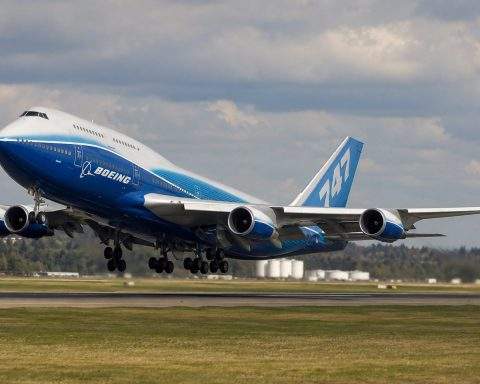
NEW YORK, July 28, 2026, 10:04 EDT – Boeing shares advanced after the company reported guidance for positive cash flow, helping to overshadow a larger-than-expected quarterly loss.

  • Boeing rose 3.4% to $218.65 during early trading in the U.S.
  • Boeing posted $631 million in free cash flow for the second quarter, compared with a $200 million outflow in the same period a year ago.
  • Boeing requires between $1.823 billion and $3.823 billion in cash flow during the second half to achieve its 2026 target.

Shares of c rose 3.4% to $218.65 following the market open on Tuesday. At 9:49 a.m. EDT, the stock was trading close to its session peak of $218.75.

The rise occurred even though the non-GAAP core loss was wider than anticipated. Market participants shifted their attention to $631 million in free cash flow. Boeing calculates this metric as operating cash flow minus capital expenditures.
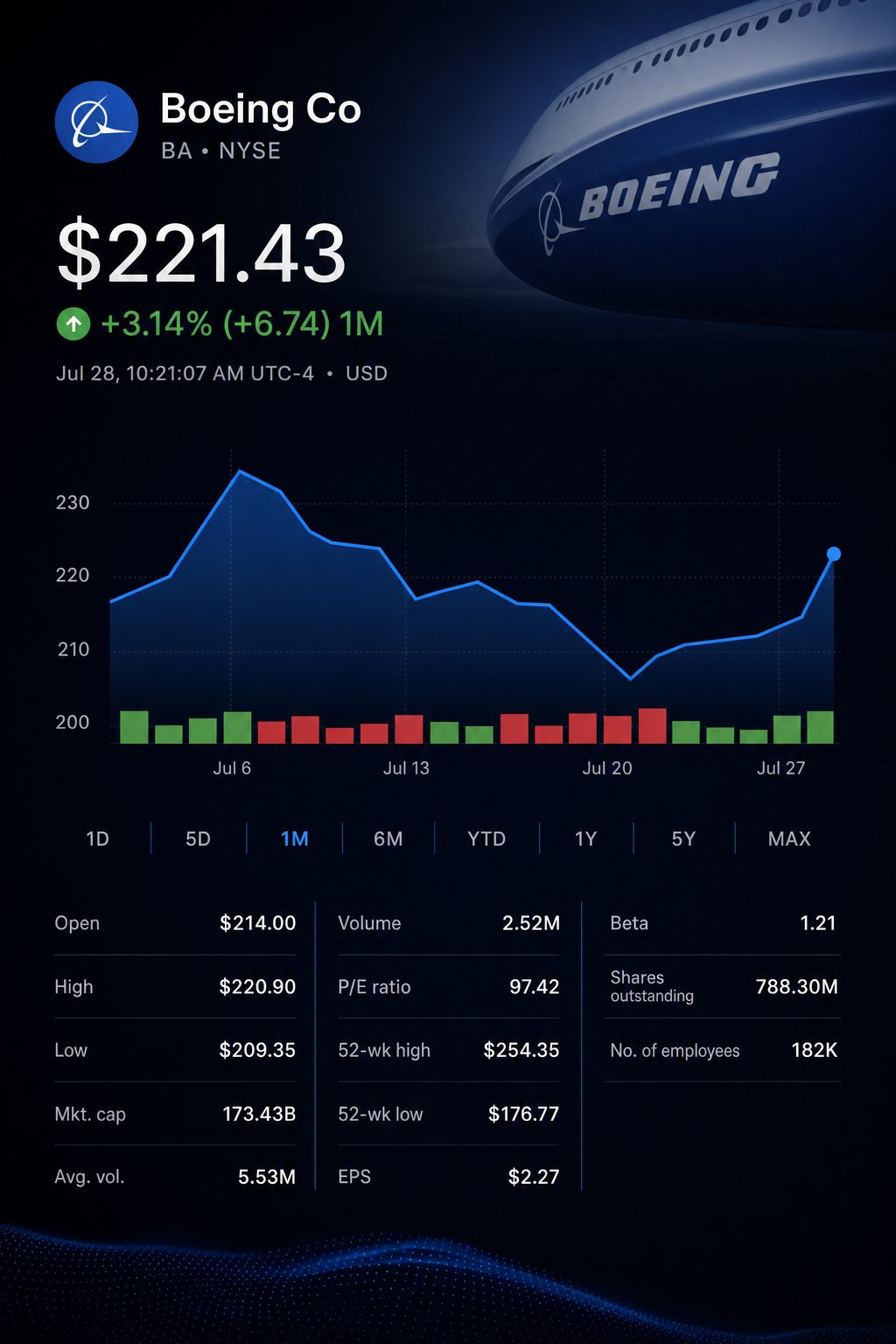
Stock chart for NYSE:BA

The cash recovery exists, though it is not yet full. Free cash flow for the first half was still negative at $823 million. Boeing continues to predict positive free cash flow between $1 billion and $3 billion in 2026.

The data suggests that Boeing faces a challenging second half, requiring between $1.823 billion and $3.823 billion in the last six months. The midpoint target stands at roughly $1.412 billion per quarter.

The quarterly midpoint stands at 2.2 times the result from the second quarter. As a result, the stock’s response signals advancement instead of full completion of the turnaround.

MeasureQ2 2026Q2 2025Change
Revenue$24.56 billion$22.75 billionup 8%
Commercial deliveries171150increase of 14%
Commercial Airplanes margin-2.7%-5.1%improved by 2.4 points
Free cash flow$631 million-$200 millionrise of $831 million
Core loss per share$0.76$1.24loss narrowed by $0.48

Source: Boeing Q2 financials and investor presentation.

The Commercial Airplanes division provides the most direct path to reaching the cash objective. Jet deliveries climbed 14% to 171 units. Revenue for the segment went up by $877 million, and its operating loss decreased by $235 million.

A straightforward analysis shows a 27% incremental operating margin on the additional revenue. Still, the division posted a loss of $322 million. Its reported margin stayed at negative 2.7%.

Output has increased, with Boeing shifting 737 production to a rate of 47 jets per month. The company also launched low-rate manufacturing on the new Everett assembly line in July.

Progress was also made on certification efforts. The 737-7 and 737-10 models have finished flight testing. Boeing maintains its forecast for certification in 2026 and initial deliveries the following year.

Chief Executive Kelly Ortberg said, “Our operations are more stable and key certification programs remain on plan.” He noted that additional work is needed in the second half. Boeing Investors

Gains in the commercial business were partially countered by defense activities. Boeing took a $280 million charge related to delays in its VC-25B presidential jet project, which resulted in a reported margin of minus 0.2% for the division.

Without factoring in that charge, Boeing reported a non-GAAP defense margin of 3.54%. The difference highlights the substantial impact a single fixed-price contract can have on quarterly results.

Boeing disclosed a core loss of 76 cents per share, exceeding the 30-cent loss anticipated by analysts polled by LSEG. The company’s net loss narrowed to $428 million from $612 million, as revenue climbed 8%.

The backlog saw further gains, climbing to an all-time high of $715 billion, compared with $695 billion at the close of the first quarter. Of this, $597 billion was attributed to commercial aircraft.

The balance sheet showed less dramatic changes. Total debt decreased by $1.3 billion, reaching $45.9 billion. Cash and marketable securities dropped by $900 million to $20 billion. This led to a net debt reduction of roughly $400 million, bringing it to $25.9 billion.

Risks persist. The cost of the presidential aircraft highlights that defense cost overruns can offset commercial profits. In a separate development, the FAA suggested new inspections for 453 Boeing 737 MAX jets registered in the U.S. The agency stated that some seats may have been installed incorrectly, potentially causing them to detach or block exits during an evacuation. The recommendation remains under consideration and has not yet been finalized.

The initial climb in shares points to investors prioritising cash over quarterly earnings. Boeing attributed its second-quarter results to positive working capital timing. Maintaining that cash with increased deliveries is seen as the key challenge for the rest of the year.

What is driving Boeing shares higher even though losses exceeded forecasts?

Boeing shares traded close to $219.21 at 9:49 a.m. ET on July 28, gaining 3.6%. The session saw an unusually wide intraday range from $204.40 to $219.21. The stock’s movement indicates investor preference for improving cash flow and higher commercial deliveries. Given the volatility, the initial read on sentiment is still tentative. Boeing Investors

Did Boeing outperform Wall Street forecasts in its second-quarter results?

Boeing posted revenue of $24.56 billion, marking an 8% rise from a year earlier. The company reported a core loss of $0.76 per share, missing analyst forecasts for a $0.30 loss. GAAP net loss reduced to $428 million, compared with $612 million previously. Operating profit came in at $156 million, turning around a prior operating loss of $176 million. Results were weighed down by a fresh charge related to a defense program. Boeing Investors

Is Boeing still on track to reach its free-cash-flow target in 2026?

Boeing left its $1 billion to $3 billion annual guidance unchanged. Free cash flow for the second quarter jumped, turning positive at $631 million. In contrast, free cash flow for the first half of the year was still negative $823 million. This leaves Boeing needing to generate about $1.8 billion to $3.8 billion in the second half. The quarter was aided by changes in working-capital timing and higher customer payments. As a result, second-quarter performance should not be viewed as a baseline going forward. Boeing Investors

Is Boeing’s 737 MAX production increase finally progressing as planned?

Boeing’s 737 program began moving toward a monthly rate of 47 jets in Q2. The company also initiated low-rate output at Everett’s new North Line facility. Executives aim to maintain stable production at 47 before targeting a shift to 52 per month. No official timeline has been set for this next increase. Maintaining stability and ongoing FAA scrutiny are the key operational challenges. Boeing Investors

Is the pace of commercial-aircraft deliveries rebounding sufficiently fast?

Boeing handed over 171 aircraft in Q2, representing a 14% increase from a year earlier. For the first six months, deliveries totaled 314, marking Boeing’s best performance since 2018. Airbus delivered 351 jets, putting Boeing 37 units behind. June’s tally featured 42 MAX jets and 13 Dreamliners. Boeing’s wider cash recovery continues to depend on ramped-up output in the second half. Boeing Investors

Which certification decisions could impact Boeing shares in the near term?

Boeing has finished certification flight tests for the 737-7 and 737-10 jets. The company maintains that it will secure certification for both models within calendar 2026. Initial deliveries of these variants are now scheduled for 2027. The 777X has advanced into a new stage of FAA certification testing. First delivery for this model is also aimed for 2027, though regulators ultimately decide the timing. Boeing Investors

How significant are the losses from Boeing’s defense programs?

Defense revenue increased by 13%, reaching $7.48 billion in the quarter. Despite the gain, the segment reported an operating loss of $15 million. A $280 million charge tied to the VC-25B program offset much of the growth. The Air Force One contract, worth $3.9 billion, is now four years behind schedule. According to Reuters, the project has exceeded its budget by more than $1 billion. Under fixed-price contract terms, Boeing is responsible for most of the extra costs. Boeing Investors

Is Boeing’s balance sheet recovering at a sufficient pace?

Consolidated debt decreased to $45.9 billion from $47.2 billion on a sequential basis. Cash and marketable securities were also down sequentially to $20.0 billion. Calculated net debt stands at about $25.9 billion. Boeing continues to have access to $10 billion in undrawn credit facilities. Quarterly interest expenses remained high, reaching roughly $600 million. Liquidity appears sufficient, but the company’s leverage continues to be a significant financial limitation. Boeing Investors

Is Boeing’s order backlog sufficient to support optimism about future revenue growth?

Backlog at quarter’s end stood at a record $715 billion for the company. Commercial backlog totaled $597 billion, with more than 6,200 airplanes included. Boeing recorded 246 net commercial orders for the quarter. The total backlog rose by $20 billion compared to Q1. However, the rate at which backlog is converted remains slow, and it continues to face risks from possible customer cancellations. Boeing Investors

Is Boeing likely to be materially impacted by the latest FAA seat inspection?

The FAA’s proposed directive applies to 453 U.S.-registered 737 MAX jets. Inspections could be needed on up to 69 seat assemblies per aircraft. The agency estimates the total inspection cost for operators at about $2.66 million. Compared to Boeing’s quarterly revenue, that sum is minor. Some expenses might be covered by warranty, so Boeing’s exact liability is unclear. The broader concern for investors is the renewed focus on Boeing’s production quality. federalregister.gov

Khadija Saeed is a financial markets reporter at TS2.tech, specializing in stocks, technology and emerging industries. She studied economics and finance at the London School of Economics and previously worked in market research before moving into financial journalism. Her coverage focuses on the companies, innovations and economic trends influencing global investors. Follow Khadija Saeed on Google News.

Google Preferred Source

TS2 TECH • DAILY MODEL PORTFOLIO

Stocks to Buy Today

Five stocks stand out, supported by recent earnings or more attractive entry points. Today's selection highlights companies raising their outlooks and reporting firm orders, rather than focusing on heavily traded chipmakers.

Today’s market stance Selective • earnings-led
#1 • HIGHEST CONVICTION 24% weight

Xylem

NYSE: XYL
STRONG BUY
Model score 92 / 100
★★★★★

A 12-cent earnings beat and raised 2026 profit outlook highlight the results, while quarterly revenue matched expectations. The water treatment segment offers AI infrastructure exposure without increasing semiconductor holdings.

Why today

Earnings per share surpassed expectations; the company raised its guidance, citing increased water demand from data centers.

Next catalyst

Order conversions are being monitored to confirm that the new margin level is sustainable.

Main risk: Annual revenue guidance moved to about $9.2bn, and project timing can shift.
#2 • BEST CONTRARIAN 22% weight

Alphabet

NASDAQ: GOOGL
BUY ON WEAKNESS
Model score 89 / 100
★★★★½

Google Cloud's revenue surged 82%, with its operating margin hitting 35.6%. However, shares declined as capital expenditures increased. The reset offers a better entry point, but exposure remains limited since quarterly free cash flow moved into negative territory.

Why today

Cloud segment outperformed expectations; company reset guidance following earnings; search operations continue to drive strong cash flow.

Next catalyst

Cloud backlog is being converted more efficiently, leading to improved alignment between expenditures and cash flow.

Main risk: 2026 capex is now $195bn to $205bn, while depreciation is rising.
#3 • DEFENSIVE GROWTH 20% weight

Unilever

LON: ULVR • NYSE: UL
BUY ON PULLBACKS
Model score 87 / 100
★★★★☆

Underlying sales increased by 5.8%, driven by a 5.5% rise in volume—the company's strongest volume growth in over ten years. Guidance has been raised, but after today's significant share price jump, a gradual approach to buying may be more prudent.

Why today

Strong volumes drive results; outlook raised; steady cash flow in low-beta environment

Next catalyst

Second-half pricing trends and updates on the Foods transaction.

Main risk: Commodity inflation, currency moves and a large one-day gap.
#4 • EARNINGS MOMENTUM 18% weight

Sherwin-Williams

NYSE: SHW
ACCUMULATE
Model score 84 / 100
★★★★☆

Sales and adjusted earnings surpassed expectations, prompting management to raise its full-year guidance. The company is benefiting from higher prices and increased market share, but the stock's rapid three-day rally suggests investors may want to hold off on buying at the open.

Why today

The company beat expectations, raised its outlook, demonstrated strong pricing power, and continued to gain market share.

Next catalyst

The company is targeting adjusted EPS between $11.80 and $12.20.

Main risk: Weak housing demand, raw-material inflation and a richer entry.
#5 • TACTICAL UPSIDE 16% weight

PayPal

NASDAQ: PYPL
TACTICAL BUY
Model score 81 / 100
★★★★☆

Adjusted earnings surpassed expectations, prompting an increase in full-year profit guidance. The reported $60.50 per share approach offers added flexibility, though its smaller weighting signals lower margins and uncertainty regarding a potential deal.

Why today

Earnings surpass forecasts; guidance raised; strategic options under review.

Next catalyst

Focus is on the $400 million cost program, margin trends, and any official response to the deal.

Main risk: Operating margin fell to 17.4%, and no sale is assured.
Portfolio structure
Water & infrastructure 24%
Technology & cloud 22%
Consumer staples 20%
Coatings & materials 18%
Payments 16%
Build positions in two or three tranches.

Avoid buying a stock that's trading more than 5% above its previous close. Revisit the list after Wednesday's Fed decision and this week's mega-cap earnings.

Strong companies, weaker entries today
Coca-Cola NYSE: KO
WAIT FOR PULLBACK

Strong quarter with improved guidance, but a nearly 6% rally limits short-term upside.

Visa NYSE: V
WAIT FOR RESULTS

Visa is set to report earnings after the close. The portfolio won’t be taking on new event risk ahead of the results.

Nvidia NASDAQ: NVDA
WATCH

While long-term demand is solid, questions persist around chip momentum and AI financing.

Portfolio heat 6.4 / 10

Moderate. Recent earnings provide solid support, though event risk is still elevated.

Market risk check

The Nasdaq faces continued pressure as chip stocks endure a steep correction. With the Federal Reserve set to announce its decision on Wednesday, investors should brace for increased intraday volatility.

TS2 DAILY MODEL PORTFOLIO 100% allocated

This is an editorial model portfolio and does not constitute personalized investment advice. The scores reflect how today's five holdings compare to the current opportunity set, rather than predicting future returns.

Trading in Taylor Morrison (NYSE:TMHC) shares halts following $8.5 billion acquisition
Previous Story

Trading in Taylor Morrison (NYSE:TMHC) shares halts following $8.5 billion acquisition

Oil Slides on Strait of Hormuz Optimism; Energy Shares Show Defiance
Next Story

Oil Slides on Strait of Hormuz Optimism; Energy Shares Show Defiance