NEW YORK, July 29, 2026, 4:03 p.m. EDT
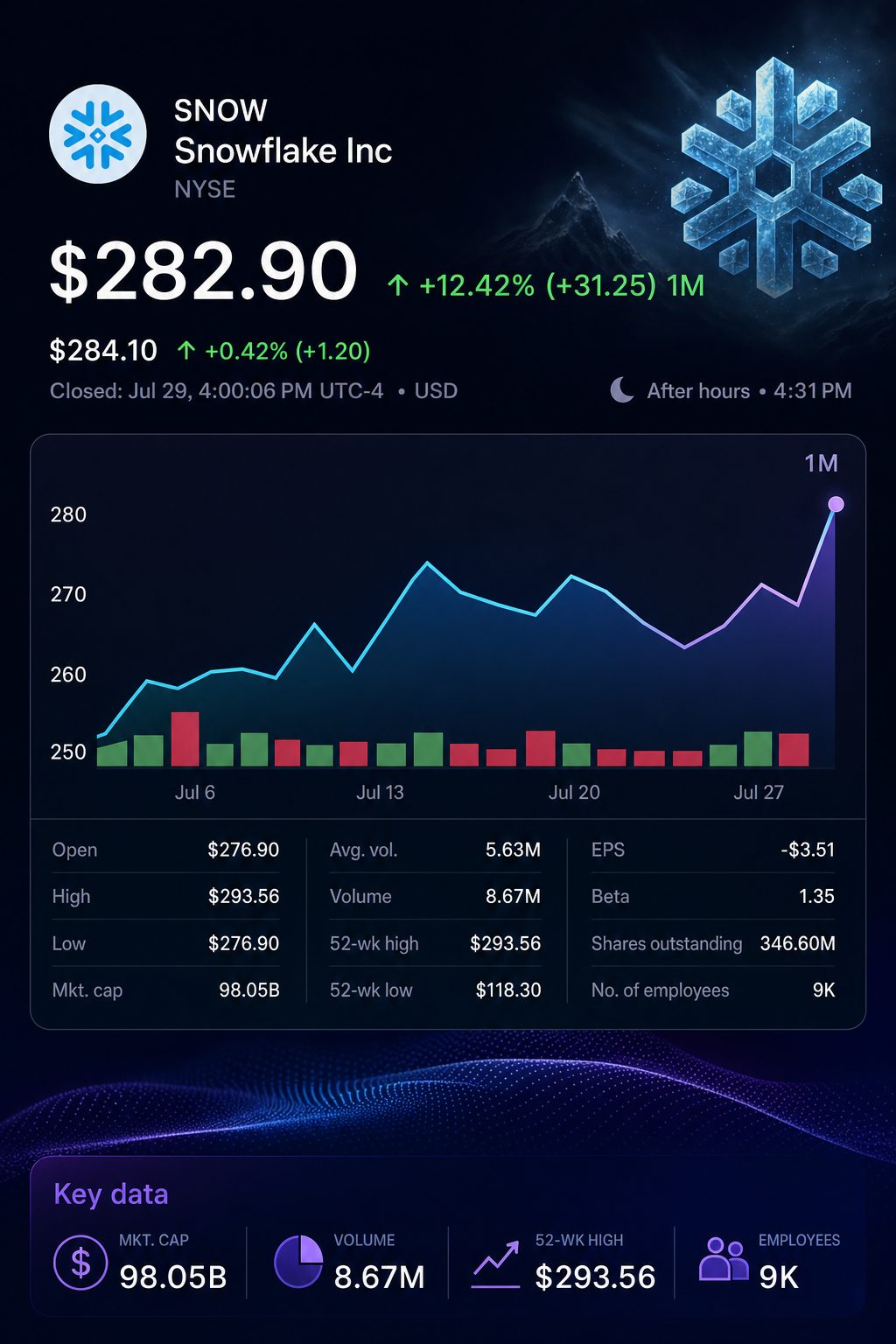
- Snowflake climbed 4.9% to $283.73 in a late session quote released with a delay.
- Wells Fargo increased its price target to $500 from $320 and maintained its Overweight rating.
- The goal is positioned only 5.8% under the $531 benchmark for the CEO award.
Snowflake Inc. NYSE:SNOW rose 4.9% to close at $283.73 on Wednesday. Shares hit an intraday peak of $293.57. Trading had just concluded and the most recent dedicated quote was still delayed. These closing numbers are provisional.
Wells Fargo & Co. NYSE:WFC lifted its price target to $500 from $320. Analyst Ryan MacWilliams maintained an Overweight rating, citing increased platform spending and data uploads driven by AI agents. “The game has changed,” MacWilliams wrote. Benzinga
The target represents another milestone. It is just 5.8% short of the $531 per share threshold set in Chief Executive Sridhar Ramaswamy’s latest compensation package. Snowflake needs to achieve this stock price by July 15, 2033.
With the share count remaining the same, $500 equals an equity value of roughly $172.5 billion. This figure sits 6.3% under the award’s market-value threshold of $184 billion. The calculations are initial estimates.
| Snowflake valuation reference | Level | Read-through from $283.73 |
|---|---|---|
| Late session price, delayed | $283.73 | Shares rose 4.9% on Wednesday |
| Wells Fargo price objective | $500.00 | Reflects 76.2% expected gain |
| CEO’s final award threshold | $531.00 | Marks 87.1% upside potential |
| Equity value based on target | $172.5 billion | This is 6.3% below the $184 billion threshold |
Initial estimate based on unchanged share count.
The rally outpaced the overall software sector. The iShares Expanded Tech-Software Sector ETF (NYSEARCA:IGV) gained roughly 0.6%, while the Invesco QQQ Trust NASDAQ:QQQ slipped 1.6%. Snowflake exceeded their performance by 4.4 and 6.6 percentage points, respectively.
MacWilliams identified Snowflake as a short-term AI winner that does not require major capital outlays. This view contrasts with AI infrastructure investments, which typically need significant funding ahead of revenue. Snowflake’s billing is based on customer platform use.
Tuesday marked the launch of Cortex AI Gateway, after which the upgrade was announced. According to Snowflake, the new product manages internal as well as third-party AI agents. It is compatible with over 100 Model Context Protocol servers. The gateway logs all activities and monitors token expenses.
“Security has to be at the center of that shift,” said Snowflake security chief Mayank Upadhyay. The gateway will soon enter public preview, but general availability has not been announced. Snowflake
Snowflake reported accelerated usage ahead of its product release. Product revenue for the first quarter climbed 34% to $1.33 billion. Remaining performance obligations were up 38% at $9.21 billion. Net revenue retention was 126%.
Over 13,600 accounts accessed Snowflake’s AI tools, while Cortex Code was adopted by more than 7,100 accounts. However, Snowflake’s release did not provide a distinct figure for revenue derived from AI. Increased usage still needs to translate to billable consumption.
Management projected second-quarter product revenue in the range of $1.415 billion to $1.420 billion, indicating growth of around 30%. The outlook for the full year is still $5.84 billion, a 31% increase.
Based on Wells Fargo’s target, the initial equity-value-to-guided-product-revenue ratio is about 29.5 times. This figure does not represent an enterprise-value multiple, but it indicates the extent of anticipated future AI monetisation built into the target.
Risks: Cortex AI Gateway is still in pre-release, and AI revenue figures are not separately disclosed. Snowflake operates with a consumption-based model, allowing customers flexibility in when and how much they use. If consumption growth slows, the $500 valuation may run ahead of the actual results reported.
The upcoming test is simple: a higher number of AI accounts should lead to sustained, accelerated consumption growth.