Meta dropped roughly 5% in after-hours trading, following a 1.3% decline at the close.
97.5% of operating cash flow for the quarter went toward capital spending.
The midpoint of third-quarter revenue guidance was roughly 1% below the FactSet consensus estimate.
Shares of Meta Platforms NASDAQ:META declined roughly 5% during after-hours trading on Wednesday. The company’s free cash flow plummeted 91%, although it reported the highest quarterly revenue on record. The U.S. cash market was shut, while trading persisted in the after-hours session.
Cash conversion proved critical. Meta directed $31.08 billion toward equipment and paying down finance-lease principal, using up 97.5% of its $31.86 billion in operating cash flow.
The previous year, the ratio stood at 66.6%. Free-cash-flow margin dropped to 1.3% from 18.0%. After infrastructure investment, significantly less cash was left.
Meta reported a year-on-year increase in capital spending of $14.07 billion, while revenue rose by $13.29 billion. This means that for every additional dollar of revenue, capital expenditures grew by $1.06.
Measure
Q2 2026
Q2 2025
Change
Revenue
$60.80 billion
$47.52 billion
up 28%
Capital spending, including lease principal
$31.08 billion
$17.01 billion
up 83%
Free cash flow
$0.78 billion
$8.55 billion
down 91%
Free-cash-flow margin
1.3%
18.0%
down 16.7 percentage points
Operating margin
31%
43%
down 12 points
Source: Data reported by Meta. Metrics such as capital-spending growth and cash-flow margins are determined using company disclosures. Free cash flow, as referenced, follows the company’s own non-GAAP definition.
The core advertising business continued to perform well. Advertising revenue grew 27% to $59.36 billion. Ad impressions gained 14%, and the average price per ad was up 12%. Daily active users increased 3% to reach 3.60 billion.
Total revenue surpassed the FactSet consensus of $60.22 billion by close to 1%. Earnings per share came in at $6.18, below the expected $7.19. Net income declined 14% to $15.85 billion.
Legal expenses and severance reached $3.58 billion. Even after removing these items, overall costs climbed roughly 42% according to disclosed data. This indicates the strain was not limited to exceptional charges.
Operating margin decreased to 31%, down from 43%. Operating income for the Family of Apps declined by 6% to $23.39 billion. Reality Labs recorded a quarterly loss of $4.62 billion.
Meta revised the lower boundary of its 2026 capital expenditure outlook to $130 billion, updating the range to $130 billion–$145 billion. The midpoint rose by 1.9% to $137.5 billion.
Meta projects full-year expenses between $165 billion and $169 billion. The company maintains its outlook for 2026 operating income to surpass that of the previous year.
Meta projects third-quarter revenue in the range of $61 billion to $64 billion, with the midpoint of $62.5 billion falling short of the analyst average estimate of $63.14 billion. The company also expects about a 1% negative impact from currency fluctuations.
Chief Executive Mark Zuckerberg said, “AI is accelerating our core business today.” Robust advertising rates reinforce his statement. However, this is not yet reflected in cash flow. Meta Investor
RBC analyst Brad Erickson stated that management must provide “concrete metrics, use cases and a clearer timeline.” The past quarter increased the requirement for proof. MarketWatch
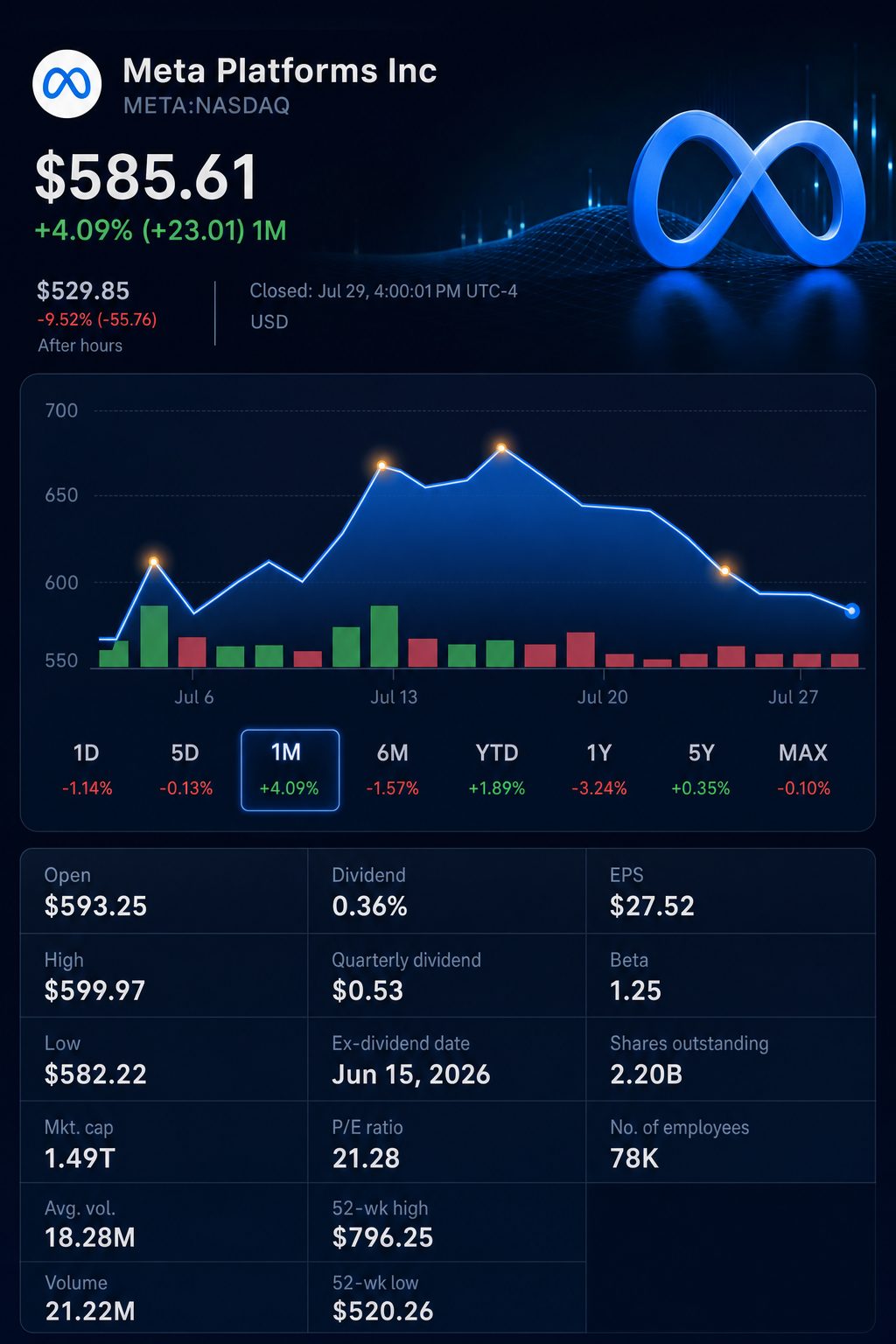
Meta finished trading at $585.61, falling 1.3%. The stock declined 6.6% over the past five sessions, marking an unprecedented 10-session losing run. Shares had fallen about 13% since July 15 prior to the after-hours slide.
Thursday’s session is expected to deliver the first assessment with full trading volume. In the coming week, adjustments to 2026 and 2027 cash-flow forecasts could prove more significant than minor shifts in revenue.
Risks are present in both directions. Improved advertising returns or revenue from paid AI features might restore cash conversion. However, increased infrastructure spending, legal setbacks or softer advertising demand could add to the strain. Meta cautioned that American trials focused on youth issues could result in a material loss.
How did Meta shares perform following the earnings announcement?
Meta ended regular trading on Wednesday at $585.61, falling 1.31%. Shares were last trading around $540.11 as of 4:59 p.m. ET following the release. The response was pronounced, as investors reacted to the EPS miss, much lower free cash flow, and increased capital expenditures. The price may remain volatile as the earnings call progresses and analysts provide commentary.
Did Meta surpass or fall short of analysts' expectations for the second quarter?
Revenue climbed 28% to $60.80 billion, surpassing the $60.22 billion forecast. Diluted earnings per share stood at $6.18, missing the $7.19 expected by Wall Street. Overall costs increased by 55%, cutting the operating margin from 43% to 31%. Legal and severance expenses amounted to $3.58 billion before tax. The shortfall is partly due to exceptional charges, rather than solely lower advertising demand.
Is Meta’s ad business continuing to post strong growth?
Meta’s main advertising business continued to perform well even after the earnings miss. Advertising revenue climbed 27% from a year earlier to $59.36 billion. Ad impressions rose 14% and the average price per ad was up 12%. The number of family daily active people hit 3.60 billion, a 3% rise compared to last year. Growth in ad volume, pricing, and user numbers each helped results in the quarter.
How significant is Meta’s issue with AI spending and cash flow?
The cash-flow situation is critical, particularly in the coming quarters. Capital expenditures in Q2 totaled $31.08 billion, an increase of about 83% compared to a year ago. Free cash flow plunged by 91% to $784 million from $8.55 billion. Capital expenditures represented approximately 51% of total revenue for the quarter. Meta did not conduct any share buybacks throughout the first half. Cash and securities amounted to $90.26 billion, while long-term debt stood at $83.66 billion.
What are the implications of Meta’s third-quarter outlook?
Meta forecast third-quarter revenue in the range of $61 billion to $64 billion. The midpoint of $62.5 billion is under the analyst consensus of $63.14 billion. This figure suggests near 22% year-over-year expansion from Q3 2025, slowing from the 28% annual rise posted in the second quarter. Currency effects are expected to trim growth by about one percentage point. Growth continues robust, but the rate is now moderating.
What is the scale of Reality Labs and the associated legal risks?
Reality Labs generated quarterly revenue of just $431 million, while posting an operating loss of $4.62 billion—over ten times its revenue. During Q2, Meta logged $2.40 billion in legal charges. Management cautioned that upcoming youth-related trials may result in additional significant losses. These uncertainties create substantial challenges for projecting future margins and cash flows.
Is the decline primarily due to Meta itself or is it influenced by broader market trends?
Wednesday’s session reflected impacts from overall market softness as well as company-driven developments. The S&P 500 dropped 1.52%, with the Nasdaq Composite retreating 1.74%. Shares of Meta slipped just 1.31% ahead of its post-market earnings release, then fell another 7.77% after results came out. Most of the after-hours losses are therefore linked to Meta’s earnings. Higher oil prices, rising yields, and investor concerns about AI-related spending continue to add to market stress.
What Meta share price levels are important at this stage?
In after-hours trade, shares hovered near $540, standing about 4% above the 52-week low of $520.26. The $520–$535 area is seen as the first notable support zone. A persistent move below $520 would signal a new 52-week low. The first resistance is identified at $585–$600, covering the level seen at Wednesday's close and recent highs. These are reference points for trading, not assurances of reversal.
What is the outlook for Meta's stock price from this point?
A feasible twelve-month base case is between $625 and $710, with a midpoint close to $670. This scenario relies on current 2027 EPS estimates around $35 holding up through further analyst adjustments. Valuation is supported by an 18–20 times forward multiple. On a one-month view, shares are expected to trade within a $515–$585 range. The downside case is $450–$520 if cash burn and costs intensify. A bullish outcome—driven by convincing AI monetization and stronger cash flow—puts the target at $775–$850. FactSet shows a median target of $815, which may be outdated, leaving substantial uncertainty around these projections.
Marcin Frąckiewicz is the founder and CEO of TS2 Space, a satellite communications company working with customers worldwide. His experience spans satellite communications, telecommunications and technology ventures. He graduated from the Warsaw School of Economics (SGH) and writes about space technology, artificial intelligence, stocks and the technology companies and industries he follows. Follow Marcin Frąckiewicz on Google News, Facebook or LinkedIn.
Surprising starts and permits data can impact homebuilders, mortgage-sensitive stocks, Treasury yields, and the dollar if results deviate significantly from consensus estimates.
#02
Home Depot Q2
The results and outlook provide key insights into housing turnover, renovation demand, professional customer activity, and U.S. discretionary spending.
#03
09:15 ET industrial production
A robust or disappointing factory or utilities report can shift expectations for economic growth, cyclical stocks, bond yields, and the Federal Reserve’s policy direction.