NEW YORK, July 31, 2026, 04:26 EDT
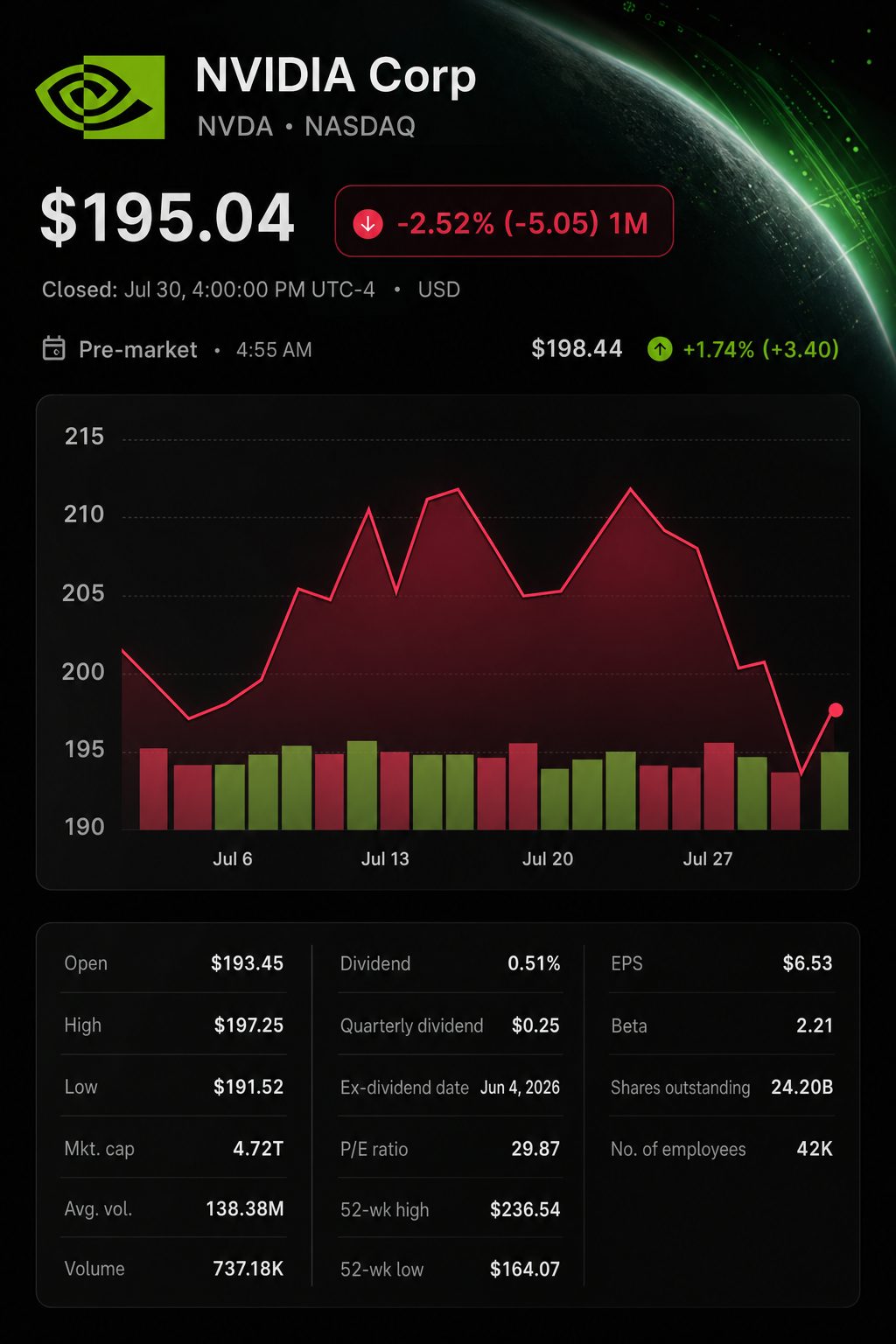
- Nvidia finished Thursday’s session at $195.04, rising 2.7%. Morningstar Inc. NASDAQ:MORN kept its fair value estimate at $280.
- Shares of Microsoft Corporation NASDAQ:MSFT rose 15.6%. Meta Platforms Inc. NASDAQ:META slipped 8.0%. Amazon.com Inc. NASDAQ:AMZN advanced 9.7% in after-hours trading.
- Initial estimate: the four leading hyperscalers together project around $732.5 billion in capital expenditures for 2026, based on midpoint ranges. Reporting standards vary.
Nvidia Corporation NASDAQ:NVDA gained 2.7% on Thursday, while its clients drew more attention. Investors on Wall Street favored AI investments linked to rapid cloud expansion, and penalized firms with less robust cash conversion. U.S. cash markets closed ahead of Friday’s session, as premarket activity took place.
The divide was pronounced. Shares of Microsoft Corporation NASDAQ:MSFT surged 15.6% following a 43% increase in Azure revenue. Meanwhile, Meta Platforms Inc. NASDAQ:META dropped 8.0% as quarterly free cash flow declined 91% to $784 million. Both firms continued to invest.
Amazon.com Inc. NASDAQ:AMZN continued that trend after markets closed on Thursday. AWS revenue climbed 37%, marking its quickest pace in 18 quarters. Shares gained 9.7% in after-hours trading, even as the company set a higher spending target of $220 billion.
| Company | Latest stock reaction | Fresh operating evidence | Cash or outlook signal |
|---|---|---|---|
| Nvidia | +2.7% | First-quarter Data Center sales up 92% | Second-quarter revenue forecast at $91 billion |
| Microsoft | +15.6% | Azure sales increased 43% | Quarter’s free cash flow hit $19.6 billion |
| Amazon | +9.7% after hours | AWS sales advanced 37% | Trailing free cash flow at negative $7.6 billion |
| Meta | -8.0% | Revenue grew 28% | Quarterly free cash flow stood at $784 million |
Spending impacts vary. Microsoft CFO Amy Hood stated that additional Azure capacity was “quickly monetized.” Amazon CEO Andy Jassy described AWS as “booming.” Investors were comfortable with heavy investments when demand for the newly available capacity was already present. Microsoft
Alphabet Inc. NASDAQ:GOOGL provides a further illustration of cloud-focused growth. Google Cloud posted an 82% revenue increase to $24.8 billion. Alphabet subsequently lifted its projected capital expenditure range for 2026 to $195 billion-$205 billion.
| Hyperscaler | 2026 capital-spending plan | Previous plan | Latest growth evidence |
|---|---|---|---|
| Microsoft | Roughly $175 billion | Investment intention remains steady | Azure rose +43% |
| Alphabet | $195 billion-$205 billion | $180 billion-$190 billion | Google Cloud climbed +82% |
| Amazon | $220 billion | $200 billion | AWS increased +37% |
| Meta | $130 billion-$145 billion | $125 billion-$145 billion | Total revenue up +28% |
The combined total at the midpoints of those ranges is a provisional $732.5 billion. Microsoft’s number incorporates a lease-accounting adjustment. As a result, the comparison serves as directional rather than a finalized accounting metric.
Each Nvidia budget signals potential demand for its chips and networking products, while the immediate financial impact varies by purchaser. The most recent quarterly results clarify the differing moves in shares seen on Thursday.
| Company | Operating cash flow | Capital outlay | Free cash flow | Outlay as share of operating cash flow |
|---|---|---|---|---|
| Microsoft | $55.40 billion | $35.80 billion spent on property and equipment | $19.60 billion | 64.6% |
| Meta | $31.86 billion | $31.08 billion, factoring in lease principal | $0.78 billion | 97.6% |
| Alphabet | $39.07 billion | $44.92 billion allocated for property and equipment | -$5.86 billion | 115.0% |
Amazon stood out from a straightforward cash-flow guideline, with trailing free cash flow at negative $7.6 billion. However, AWS achieved a 39.4% operating margin and generated $16.6 billion in operating income during the quarter. This strong profit performance offset the company’s cash outflows.
Morningstar Inc. NASDAQ:MORN kept its Nvidia fair value estimate unchanged at $280. The stock’s price on Thursday was 30.3% lower than this target. Achieving $280 would mean a 43.6% increase, as the percentage calculations are based on separate reference points.
| Nvidia checkpoint | Value |
|---|---|
| Closing price Thursday | $195.04 |
| July 20-24, previous full week | +1.8% |
| Current week to Thursday | -5.7% |
| Morningstar’s fair value estimate | $280 |
| Percentage below fair value | 30.3% |
| Revenue Q1 fiscal 2027 | $81.6 billion, +85% |
| Data Center revenue Q1 | $75.2 billion, +92% |
| Q2 expected revenue | $91 billion, plus or minus 2% |
“These are true battleground stocks,” said Jed Ellerbroek, portfolio manager at Argent Capital Management. The focus is moving from expenditure to observable outcomes. Nvidia is still the key supplier, though its clients are dealing with varying financial impacts. Reuters
The next sector assessment is set for Tuesday. Advanced Micro Devices Inc. NASDAQ:AMD will announce second-quarter earnings following the market close on August 4. The company’s revenue midpoint guidance of $11.2 billion suggests around 46% growth year-over-year. Investors will watch data-center commentary to gauge whether demand extends widely beyond Nvidia.
Risks are still significant. Nvidia’s $91 billion projection for the second quarter does not include any China data-center compute sales. Reduced cloud orders, holdups in facility construction, or stricter spending could shift the current shortfall in capacity to a surplus. Poor cash conversion might also swiftly bring back worries about capital expenditure.