HELSINKI, July 31, 2026, 12:10 EEST
- Nokia gained 3.8% to €8.23, while the Helsinki benchmark increased 0.9%.
- S&P maintained Nokia’s BBB- rating while shifting its credit outlook to positive.
- AI and cloud bookings were 6.3 times greater than quarterly revenue from those clients.
Nokia Oyj HEL:NOKIA gained 3.8%, trading at €8.23 as of 12:01 EEST on Friday. The OMX Helsinki 25 index advanced 0.9%. Shares in Helsinki traded as planned, with markets set to close at 18:30 EEST.
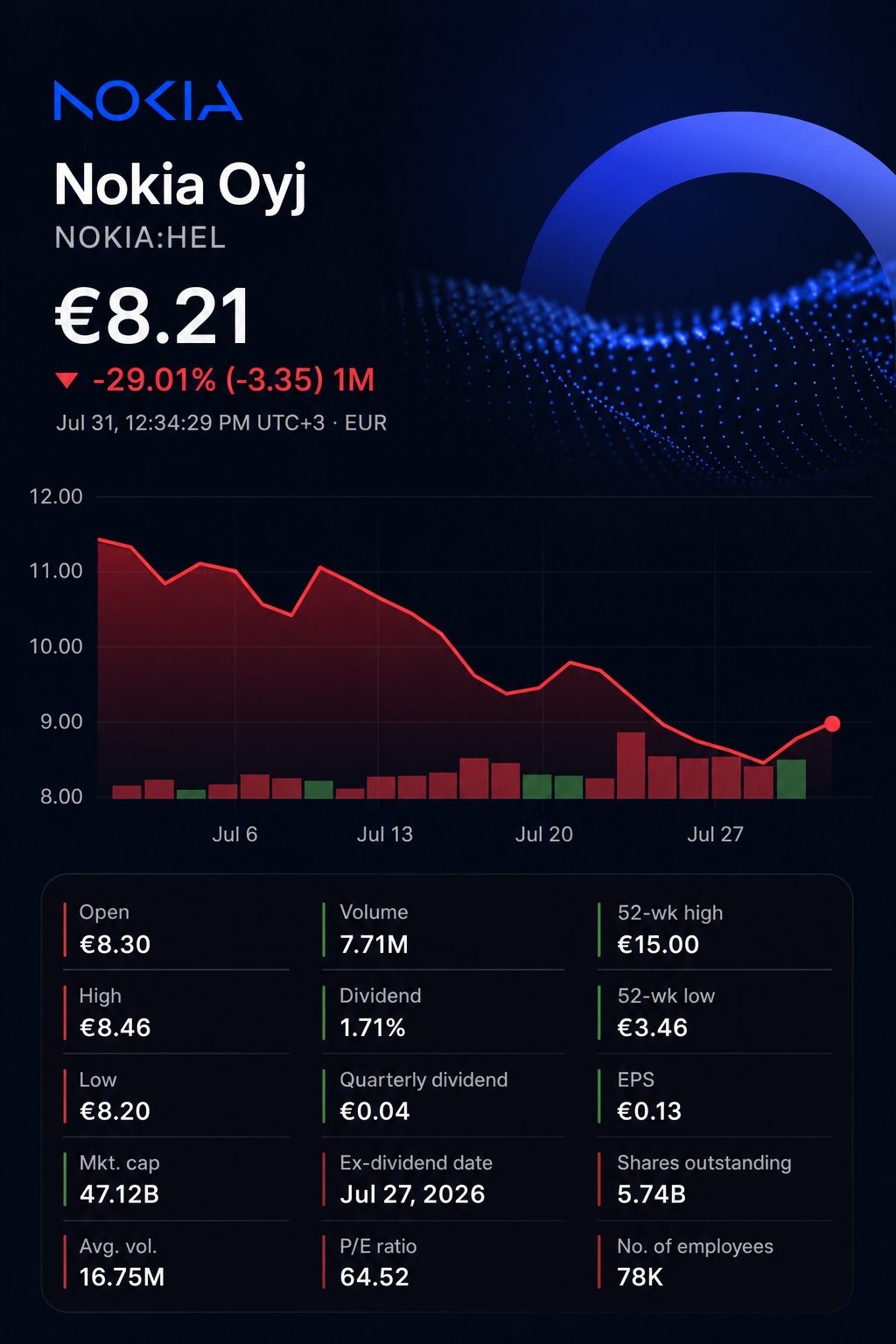
The stock is up 8.9% since Wednesday’s close, while the index advanced 1.4%. The gap brought Thursday’s company-focused credit update to the forefront for investors.
| Market measure | Nokia | Benchmark |
|---|---|---|
| Friday session | €8.23, +3.76% | OMXH25 6,259.09, +0.91% |
| Change from Wednesday close* | +8.9% | OMXH25 +1.4% |
| U.S. close on Thursday | ADR NYSE:NOK $9.09, +8.09% | Nasdaq Composite +2.78% |
Adjustments from Wednesday reflect both closing prices as quoted and prices recorded during the trading session.
S&P Global Ratings shifted its outlook on Nokia to positive from stable, while maintaining the BBB- long-term and A-3 short-term ratings. The agency said an upgrade by one notch is possible in the next 24 months.
The credit perspective stops short of fully backing earnings. S&P projects a decline in Nokia’s margin and cash generation for 2026. The agency requires free operating cash flow to exceed €1.3 billion for an upgrade.
| S&P measure | 2025 base | 2026 forecast | Rating test |
|---|---|---|---|
| Adjusted EBITDA margin | 12.1% | Roughly 11.0% | Consistently below 10% margin would threaten stable outlook |
| Free operating cash flow after leases | €1.25 billion | Circa €1.1 billion | Exceeding €1.3 billion needed for a possible upgrade |
| Adjusted debt/EBITDA | — | — | 1.5 times or less |
| Funds from operations/debt | — | — | More than 60% |
This turns order conversion into the key equity metric. Nokia’s demand pipeline remains substantial. Revenue, margins and cash follow at a later stage.
Nokia reported AI and cloud orders totaling €2.8 billion in the second quarter, while revenue from these clients reached €446 million. The orders represented 6.3 times the quarterly sales.
Management anticipates about half will generate revenue in the next twelve months, suggesting an estimated €1.4 billion. This represents 78% of annualised AI and cloud sales from the second quarter.
| AI and cloud metric | Disclosed or forecast value | Analyst calculation for comparison |
|---|---|---|
| Second quarter customer sales | €446 million | €1.784 billion on an annual basis |
| Second quarter order intake | €2.8 billion | 6.3 times the quarter’s sales |
| Anticipated conversion inside 12 months | Roughly 50% | Approximately €1.4 billion |
| Proportion converted versus annualised sales | — | Roughly 78% |
Nokia’s disclosed customer sales, orders, and conversion guidance form the basis for the calculated figures.
Chief Executive Justin Hotard stated: “Demand remains strong, while supply continues to be the main industry constraint.” Nokia added that shortages are encouraging customers to place orders further in advance. nokia.com
Second-quarter earnings provided some encouragement. Comparable operating profit increased by 18% to €434 million, exceeding the analyst consensus of €382 million by 13.6%.
| Q2 measure | 2026 | 2025 | Change or comparison |
|---|---|---|---|
| Comparable net sales | €4.815 billion | €4.448 billion | +8% |
| Comparable operating profit | €434 million | €367 million | +18%; 13.6% higher than consensus |
| Comparable operating margin | 9.0% | 8.3% | increase of 70 basis points |
| Network Infrastructure sales | €2.037 billion | €1.825 billion | +12% |
Full-year guidance requires close attention. Nokia’s comparable operating profit now stands at €2.1 billion to €2.6 billion. Still, the €100 million rise results from a technical reporting adjustment rather than any shift in the underlying operational outlook.
Nokia anticipates sales to rise by 3% to 7% quarter-on-quarter in the third quarter. The company forecasts that comparable operating profit will stay roughly unchanged. Shifts in software timing are set to move a significant profit rise into the fourth quarter.
Cash requirements stay elevated. Nokia forecasts capital expenditures of €800 million to €900 million. Cash outflows tied to restructuring are expected to total €700 million to €800 million.
Ericsson STO:ERIC-B highlights the risks tied to component costs. The company reported a 6% decline in second-quarter sales. Free cash flow before acquisitions decreased to SEK 0.4 billion compared to SEK 2.6 billion. Ericsson anticipates continued margin pressure in its networks business in the third quarter.
Risks: Nokia identifies semiconductor availability, customer spending, tariffs, and competition as major uncertainties. The main investment thesis would be undermined by delayed or lower-margin order conversion.
Order intake is apparent, but actual cash conversion remains unclear. Nokia faces the challenge of translating roughly €1.4 billion in anticipated order conversions into sustained cash flow. S&P projects €1.1 billion, setting a tough benchmark for the company.
Related articles: NYSE:NOK