PHILADELPHIA, July 31, 2026, 04:25 EDT — U.S. stocks traded before the bell as investors awaited the main session’s 09:30 EDT start.
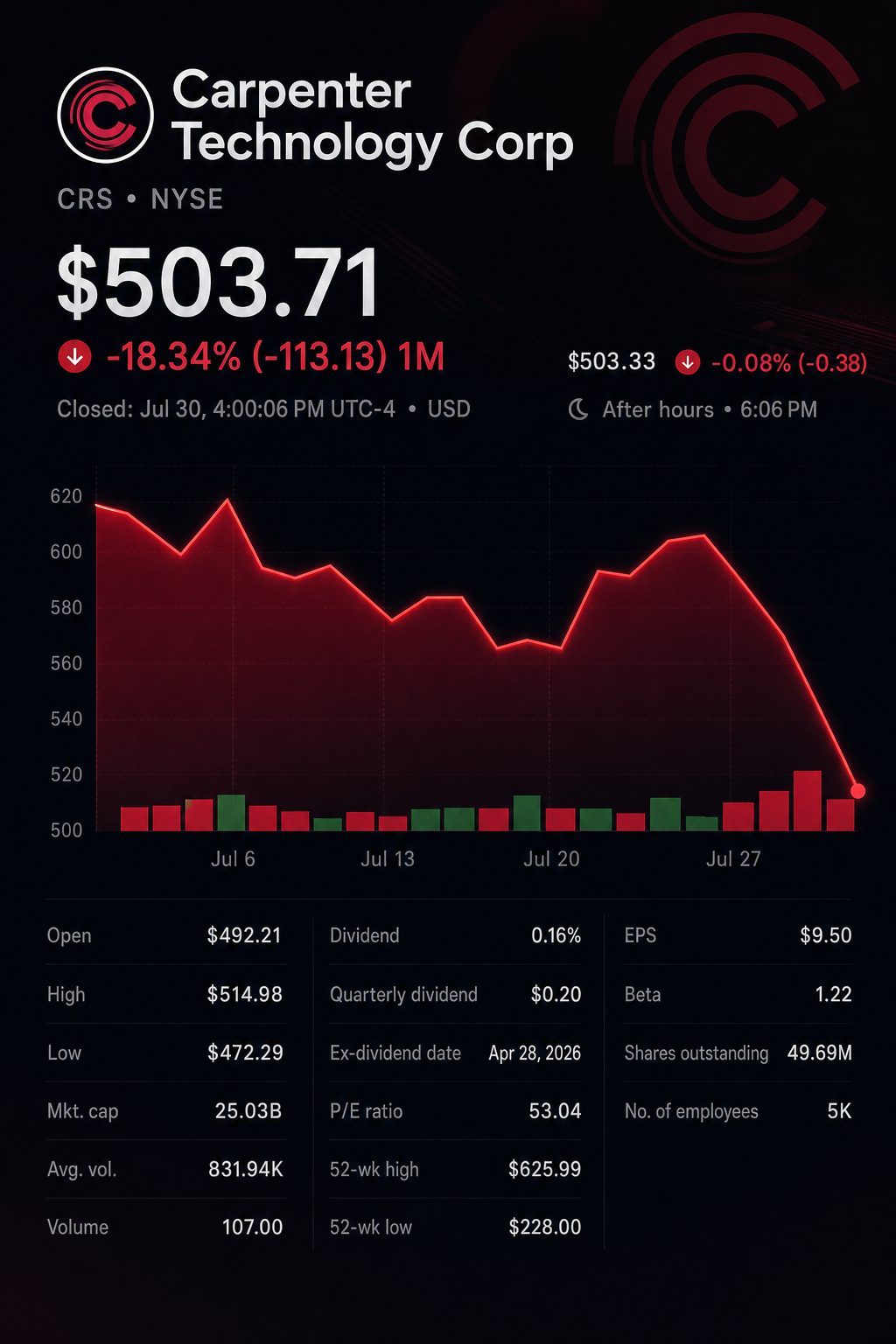
- Carpenter ended Thursday at $503.71, falling 5.1%. In comparison, the S&P 500 rose 1.7%.
- Adjusted earnings exceeded preliminary estimates by 5.2%, while revenue lagged by 1.3%.
- After Brian Malloy died on July 24, Tony Thene resumed the role of CEO.
Shares of Carpenter Technology NYSE:CRS fell 5.1% on Thursday, ending the session at $503.71. The decline came after the company reported its highest-ever quarterly profit and slightly missed revenue expectations.
Investors experienced a sudden change at the top, as Brian Malloy passed away on July 24, just three weeks into his new role. Tony Thene was reinstated as chief executive two days after Malloy’s death.
The tougher issue is found within the sales mix. Aerospace and defense accounted for 65.6% of revenue in fiscal 2026, not including raw-material surcharges. This segment contributed 120% of the company’s total net annual growth.
Carpenter reported that Malloy passed away without warning. No cause of death was provided. The company’s board described him as “a highly respected leader” known for his important contributions. Carpenter Technology
Quarterly results summary
| Metric | Q4 FY2026 | Q4 FY2025 | Change | Preliminary consensus | Beat/(miss) |
|---|---|---|---|---|---|
| Revenue | $851.0 million | $755.6 million | +12.6% | $862.03 million | (1.3%) |
| Adjusted EPS | $3.23 | $2.21 | +46.2% | $3.07 | +5.2% |
| Operating income | $206.9 million | $151.4 million | +36.7% | — | — |
| Adjusted free cash flow | $155.0 million | $201.3 million | (23.0%) | — | — |
Data: Carpenter Technology, Investing.com. Consensus numbers are initial; differences reflect stated results.
Quarterly results were driven by margins rather than top-line revenue. Operating income climbed 36.7%, and adjusted earnings advanced 46.2%. Adjusted free cash flow declined 23.0% against a robust prior-year period.
Specialty Alloys Operations reported an adjusted margin excluding surcharges of 37.8%, up from 30.5% the previous year. The business segment delivered $229.7 million in operating income for the quarter.
Thene struck a confident note regarding the outlook. “If you want to take that guide and say that’s the floor for FY 2027, you wouldn’t get any pushback from me,” he told analysts. He cited commercial-aircraft build rates as the main contributing factor. Investing.com
Sources of growth in fiscal 2026
| End market | Revenue excluding surcharges | Year-on-year | FY2026 share |
|---|---|---|---|
| Aerospace and defense | $1,658.4 million | up 15.1% | 65.6% |
| Industrial and consumer | $320.3 million | rising 11.2% | 12.7% |
| Medical | $224.3 million | down 24.2% | 8.9% |
| Energy | $170.7 million | up 12.8% | 6.8% |
| Transportation | $77.1 million | down 10.8% | 3.1% |
| Distribution | $76.7 million | falling 8.1% | 3.0% |
| Total | $2,527.5 million | up 7.7% | 100.0% |
Source: Carpenter Technology. Calculations use company data. Some totals may not add exactly due to rounding.
Aerospace and defense contributed $217.7 million in ex-surcharge revenue, while total company growth reached just $181.4 million. Softer results from medical, transportation, and distribution segments dampened some of the gains from aerospace.
The concentration underscores the importance of operational continuity. Malloy was in charge of the leading alloys division prior to his role as chief operating officer. Thene was at the helm of Carpenter from 2015 until June 2026.
Thursday market overview
| Security | Close or index level | Daily move | Market value |
|---|---|---|---|
| Carpenter Technology NYSE:CRS | $503.71 | (5.1%) | $25.34 billion |
| ATI (NYSE:ATI) | $181.90 | +2.2% | $24.82 billion |
| Howmet Aerospace NYSE:HWM | $277.28 | +1.7% | $111.74 billion |
| S&P 500 | 7,437.63 | +1.7% | — |
Sources: Investing.com and market-price data.
Carpenter moved in contrast to peers, with ATI and Howmet gaining as the broader market strengthened. This suggests the move reflects a change in expectations for the company rather than a decline across the sector.
Forecast and valuation breakdown
| Measure | Base | Target or market value | Implied change or multiple |
|---|---|---|---|
| Operating income | FY2026: $702 million | FY2027 midpoint: $865 million | Up 23.2% |
| Adjusted free cash flow | FY2026: $362.3 million | FY2027 midpoint: $415 million | Up 14.5% |
| Capital expenditure | FY2026: $242.7 million | FY2027 midpoint: $365 million | Up 50.4% |
| Operating income | FY2026: $702 million | FY2029 midpoint: $1.25 billion | Annual growth of 21.2% |
| Adjusted EPS valuation | FY2026: $10.76 | Thursday price: $503.71 | 46.8x |
| Adjusted cash-flow valuation | FY2027 midpoint: $415 million | Market value: $25.34 billion | 61.1x |
Company projections are presented as ranges; midpoints and valuation multiples serve as indicative estimates. Adjusted EPS and free cash flow refer to non-GAAP metrics as described by Carpenter.
The valuation remains demanding. At the midpoint of its guidance, operating income may climb 23.2%. However, adjusted free cash flow would expand at a more modest pace as spending rises.
Continuity provides a degree of security. The operational plan and brownfield growth were established before this week’s leadership transition. The initiative is still within budget and aims to begin delivering results in fiscal 2028.
Risks: Aircraft output may not meet management’s projected levels. Medical revenue dropped 24.2%, and planned capital expenditures are increasing. Any issues with execution might put Carpenter’s premium valuation at risk.
The immediate focus on Friday is whether the shares steady following Thursday’s divergence. Attention then turns to first-quarter income guidance, set between $195 million and $200 million. Brownfield commissioning remains on track for early fiscal 2028.