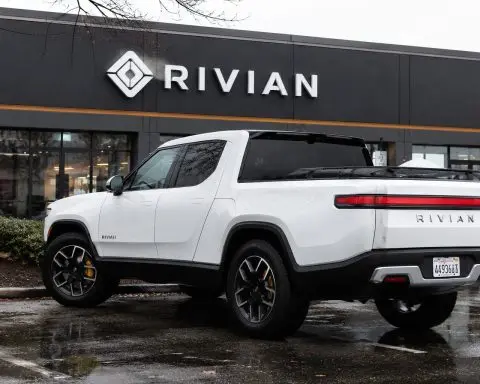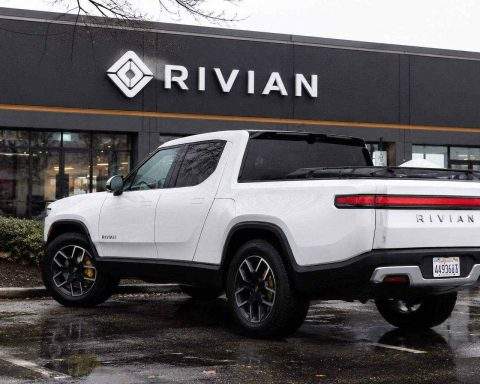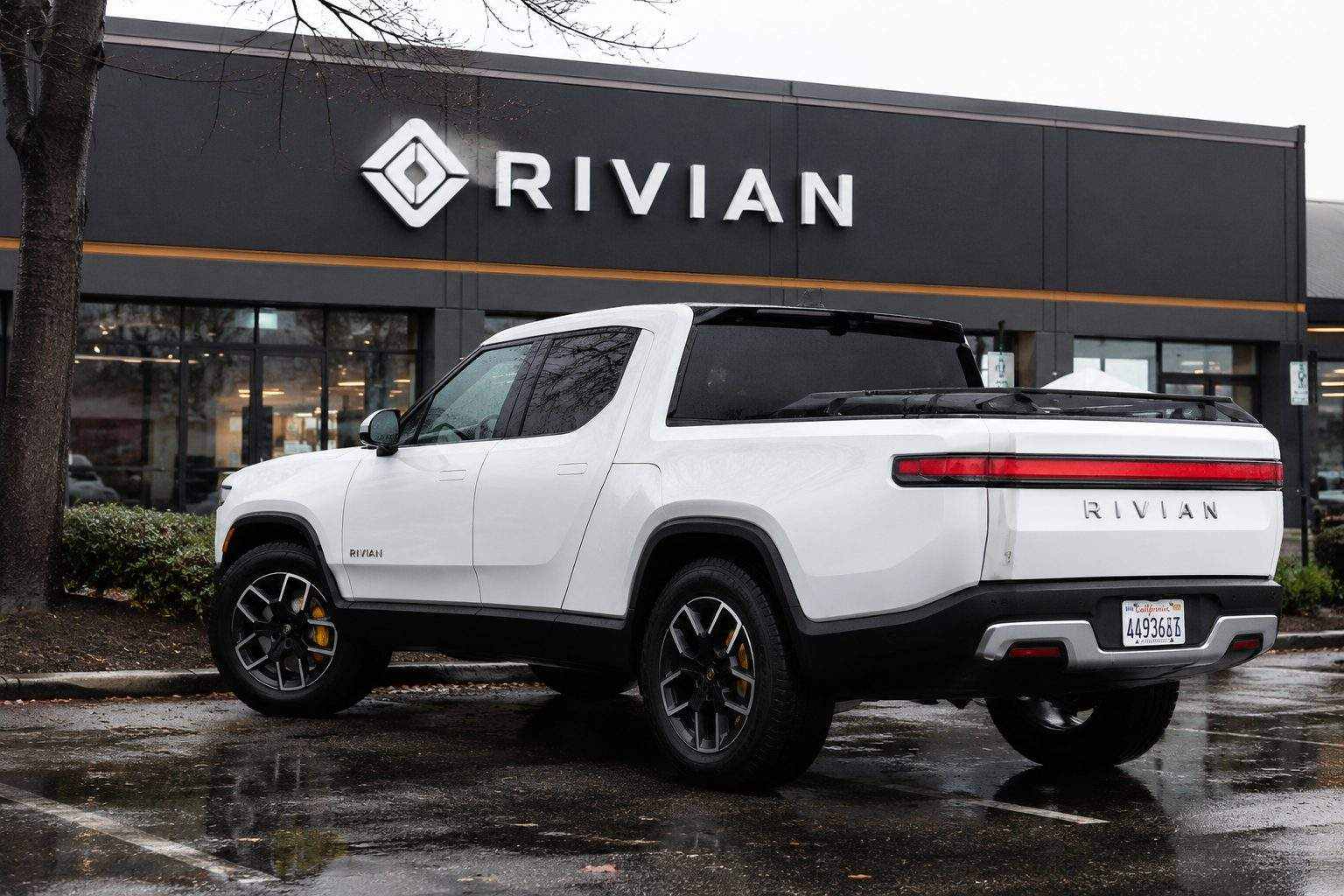
Rivian (NASDAQ:RIVN) shares decline after Q2 results benefit from software and credits

Rivian (NASDAQ:RIVN) shares decline after Q2 results benefit from software and credits

NEW YORK, July 31, 2026, 10:13 a.m. EDT — Shares of Rivian dropped as the company’s second-quarter performance drew support from software sales and regulatory credits.

  • Rivian shares dropped 4.3%, even as the Nasdaq began the session up 0.9%.
  • Gross profit from software reached $215 million, while automotive posted a loss of $36 million.
  • Sales generated from the Volkswagen joint venture and automotive credits accounted for 25% of total revenue.

Shares of Rivian Automotive, Inc. were at $16.11 at about 9:58 a.m. EDT, declining 4.3% from the previous session’s close. During this time, U.S. markets were trading, and Nasdaq Composite advanced 0.9% at the open.
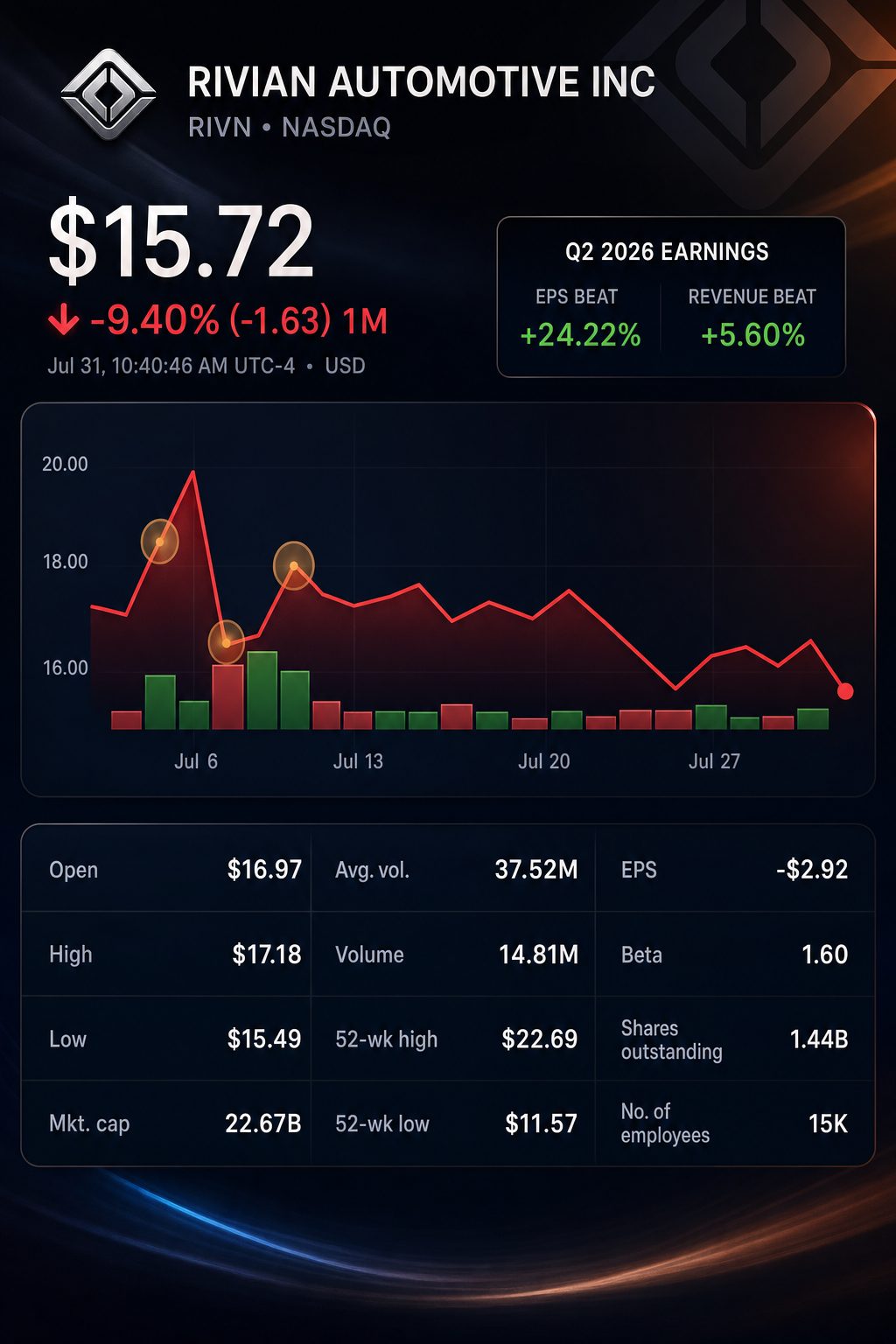
Stock chart for NASDAQ:RIVN

The pullback came after Rivian exceeded earnings estimates, yet also highlighted persisting margin concerns. The company’s vehicle segment remained unprofitable prior to accounting for operating expenses.

Market response

Security or indexPrice or levelSession move
Rivian Automotive, Inc. $16.11down 4.3%
Tesla, Inc. $306.46down 0.8%
Lucid Group, Inc. $7.87off 3.1%
Nasdaq Composite25,340.71 at openup 0.9%

Stock prices noted as of 9:58 a.m. EDT. Nasdaq figures represent the initial trade.

Revenue for the second quarter increased by 27% to $1.658 billion, surpassing LSEG’s forecast by roughly 9.8%. The adjusted loss per share stood at 46 cents, compared to the anticipated 63 cents.

Gross profit on a consolidated basis totaled $179 million, compared to a loss of $206 million. Deliveries increased by 14% to 12,194 vehicles. However, the improvement did not become self-funded through vehicles.

Quarterly performance summary

MetricQ2 2026 resultComparisonDifference
Revenue$1.658 billion$1.510 billion LSEG estimateup 9.8%
Adjusted loss per share$0.46$0.63 LSEG estimate$0.17 less
Gross profit$179 million-$206 million in Q2 2025increase of $385 million
Deliveries12,19410,661 in Q2 202514.4% higher

Rivian provided actual figures in its filing. Consensus data was sourced from LSEG via Reuters.

Gross profit from software and services totaled $215 million, while automotive operations recorded a $36 million loss. As a result, software accounted for 120% of overall consolidated gross profit.

Software posted a gross margin of 41.7%, while automotive recorded a negative margin of 3.1%. That remains the key issue.

Segment profitability

SegmentRevenueGross profitGross marginShare of consolidated gross profit
Automotive$1.143 billion-$36 million-3.1%-20.1%
Software and services$515 million$215 million41.7%120.1%
Consolidated$1.658 billion$179 million10.8%100.0%

Rivian’s disclosed segment data forms the basis for margins and profit shares. Because the automotive segment stayed negative, software accounted for over 100%.

Another factor is revenue concentration. Volkswagen AG brought in $308 million via the joint venture. Regulatory credits for vehicles contributed an additional $106 million. Together, these segments made up 25.0% of total revenue.

A straightforward adjustment highlights the margin test. Excluding automotive credits, the division’s gross loss would expand to approximately $142 million. After including the specified $100 million R2 ramp cost, the result is about $42 million in the red. This early calculation is not official company guidance.

Chief Executive RJ Scaringe stated that the reservation-to-order conversion rate was “meaningfully above our own internal projections.” He anticipates the R2 gross margin will become positive in the second half. Reuters

Output growth will need to accelerate. Rivian shipped 22,559 vehicles in the first half. To meet its full-year goal of 65,000 to 70,000 units, it must deliver an additional 42,441 to 47,441 vehicles.

Challenge for deliveries in the second half

MetricLow endHigh end
2026 delivery goal65,00070,000
Deliveries in first half22,55922,559
Deliveries needed second half42,44147,441
Quarterly average needed21,22123,721
Rise from Q2 volume per quarter74.0%94.5%

Figures are based on Rivian’s reported deliveries for the first half and its stated full-year goal.

Cash reserves provide flexibility. As of June 30, cash and short-term investments stood at $5.31 billion. A subsequent stock sale in July generated an additional $1.317 billion net. During the first six months, operating cash outflows combined with capital expenditures reached $1.924 billion.

Rivian lowered its 2026 capital expenditure forecast to $1.7 billion-$1.8 billion, down from the previous $1.95 billion-$2.05 billion outlook. The midpoint drops by $250 million.

Risks: R2 rollout could progress more slowly than anticipated. Regulatory-credit contributions may not reach previous levels. Rivian notes revenue concentration with Volkswagen and projects a drop in related software gross profit in 2028. Any future equity raising would dilute existing shareholders.

Automotive gross margin moves to the spotlight in the wake of Friday’s reversal. While software contributes to overall performance, it does not resolve the ongoing discussion over vehicle margins.

TS2 TECH • EXTENDED COVERAGE

Further analysis

What is causing Rivian shares to drop today even though the company reported better-than-expected quarterly results?
RIVN was trading around $16.04 shortly after 10:00 ET on July 31, marking a decline of about 4.7%. The stock had previously touched $17.72 after an initial surge following its earnings release. Revenue for the second quarter climbed 27% to $1.66 billion, topping the $1.51 billion analyst estimate. Reuters Automotive gross profit remained in the red, with regulatory credits adding $108 million. The move lower indicates investors were likely seeking improved vehicle margins, though specific reasons are not confirmed. SEC
Was Rivian able to achieve profitability in the second quarter?
Rivian posted a consolidated gross profit of $179 million, compared to a $206 million loss previously. Its vehicle operations continued to record a gross loss of $36 million, while software and services brought in a gross profit of $215 million. Operating expenses stood at $1.02 billion, resulting in an operating loss of $836 million. Net loss totaled $837 million, indicating overall profitability remains out of reach. SEC
Is Rivian capable of meeting its increased 2026 delivery target?
Deliveries for the first half reached 22,559 vehicles, with 12,194 delivered in the second quarter. The company's management projects full-year 2026 deliveries between 65,000 and 70,000. This signals a requirement of 42,441 to 47,441 deliveries in the second half. The necessary quarterly pace ranges from 21,221 to 23,721 units, which is 74% to 95% higher than the second quarter. The bulk of this growth will need to come from R2 production and customer conversions. The ramp-up is significant. SEC
Does Rivian have sufficient demand for the R2 to back its expansion strategy?
Management reports that Launch Edition reservation conversions are significantly above the company’s internal forecasts. Still, Rivian has not provided any specific figures on reservation totals or cancellation rates. Reuters The initial version is priced at $57,990, higher than the expected $45,000 entry-level model. The Premium trim, set at $53,990, is scheduled for late 2026. The Standard option at $48,490 should arrive in early 2027, with a $45,000 variant set to come later that year. CEO RJ Scaringe anticipates positive R2 gross margin in the second half of 2026. While indicators for demand appear positive, broad market demand has yet to be proven. Reuters
What is Rivian's current cash position, and could it require additional funding?
June liquidity stood at $5.85 billion, with $5.31 billion of that comprising cash and investments. The company’s July share sale generated about $1.3 billion post-fees. That brings pro forma liquidity to roughly $7.15 billion before additional expenditures. SEC Operating cash outflows for the first half reached $1.19 billion, and capital expenditures amounted to $734 million, for a combined outflow of about $1.92 billion. The company’s full-year capital expenditure forecast is set at $1.7 billion to $1.8 billion. There is no guarantee on the exact funding runway; future debt or equity financing could still be required. Reuters
What level of shareholder dilution has Rivian produced so far this year?
The number of outstanding shares climbed from 1.240 billion in December to 1.362 billion by June, marking a 9.8% rise over six months. SEC A fully subscribed offering in July contributed an additional 86.25 million shares at a price of $15.50 each. On a pro forma basis, total shares are near 1.448 billion, up approximately 16.8% compared to the end of the year. SEC Volkswagen and Uber’s equity purchases drove the first-half increase. With further equity funding possible, additional dilution risk remains. SEC
To what extent do Volkswagen and software revenue impact Rivian's earnings?
Software and services brought in $515 million in second-quarter revenue. The Volkswagen joint venture contributed $308 million, accounting for nearly 60%. Reuters Gross profit for that segment totaled $215 million. The automotive segment posted a $36 million gross loss. Excluding software, overall gross profit would have stayed negative. Rivian forecasts a software gross profit decrease in 2028 as a joint venture commitment winds down. Concentration risk remains, though continued software sales could help soften the impact. SEC
What do the latest analyst price targets indicate for RIVN shares?
FactSet's consensus price target stands at $18.79 on average, with the median target at $18. These compare to the current price of $16.04, suggesting an upside potential of about 17% and 12%. The forecasted targets range from $13 to $25, indicating possible downside of 19% and upside of up to 56%. The Wall Street Journal The prevailing analyst view is Overweight, with 14 positive ratings, nine neutral, and five negative calls. The range of opinions remains broad. Since results were published on July 30, analysts could update their targets. The Wall Street Journal

Marcin Frąckiewicz is the founder and CEO of TS2 Space, a satellite communications company serving customers around the world. A graduate of the Warsaw School of Economics (SGH), he has more than two decades of experience in telecommunications, satellite services and technology ventures. He writes about satellite communications, space technology, artificial intelligence and the stock market, with a particular focus on technology companies, semiconductors, emerging industries and the trends shaping global innovation. Follow Marcin Frąckiewicz on Google News, Facebook. or Linkedin.

Western Union (NYSE:WU) falls 11% as digital expansion pressures transaction margins
Previous Story

Western Union (NYSE:WU) falls 11% as digital expansion pressures transaction margins

Novo Nordisk shares fall after ZEUS trial disappointment highlights 94% sales reliance
Next Story

Novo Nordisk shares fall after ZEUS trial disappointment highlights 94% sales reliance