
New York, July 12, 2026, 15:10 (EDT)
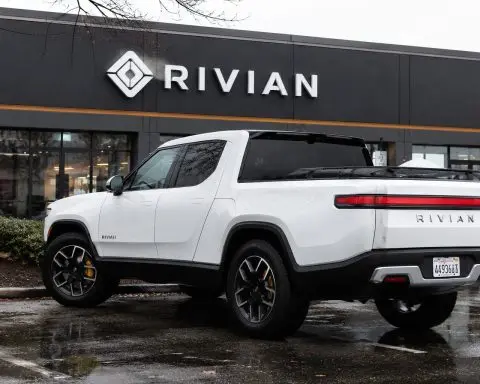
Rivian Automotive NASDAQ:RIVN closed Friday at $17.48, down 3.5%, after selling 86.25 million shares at $15.50 apiece in an offering expected to net the electric-vehicle maker about $1.32 billion. U.S. markets were closed Sunday. A cash-adjusted reading of the deal shows a larger figure: roughly $3.4 billion of value disappeared against a simple no-repricing benchmark.
That is not just dilution. Dilution — when new shares make an existing holding a smaller slice of the company — reduced an unchanged shareholder’s percentage ownership by about 6.0%, while Rivian’s price fell 13.2% from Monday’s $20.14 pre-announcement close. The gap suggests investors also marked down risks around cash use and the R2 production ramp, or Rivian’s effort to raise output quickly.
The calculation uses Rivian’s June 1 share count as a proxy, gives full effect to the underwriters’ extra 11.25 million shares, and adds the company’s estimated net proceeds to Monday’s equity value. It is an arithmetic benchmark, not a price target.
| Measure | Amount | What it shows |
|---|---|---|
| Shares before offering | 1.361 billion | Class A and B shares as of June 1 |
| New shares sold | 86.25 million | Full underwriter option exercised |
| Estimated shares after offering | 1.447 billion | Share count increased 6.3% |
| Ownership reduction for unchanged holder | 6.0% | Same shares represent a smaller stake |
| Monday pre-offer equity value | $27.41 billion | Pre-offer shares at $20.14 |
| Plus estimated net proceeds | $1.32 billion | Cash-adjusted value of $28.73 billion |
| Cash-adjusted per-share benchmark | $19.85 | Enlarged share count, including new cash |
| Friday post-offer equity value | $25.30 billion | Enlarged share count at $17.48 |
| Implied valuation gap | $3.43 billion | Friday price was 11.9% below the benchmark |
Put another way, the first-order effect of issuing discounted stock would have moved the per-share figure from $20.14 to about $19.85. Rivian finished another $2.37 below that level. A separate market-data estimate also put its Friday market value at about $25.3 billion, matching the calculation within rounding. The math does not prove why the stock moved, but it shows the selling went beyond the mechanical increase in shares.
Trading was heavy. About 368.7 million Rivian shares changed hands from Monday through Friday, roughly 4.3 times the enlarged offering; volume can count the same share repeatedly, so that does not represent 368.7 million distinct investors. Friday’s close was still 12.8% above the offer price, suggesting the deal found support, though the stock ended 6.2% below its July 2 close after rallying before the offering was announced.
The week was not a uniform selloff in electric-vehicle shares. Rivian lagged Tesla NASDAQ:TSLA and the Nasdaq Composite, while doing slightly better than smaller rival Lucid Group NASDAQ:LCID.
| Stock or index | Friday close | Week to July 10 |
|---|---|---|
| Rivian | $17.48 | -6.2% |
| Tesla | $407.76 | +3.6% |
| Lucid Group | $5.55 | -8.7% |
| Nasdaq Composite | 26,281.61 | +1.7% |
Still, Rivian’s operating update gave buyers something to hold onto. The company delivered 12,194 vehicles in the second quarter, above its 9,000-to-11,000 outlook, and raised its 2026 delivery forecast to 65,000–70,000 vehicles. Preliminary, unaudited revenue was put at $1.55 billion to $1.65 billion, with cash, equivalents and short-term investments estimated at $5.3 billion. Rivian said higher deliveries were partly offset by a lower average selling price — revenue received per vehicle — as commercial vans made up more of the mix.
Analysts remain divided over whether the extra capital buys enough time. HSBC Holdings LON:HSBA analyst Neil Churchill put the concern bluntly: Rivian “is loss making and cash burning.” JPMorgan Chase NYSE:JPM analyst Rajat Gupta raised his price target to $15 from $9 after the delivery beat but kept an Underweight rating, meaning he expects relative underperformance. “We are now forecasting 2026 deliveries of about 68,100,” Gupta wrote, close to the midpoint of Rivian’s guidance. MarketWatch
But the downside case remains tied to margins and future funding. Rivian’s prospectus lists about 178 million potential shares from options, restricted stock units, warrants and other awards, plus roughly 149 million shares tied to convertible notes. Those are not immediate issuances, and some may never reach the market, but they represent potential additional supply. A July 30 result showing heavier cash use or weaker vehicle margins could send the stock back toward the $15.50 offer price.
When trading resumes Monday, the outside catalysts are June consumer-price data on Tuesday, producer prices on Wednesday and retail sales on Thursday, all due at 8:30 a.m. Eastern. Hot inflation readings could lift bond yields and pressure rate-sensitive growth stocks — shares valued heavily on profits expected years from now. Rivian’s next scheduled financial report is July 30 after the close; until then, $15.50 is the deal reference and $20.14 remains the pre-offer hurdle.
Related articles: NASDAQ:RIVN