NEW YORK, July 31, 2026, 19:01 EDT — Regular session ended; after-hours trading continued to be active.
- Shares of Oracle Corporation ended Friday at $129.87, up 1.8% on the day and 12.9% over the week.
- The stock recovered by 10.3% across two sessions, but is still 62.4% under its 52-week peak.
- The projected conversion of the 12-month backlog represents about 85% of Oracle’s revenue goal for fiscal 2027.
Oracle Corporation NYSE:ORCL ended Friday’s session at $129.87, rising 1.8%. The stock advanced 12.9% over the week. In after-hours trading, shares slipped 0.5% to $129.25.
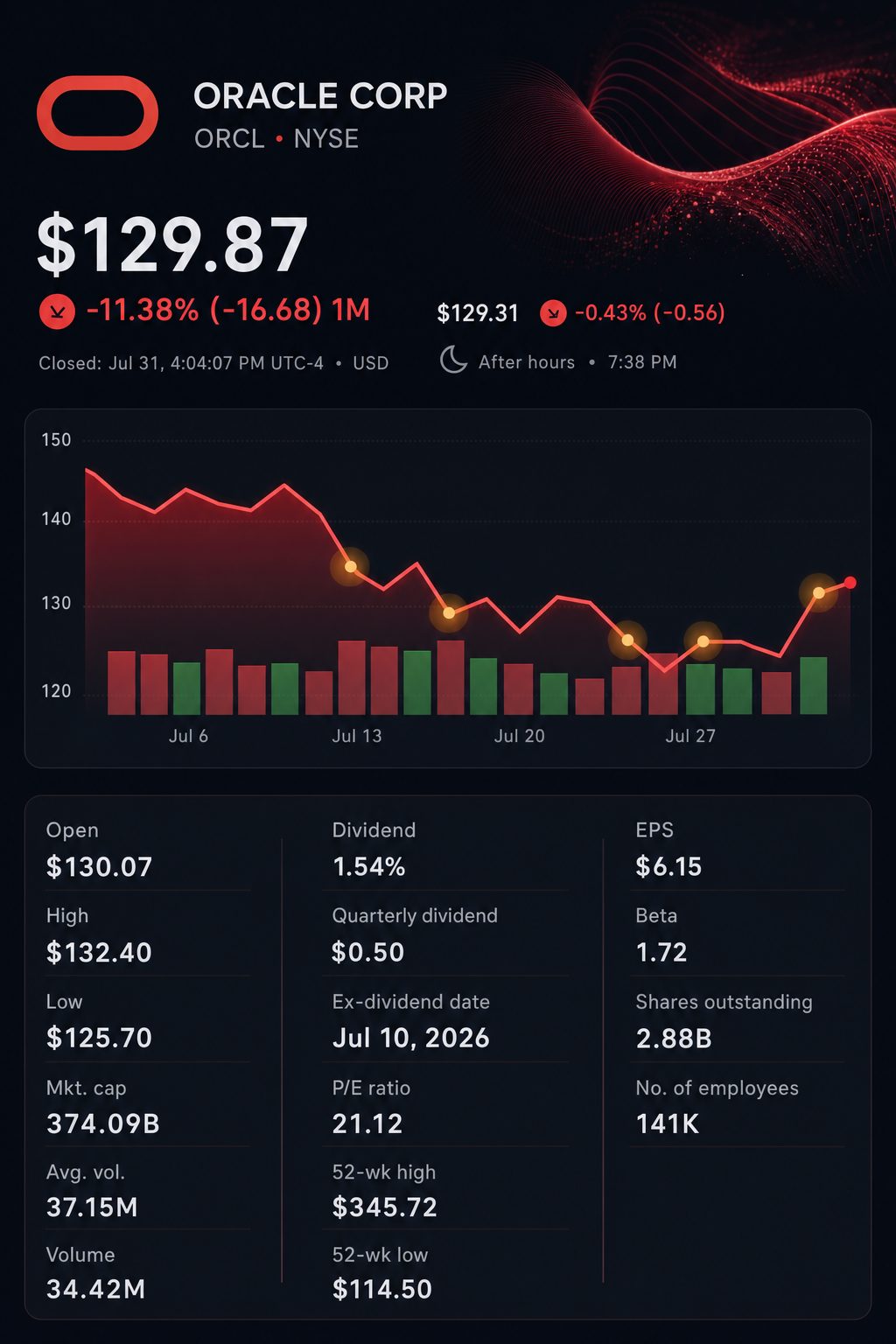
The stock started its two-session bounce after closing at $117.74 on Wednesday. The move came in the wake of Oracle announcing a broader Gemini partnership and larger competitors posting robust cloud performances. Despite this, Oracle is still trading 62.4% under its 52-week high seen in September.
The focus for investors has changed. Doubts about demand have eased. The greater challenges now are in financing, execution and turning profits into cash.
Oracle saw much stronger gains than the overall market in the previous week.
| Security or index | Friday | Week |
|---|---|---|
| Oracle | up 1.8% | up 12.9% |
| S&P 500 | up 0.7% | up 1.1% |
| Nasdaq Composite | up 1.0% | up 1.6% |
| Dow Jones Industrial Average | up 0.5% | up 1.0% |
Oracle and Alphabet Inc. NASDAQ:GOOGL strengthened their collaboration on Thursday. Google’s Gemini models will be integrated into Oracle AI Agent Studio, Fusion Applications, and NetSuite. The companies did not specify any revenue commitment.
Oracle applications head Chris Leone stated that customers require “the flexibility to choose the AI model best suited to each problem.” The partnership aligns with Oracle’s strategy of supporting multiple AI models instead of relying on a single, exclusive AI platform. Oracle
Latest earnings from Microsoft Corporation NASDAQ:MSFT and Amazon.com Inc. NASDAQ:AMZN have reinforced the case for increased demand. Reporting schedules and the way revenues are defined vary, meaning growth rates are indicative.
| Cloud platform | Latest reported growth | Reporting period |
|---|---|---|
| Oracle Cloud Infrastructure | +93% | Fiscal Q4 2026 |
| Alphabet Google Cloud | +82% | Calendar Q2 2026 |
| Microsoft Azure and other cloud services | +43% | Fiscal Q4 2026 |
| Amazon Web Services | +37% | Calendar Q2 2026 |
Microsoft reported that its commercial backlog increased by 84% to reach $678 billion. Amazon noted that AWS recorded its highest growth rate in 18 quarters. The results highlight how investment in AI infrastructure is driving revenue.
Oracle’s contract coverage provides investors with a more transparent indicator. The company’s management projects that 12% of its $638 billion backlog will be realized in the next 12 months, equating to approximately $76.6 billion in anticipated revenue.
| Oracle contract measure | Value |
|---|---|
| Outstanding performance obligations | $638.0 billion |
| Anticipated conversion in next 12 months | $76.6 billion |
| Revenue forecast for fiscal 2027 | $90.0 billion |
| Percent of backlog projected to meet revenue goal | 85.1% |
The timing periods do not match exactly. However, existing contracts seem to account for the bulk of Oracle’s yearly target. This lowers demand risks but puts more focus on execution.
Cash flow continues to serve as a balancing factor. Capital expenditures for fiscal 2026 represented 82.6% of revenue. Free cash flow stayed negative, though operating cash flow set a new record.
| Fiscal 2026 metric | Stated | Share of revenue |
|---|---|---|
| Total revenue | $67.40 billion | 100.0% |
| Cash flow from operations | $32.00 billion | 47.5% |
| Capital expenditure | $55.66 billion | 82.6% |
| Free cash flow | -$23.70 billion | -35.2% |
Oracle reported that $75 billion in large AI agreements feature prepaid elements or hardware contributed by clients, easing its upfront capital requirements. The company maintains its forecast for approximately $40 billion in debt and equity financing for fiscal 2027, which incorporates a $20 billion at-the-market equity program.
Analyst Jacob Bourne of eMarketer noted, “The demand is real with cloud infrastructure revenue and backlog growing fast.” Bourne added that securing funding was getting more challenging as spending increased while free cash flow remained negative. Reuters
Risks continue to be centred on financing, delivery, and margins. In July, cover ratios for hyperscaler bond sales dropped below twice coverage. Colby Stilson of Brown Advisory stated credit markets were exhibiting “fatigue.” Broader spreads could lead to higher funding expenses in the future. Reuters
External tests are set for next week instead of a new Oracle update. Labour figures may influence yields, and a leading chipmaker is expected to provide fresh details on AI demand.
| Date and time, ET | Event | Oracle read-through |
|---|---|---|
| Aug. 4, 10:00 | June JOLTS figures | Technology company valuations, interest rate impact |
| Aug. 4, after close | Advanced Micro Devices Inc. NASDAQ:AMD earnings | Demand for AI accelerators and cloud capital spending |
| Aug. 7, 08:30 | July jobs data | Implications for Treasury yields and stock risk appetite |
Oracle’s upcoming benchmark is its guidance for the fiscal first quarter. The company forecasts revenue growth between 27% and 29%. Cloud revenue is projected to rise by 58% to 64%, with adjusted earnings anticipated at $1.72 to $1.76 per share. The share price rally has led to a higher demand valuation. Ongoing performance on conversion will determine if the gains persist.
Related articles: NYSE:ORCL