NEW YORK, August 2, 2026, 17:03 EDT – Alphabet’s recovery will be challenged in the second half as the company targets $119 billion in spending on artificial intelligence, marking a crucial period ahead.
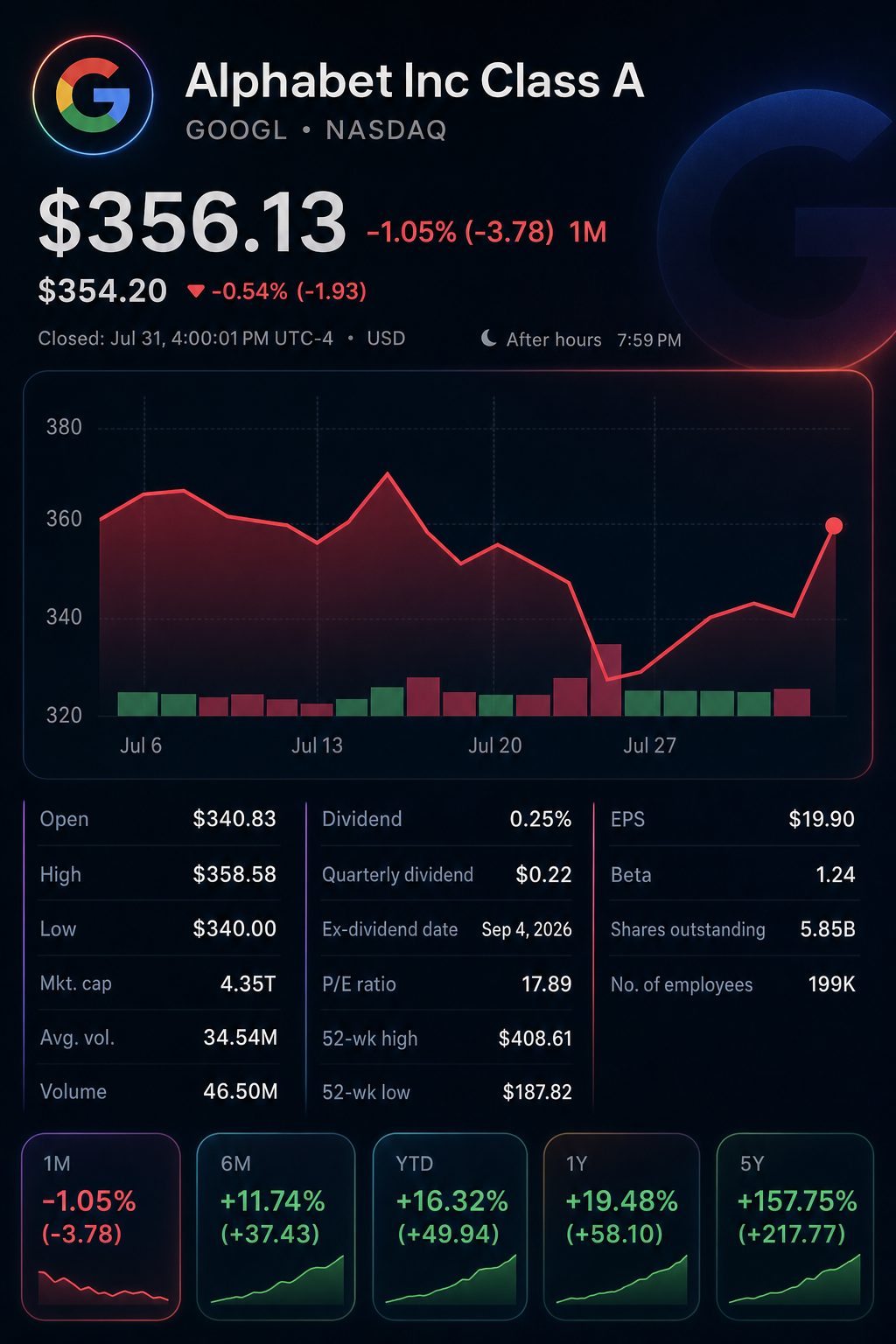
- U.S. markets did not open on Sunday. Alphabet ended trading on Friday at $356.13, an increase of 11.4% for the week.
- The midpoint of guidance indicates $119.4 billion in capital spending for the second half.
- Advanced Micro Devices NASDAQ:AMD will announce results Tuesday. The U.S. employment report is due Friday.
Alphabet must invest roughly $119.4 billion in the latter half to meet the midpoint of its forecast. This remains the key challenge for the stock’s recovery.
The implied quarterly rate is $59.7 billion, marking a 33% increase over the second quarter’s spending of $44.9 billion.
Operating cash flow for the second quarter totaled $39.1 billion. If maintained, this would suggest negative free cash flow of about $20.6 billion for the quarter. This is an indicative calculation, not official company guidance.
Alphabet initially dropped 7.1% on July 23, but finished Friday trading 4.1% higher than its closing price before the report. Last week, shares climbed 11.4%.
The referenced commentaries covered three aspects of the discussion. Jim Cramer highlighted the impact of spending penalties. Seeking Alpha addressed concerns over negative free cash flow. Barron’s looked at strategies for downside hedging. Collectively, they outline a debate focused on timing as opposed to demand.
Revenue grew at a faster pace, but cash conversion deteriorated.
| Alphabet cash-flow measure | Q2 2025 | Q2 2026 | Change |
|---|---|---|---|
| Revenue | $96.4 billion | $119.8 billion | +24% |
| Operating cash flow | $27.7 billion | $39.1 billion | +41% |
| Capital spending | $22.4 billion | $44.9 billion | +100% |
| Free cash flow | $5.3 billion | -$5.9 billion | -$11.2 billion |
| Free-cash-flow margin | 5.5% | -4.9% | -10.4 points |
| Capex as share of operating cash | 80.9% | 115.0% | +34.1 points |
Capital expenditures increased twofold, and operating cash flow climbed 41%. As a result, spending outpaced the cash generated from operations. Nonetheless, free cash flow over the trailing 12 months stood at $53.3 billion, representing a decline of approximately 20% compared to the previous year.
Management’s yearly outlook raises the bar for the second half. These figures are based on quarterly results being evenly distributed.
| 2026 capex estimate | Low scenario | Median | High scenario |
|---|---|---|---|
| Annual outlook | $195.0 billion | $200.0 billion | $205.0 billion |
| H1 expenditure | $80.6 billion | $80.6 billion | $80.6 billion |
| S2 spending needed | $114.4 billion | $119.4 billion | $124.4 billion |
| Quarterly average required | $57.2 billion | $59.7 billion | $62.2 billion |
| Rise over Q2 rate | 27% | 33% | 38% |
Early estimate. Alphabet has not released a second-half quarterly expenditure timetable.
Chief Financial Officer Anat Ashkenazi stated that the rise was due to accelerated capacity delivery. She cautioned that “free cash flow will remain under pressure.” Alphabet Investor Relations
Alphabet’s balance sheet provides flexibility. The company reported $242.5 billion in cash and marketable securities, while its long-term debt stood at $98.2 billion. Total contractual obligations reached $811 billion, with $200.7 billion listed as short-term.
Peers’ recent responses indicate a new norm in the market. Microsoft NASDAQ:MSFT and Amazon.com NASDAQ:AMZN reported strong gains in cloud revenue. Shares of both climbed following their earnings announcements. In contrast, only Alphabet saw a negative response at first.
| Company | Latest cloud growth | Reported cash-flow measure | First full-session move |
|---|---|---|---|
| Alphabet | Google Cloud up 82% | Q2 FCF: negative $5.9 billion | Down 7.1% |
| Microsoft | Azure up 43% | Fiscal Q4 FCF: positive $19.6 billion | Roughly up 15% |
| Amazon | AWS up 37% | TTM FCF: negative $7.6 billion | Roughly up 15% |
Cash-flow timelines vary. Stock movements reflect the initial complete trading days after earnings are released.
Bill Birmingham at REX Financial described the gap directly: “The new dividing line is whether unprecedented spending is producing visible, near-term revenue and margin expansion.” Reuters
Alphabet provides proof through this test. Cloud revenue increased by 82%, and the operating margin climbed to 35.6%, compared to 20.7% previously. Revenue from search continued to rise, posting a 17% gain.
Barron’s cited its hedge when Alphabet was at $333.71. Alphabet’s shares ended Friday up 6.7% from that level. The terms for those options would now need updated pricing.
Two outside catalysts are on the calendar for next week. AMD will post earnings after Tuesday’s market close. On Friday, economists anticipate the July U.S. jobs report will show payrolls rising by 83,000 and the unemployment rate at 4.3%.
Risks persist. Capital returns might not be distributed evenly, meaning the straight-line projection could be overly severe. Quicker cloud payments could bolster cash flow. However, weaker AI demand, higher regulatory expenses or increased infrastructure spending could have a negative impact.
Related articles: NASDAQ:AMD