NEW YORK, August 4, 2026, 06:10 EDT
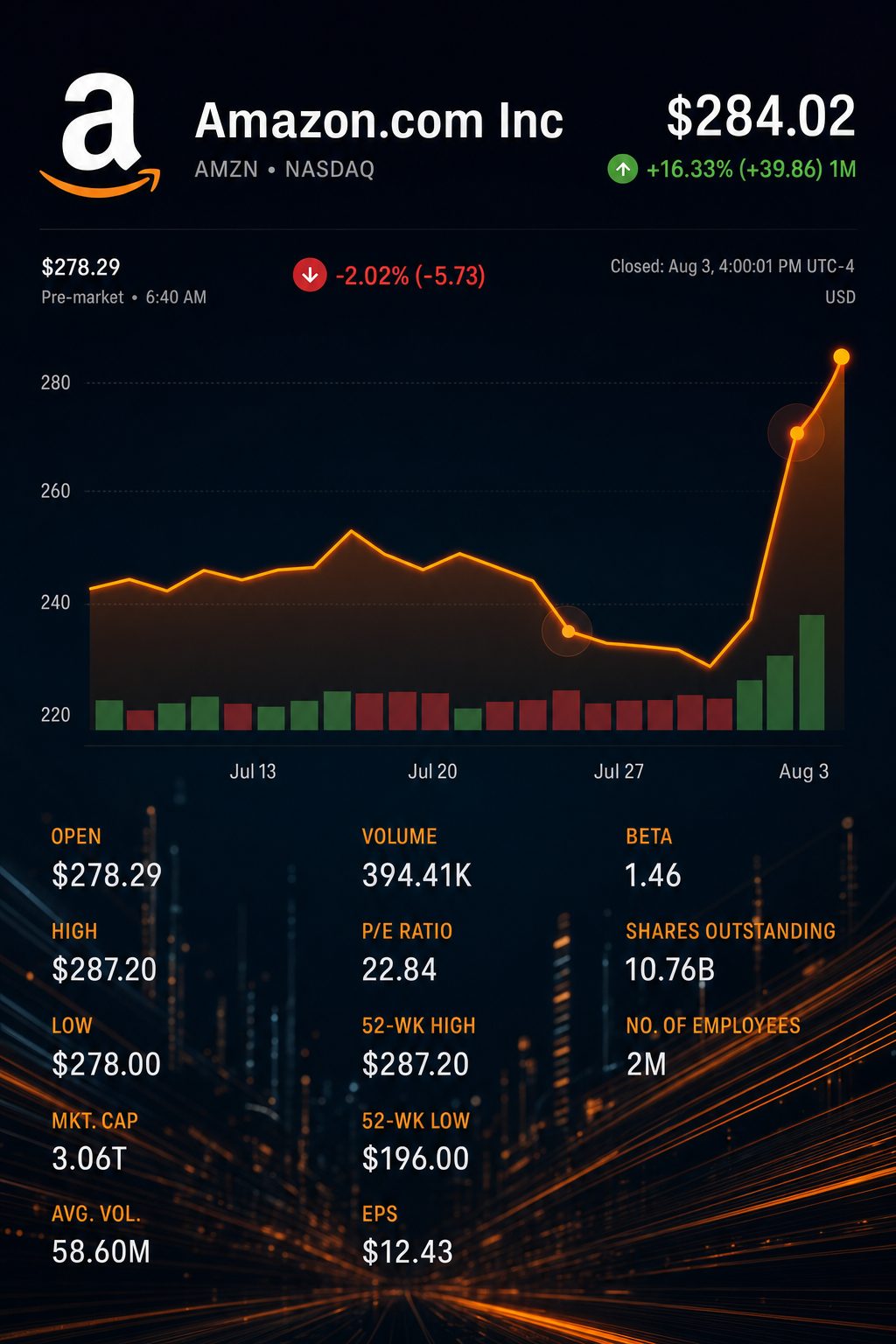
- Shares were down 1.7% at $279.15 before the bell, after Monday’s record close.
- Bezos’s 15 million-share filing equals 0.14% of Amazon’s outstanding stock.
- AWS delivered a calculated 56.9% incremental operating margin in the second quarter.
Amazon.com, Inc. NASDAQ:AMZN fell 1.7% in premarket trading on Tuesday. The move followed a Form 144 notice covering 15 million shares held by founder and Executive Chair Jeff Bezos. Monday’s $284.02 close put Amazon above $3 trillion for the first time.
The filing valued the proposed sale at $4.07 billion. That looks large. Yet the block represents only 0.14% of outstanding shares. The underlying trading plan was adopted in November 2025, well before last week’s results.
The filing and Monday’s trading data put the block in context. The volume comparison measures scale, not expected execution speed.
| Proposed-sale measure | Filing or market value | Relative scale |
|---|---|---|
| Shares proposed | 15.0 million | 0.14% of shares outstanding |
| Aggregate filing value | $4.07 billion | 0.13% of Monday’s market value |
| Full block versus Monday volume | 15.0m / 90.83m | 16.5% |
| Trading-plan period | Nov. 14, 2025-Feb. 26, 2027 | Pre-arranged Rule 10b5-1 plan |
The premarket quote remained 18.5% above Thursday’s pre-results close. Most of the post-earnings rerating therefore remained intact. Nasdaq’s premarket session was open at the dateline time.
The larger investor signal is AWS operating leverage. Using year-over-year changes, AWS produced about 57 cents of extra operating income for each additional revenue dollar. That is a calculated measure, not a company-reported metric.
Company data show the sharp margin step-up.
| AWS metric | Q2 2025 | Q2 2026 | Change |
|---|---|---|---|
| Revenue | $30.87 billion | $42.23 billion | +36.8% |
| Operating income | $10.16 billion | $16.62 billion | +63.6% |
| Operating margin | 32.9% | 39.4% | +6.5 percentage points |
| Incremental operating margin, calculated | — | — | 56.9% |
AWS revenue grew much slower than operating income. That matters. Chief Executive Andy Jassy said “AWS is booming,” after the unit posted its fastest growth in 18 quarters. Amazon
The performance also changed Amazon’s profit mix. AWS generated 60.5% of consolidated operating income from 21.1% of sales. Retail remained larger in revenue, but far thinner in margin.
Second-quarter segment results show the concentration.
| Q2 2026 segment | Sales | Sales share | Operating income | Profit share | Operating margin |
|---|---|---|---|---|---|
| North America | $116.18 billion | 57.9% | $9.12 billion | 33.2% | 7.9% |
| International | $42.20 billion | 21.0% | $1.72 billion | 6.3% | 4.1% |
| AWS | $42.23 billion | 21.1% | $16.62 billion | 60.5% | 39.4% |
The cash-flow picture is weaker. Trailing property purchases rose 64% to $169.0 billion. Operating cash flow increased 33% to $161.4 billion. Free cash flow swung to negative $7.6 billion.
The spending rate has now overtaken operating cash generation.
| Trailing 12 months ended June | 2025 | 2026 | Change |
|---|---|---|---|
| Operating cash flow | $121.1 billion | $161.4 billion | +33% |
| Property and equipment purchases, net | $103.0 billion | $169.0 billion | +64% |
| Free cash flow | $18.2 billion | $(7.6) billion | $(25.8) billion |
| Property purchases as share of operating cash flow | 85.0% | 104.7% | +19.7 points |
Management lifted projected 2026 cash capital spending to $220 billion. That is about 71% above 2025 spending. Jassy said even the higher budget would not meet all current demand.
Reported earnings also need care. The $62.6 billion quarterly profit included $53.4 billion of pre-tax other income, mainly from Amazon’s Anthropic investment. That gain makes the reported 22.8-times trailing price-to-earnings ratio a noisy operating benchmark.
Relevant cloud peers also rallied Monday. Microsoft Corporation NASDAQ:MSFT rose 4%, while Alphabet Inc. NASDAQ:GOOGL gained 3.6%. Investors continued favoring companies showing a visible link between infrastructure spending and cloud growth.
Bill Birmingham of REX Financial framed the test as “visible, near-term revenue and margin expansion.” Amazon cleared that test inside AWS. It has not yet cleared it in free cash flow. Reuters
Amazon expects third-quarter sales between $197 billion and $202 billion. The $199.5 billion midpoint is 2.2% below the FactSet consensus estimate. Its operating-income midpoint implies roughly 41% growth from last year.
Risks remain concentrated in execution. Memory, energy and tariff costs could raise the buildout bill. A slower demand ramp would leave $220 billion of spending against negative free cash flow. Amazon also flags chip supply, customer demand and data-center optimization.
The Bezos filing adds a near-term supply overhang. The larger valuation test remains AWS conversion. Holding incremental margins near 57% would support the spending case. A sharp retreat would renew scrutiny of the $220 billion plan.
Related articles: NASDAQ:AMZN