NEW YORK, August 4, 2026, 08:04 EDT
- Revenue topped analyst forecasts by 4.4%, while adjusted EPS was 13.2% higher than estimates.
- Pfizer increased its 2026 revenue midpoint by 0.8% to $61.5 billion.
- The four main drugs contributed $797 million, surpassing the decline from COVID-related products by $271 million.
Pfizer Inc. NYSE:PFE increased its 2026 minimum sales outlook following stronger-than-expected quarterly results. Key insight for investors lies within the updated guidance breakdown. Non-COVID product sales rose by $1.5 billion, offset by a $1 billion decline in COVID-related sales.
That resulted in just a $500 million increase at the midpoint. However, the revenue composition improved significantly. Non-COVID gains were triple the amount of the net increase in guidance.
During the quarter, four major franchises—Eliquis, Vyndaqel, Padcev and Lorbrena—generated a combined $797 million increase from a year earlier. That figure is 2.1 times larger than Pfizer’s overall revenue growth. The total also surpassed the combined drop from COVID products by $271 million, based on company-reported sales figures.
The quarter surpassed consensus expectations across both primary metrics. Adjusted profit, though, fell by one cent compared to the previous year.
| Q2 measure | Actual | Analyst estimate | Q2 2025 | Beat/(miss) |
|---|---|---|---|---|
| Revenue | $15.034bn | $14.40bn | $14.653bn | +4.4% |
| Adjusted EPS | $0.77 | $0.68 | $0.78 | +13.2% |
| Reported net income/(loss) | $(248)m | — | $2.910bn | — |
| Reported EPS | $(0.04) | — | $0.51 | — |
Consensus data reflects analyst projections. Beat rates are derived.
The GAAP loss was driven by $4.325 billion in non-cash impairment charges. Approximately $3.8 billion was linked to sigvotatug vedotin following underwhelming Phase 3 data. An additional $525 million pertained to Oxbryta rights. Pfizer did not identify a feasible U.S. reentry option.
The sales bridge illustrates the extent of the offset’s concentration.
| Product or group | Q2 2026 sales | Q2 2025 sales | Dollar change | Operational change |
|---|---|---|---|---|
| Eliquis | $2,425m | $2,003m | +$422m | +19% |
| Vyndaqel family | $1,762m | $1,615m | +$147m | +8% |
| Padcev | $667m | $542m | +$125m | +23% |
| Lorbrena | $354m | $251m | +$103m | +37% |
| Four-drug subtotal | $5,208m | $4,411m | +$797m | — |
| Paxlovid + Comirnaty | $282m | $808m | $(526)m | -95% / -34% |
| Total Pfizer revenue | $15,034m | $14,653m | +$381m | +1% |
Reported figures are used to calculate subtotals and dollar changes.
Eliquis contributed $422 million, accounting for 111% of Pfizer’s overall sales growth. The operational increase was prompted by higher U.S. net prices and worldwide demand. Some global markets faced pressure due to generic competitors.
The full-year bridge also provides important insights.
| 2026 item | Previous view | Positive change | Offset | Revised view |
|---|---|---|---|---|
| Revenue range | $59.5–$62.5bn | — | — | $60.5–$62.5bn |
| Revenue midpoint | $61.0bn | +$1.5bn non-COVID | $(1.0)bn COVID | $61.5bn |
| COVID-product revenue | About $5.0bn | — | $(1.0)bn | About $4.0bn |
| Adjusted EPS | $2.80–$3.00 | +$0.10 non-COVID | $(0.10) licensing charge | $2.80–$3.00 |
The midpoint increased by only 0.8%. Gains outside of COVID accounted for 2.5% of the previous midpoint, while losses tied to COVID subtracted 1.6%. Analysts on Wall Street had forecast a midpoint of $61.8 billion, staying higher than Pfizer’s figure of $61.5 billion.
Pfizer unveiled an additional $2.5 billion in savings expected by 2029. Of this, $1 billion is planned to come from reductions in selling and administrative expenses, while $1.5 billion will derive from manufacturing. Total estimated one-off implementation costs may reach $6 billion.
Chief Executive Albert Bourla described oncology as “a source of strength.” He also pointed to “meaningful momentum” in obesity. However, the largest increase in dollar terms was recorded in established commercial franchises.
In the first half, Pfizer allocated $5.3 billion to internal R&D. The company paid out $4.9 billion in dividends. Management anticipates there will be no share repurchases in 2026. The remaining buyback authorization stands at $3.3 billion.
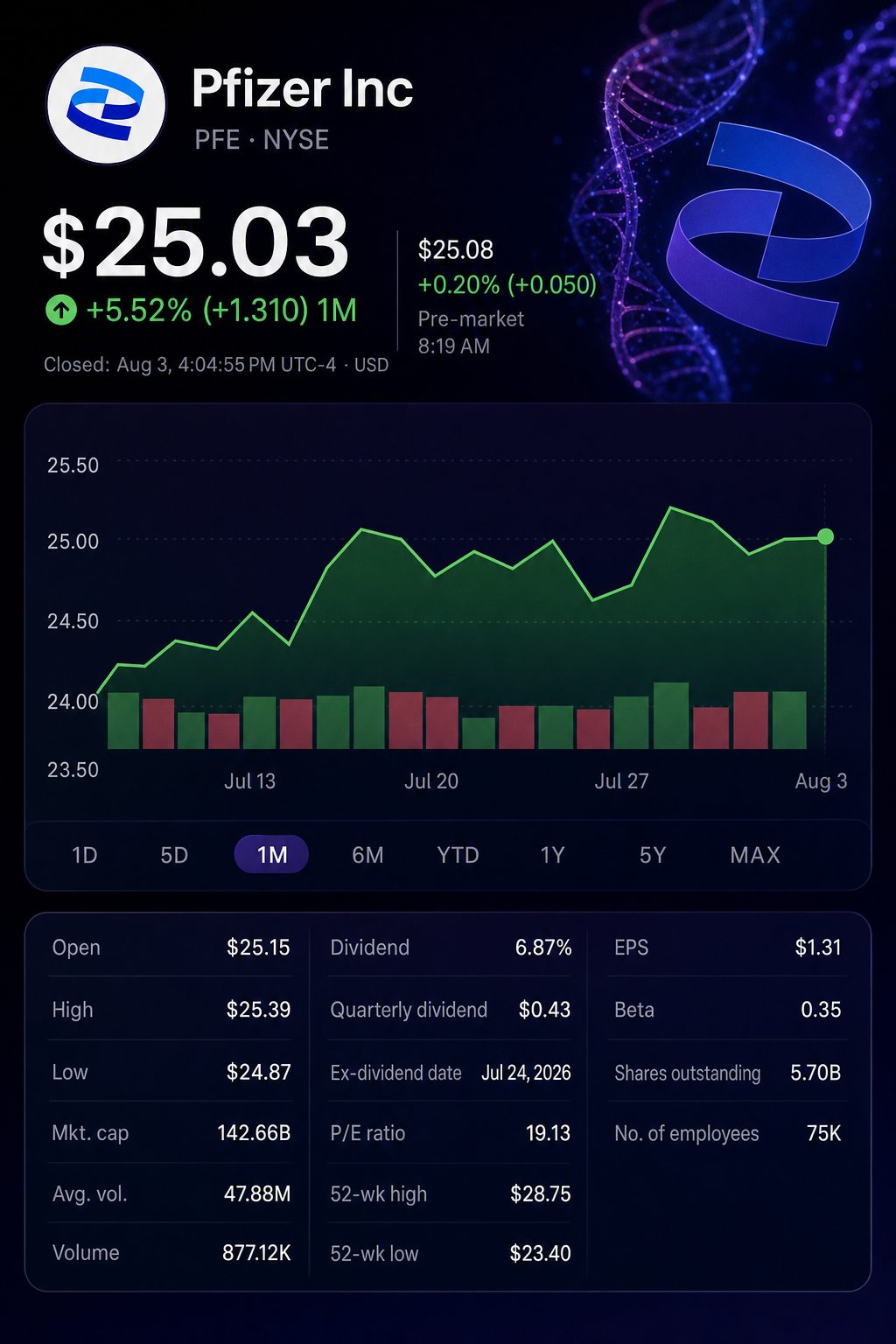
U.S. regular markets were yet to open at the time of publication. Pfizer stock was steady in premarket trading at $25.03.
Key risks continue to center on patent erosion, lower COVID demand, and pipeline performance. Pfizer expects roughly $1.1 billion in generic and biosimilar headwinds. The impairment highlights the speed at which pipeline valuations can change.
Related articles: NYSE:PFE