
SEATTLE, August 12, 2026, 15:23 EDT
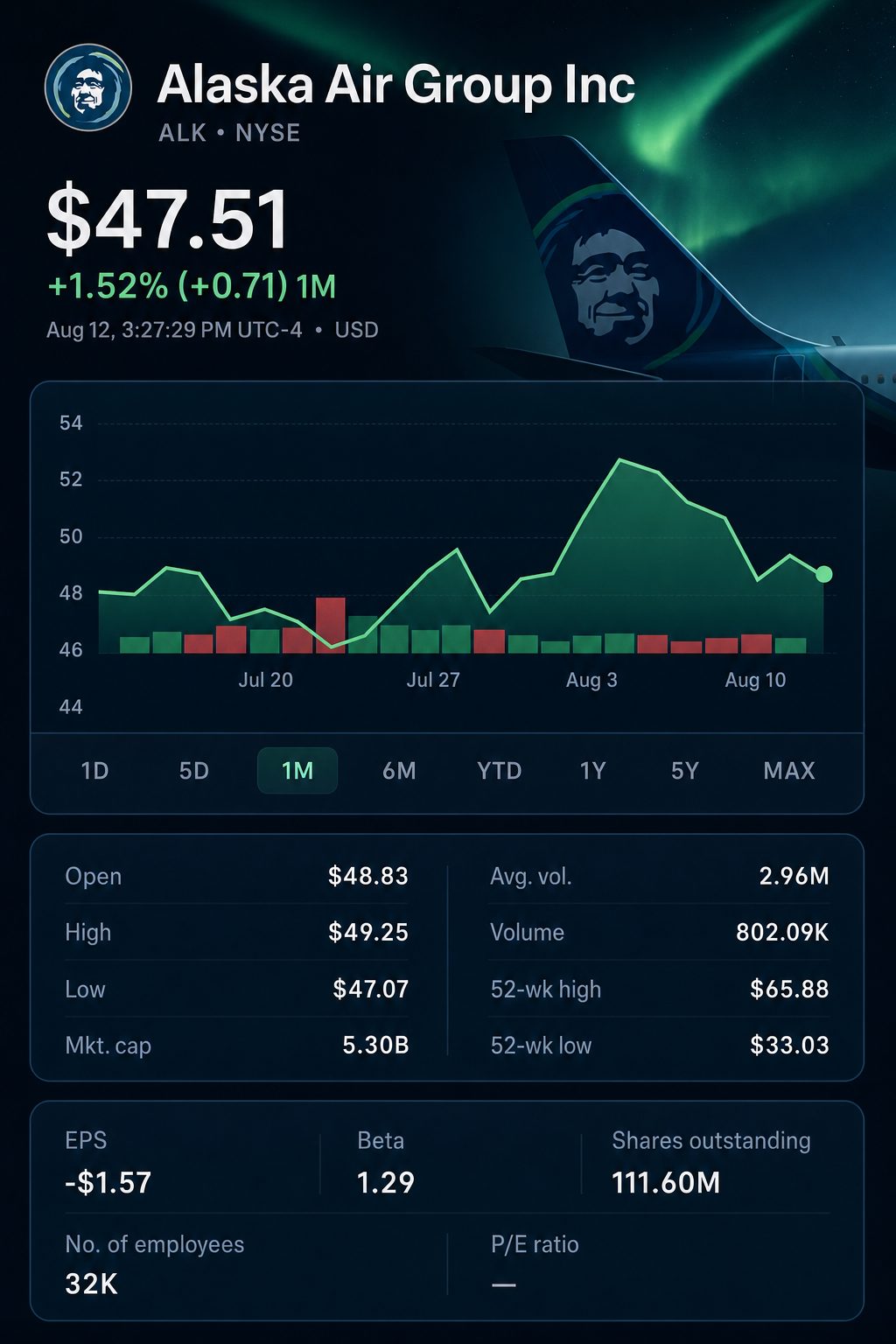
- Alaska Air stock declined 1.7% in regular trading on Wednesday.
- A Miami flight continued its journey after officials determined there was no credible security threat.
- The $600 million fuel headwind from last quarter represented 11% of market value.
Shares of Alaska Air Group Inc. NYSE:ALK dropped 1.7% to $47.60 on Wednesday afternoon. New searches for “alaska airline” spiked after a security incident in Miami over the weekend. However, investors remain focused on fuel costs rather than the impact of a single disrupted flight. Google Trends; Google Finance
Officials determined there was no credible threat on Alaska Airlines Flight 305. Two passengers were taken off the plane and given a temporary ban. The flight proceeded to Seattle without additional incident. Details of any financial effect were not provided.
This means the surge in searches is a limited indicator for earnings. Alaska faced an additional $600 million in fuel costs in its most recent quarter. That amount accounts for 11.3% of its $5.31 billion market capitalisation as of Wednesday.
| Airline stock | Price | Day change |
|---|---|---|
| Alaska Air Group Inc. NYSE:ALK | $47.60 | -1.65% |
| Delta Air Lines Inc. NYSE:DAL | $89.98 | -0.48% |
| United Airlines Holdings Inc. NASDAQ:UAL | $124.68 | -1.29% |
| Southwest Airlines Co. NYSE:LUV | $44.82 | -1.54% |
Alaska lagged behind both Delta and United, while the broader sector moved down. The stock traded between $47.07 and $49.24. Trading volume stayed under its three-month daily average at the quoted time.
Revenue for the second quarter climbed 10% to $4.1 billion as capacity edged up 1%. Unit revenue advanced 8.6%. Premium, cargo, and managed corporate revenue each outpaced the system’s overall growth.
| Q2 measure | Reported | Investor comparison |
|---|---|---|
| Total revenue | $4.1 billion | 10% higher year over year |
| Capacity | 1% increase | Revenue outpaced capacity |
| Unit revenue | Up 8.6% | Hawai’i impact trimmed growth by 3 points |
| Adjusted net result | Net loss of $102 million | Per share loss at $0.92 |
| Economic fuel cost | $4.43 per gallon | 85% higher year over year |
The profit impact was significant. Fuel costs climbed by $600 million, nearly six times greater than the adjusted loss. Chief Executive Ben Minicucci stated, “Absent the fuel headwind, we would have delivered a solidly profitable quarter.” Company release
The management currently projects $3.75 per gallon for the third quarter, a decrease of 15.3% from the second quarter. Unit revenue is expected to increase by a low double-digit percentage as capacity expands 2% to 3%.
| Operating test | Q2 actual | Q3 expectation |
|---|---|---|
| Economic fuel price | $4.43 per gallon | $3.75 per gallon |
| Capacity growth | 1% | 2% to 3% |
| Unit revenue growth | 8.6% | Low double digits |
| Non-fuel unit-cost growth | 6.5% | Low to mid single digits |
| Adjusted EPS | -$0.92 | $0.00 to $1.00 |
The balance sheet reflects increased flexibility. Alaska secured $1 billion in the quarter. Total available liquidity stood at $3.8 billion, and unencumbered assets were roughly $20 billion. Leadership intends to pay down debt as fuel costs decrease and earnings recover.
Analyst sentiment stays optimistic, though price targets diverge significantly. Out of 11 analysts tracked, 10 recommend buying ALK. Their average price target stands at $64.77, representing a 36% premium to the current intraday level. The most conservative target is $37.
| Analyst | Firm | Recommendation | Target | Date |
|---|---|---|---|---|
| Ravi Shanker | Morgan Stanley NYSE:MS | Buy | $78 | Aug. 11 |
| John Godyn | Citigroup NYSE:C | Sell | $37 | Aug. 7 |
| Jamie Baker | JPMorgan Chase NYSE:JPM | Buy | $92 | July 28 |
| Atul Maheswari | UBS Group NYSE:UBS | Buy | $56 | July 23 |
| Michael Goldie | Bank of Montreal NYSE:BMO | Buy | $62.50 | July 23 |
Bulls point to reduced fuel costs, improved yields and benefits from integrating Hawaiian. Bears cite poor earnings conversion. The dispute is reflected in a broad $37-to-$92 target range.
Risks: Fuel costs may shift rapidly. Security incidents, adverse weather, and integration challenges might impact operations. Elevated leverage could postpone capital returns if cash flow falls short of projections.
A single security incident does not overturn the thesis. The Q3 fuel expense could. Investors require the forecasted cost reduction to appear in the income statement.