
NEW YORK, August 20, 2026, 11:10 EDT – Costco shares fell as a new Medicare pilot project put fresh pressure on its 47× valuation.
- Costco stock dropped 1.8% to $939.49 during late-morning trading.
- The partnership with SCAN provides Costco with reach to approximately five million Medicare members.
- The pilot measures store traffic instead of membership-fee income.
Shares of Costco Wholesale NASDAQ:COST dropped 1.8% to $939.49 on Thursday after a recent Medicare initiative that could expand the company’s presence in health services.
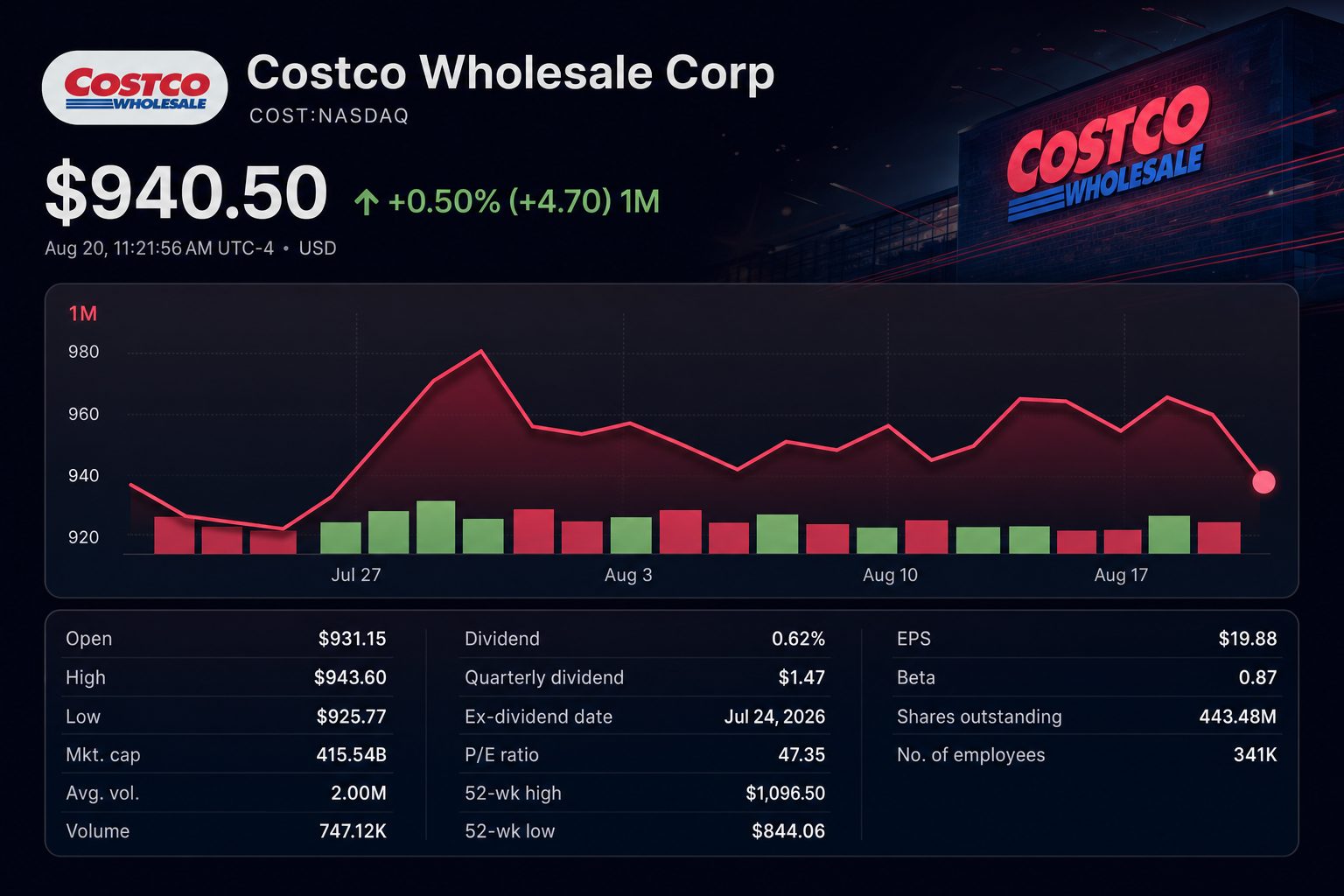
The development is significant as Costco continues to trade at 47.2 times earnings. While its core business remains robust, such a valuation requires further growth that does not erode the retailer’s already slim margins.
Costco and SCAN Group, a nonprofit insurer, aim to offer Medicare coverage in-store, online, and via agents. The pilot program will operate in two states for Medicare Advantage and one state for Medicare Supplement, pending regulatory clearance. The initiative will target markets with an estimated five million eligible individuals.
U.S. regulations bar Costco from linking coverage to a paid membership. Immediate gains will likely come from increased use of its pharmacy, optical, hearing, food, and over-the-counter offerings. Financial details were not released.
Costco Chief Executive Ron Vachris said, “Selecting SCAN as our partner to deliver a better healthcare experience for seniors is an extension of that commitment.” Partner announcement coverage
| Operating measure | Latest period | Change |
|---|---|---|
| Q3 net sales | $69.15 billion | up 11.6% |
| Q3 net income | $2.19 billion | increased 15.2% |
| Q3 diluted EPS | $4.93 | rose 15.2% |
| Q3 membership fees | $1.37 billion | advanced 10.7% |
| July net sales | $23.12 billion | up 10.7% |
| July digital sales, adjusted | — | increased 18.2% |
Costco’s strong foundation allows it to try new approaches. Digital sales for the third quarter rose 20.8% after adjusting for fuel and currency. However, gross margin fell by 21 basis points to 11.04%, making operational performance a key factor for the shares.
| Example pilot reach | Estimated plan enrolments | Portion of SCAN’s existing population |
|---|---|---|
| 0.5% | 25,000 | 5.4% |
| 1.0% | 50,000 | 10.9% |
| 2.5% | 125,000 | 27.2% |
| 5.0% | 250,000 | 54.3% |
SCAN could see a significant impact even with limited adoption. Gaining just 1% of conversions would mean an additional 50,000 plan members, representing roughly 11% of SCAN’s existing membership. The direct financial details for Costco are still not clear.
The alignment is more apparent. Costco reported 82.9 million paid members as of May, with Executive members making up 41.2 million of the total. Membership renewal rates in the U.S. and Canada held at 92.2%.
| Market measure | Value | Investor read |
|---|---|---|
| Share price | $939.49 | Fell 1.8% on Thursday |
| Market value | $415.63 billion | Commands large-cap status |
| P/E ratio | 47.2× | 2.1% yield on earnings |
| 52-week high | $1,096.50 | Shares sit 14.3% under high |
| 52-week low | $844.06 | Shares trading 11.3% above low |
| Dividend yield | 0.63% | Valuation focused on growth, not yield |
Peers provided minimal refuge. Walmart NASDAQ:WMT slipped 9.4% to $103.58, while Amazon NASDAQ:AMZN dropped 2.0% to $260.54 at the same point. Costco declined less sharply, indicating comparative strength rather than full protection.
| Company | Price | Day move | Business overlap |
|---|---|---|---|
| Costco NASDAQ:COST | $939.49 | -1.83% | Warehouse club membership |
| Walmart NASDAQ:WMT | $103.58 | -9.38% | Grocery along with health offerings |
| Amazon NASDAQ:AMZN | $260.54 | -1.99% | Online retail and medical services |
The outlook on Wall Street reflects the divide. Bernstein points to ongoing resilience in membership and sales. Roth Capital, meanwhile, holds concerns about valuation, even with Costco’s steady performance.
| Analyst or consensus | Recommendation | Target | Implied move |
|---|---|---|---|
| Bernstein — Zhihan Ma | Buy | $1,194 | +27.1% |
| RBC Capital | Sector Perform | $1,000 | +6.4% |
| Roth Capital | Sell | $781 | -16.9% |
| Published consensus | Buy | $1,077 | +14.6% |
The Medicare pilot by itself does not warrant a market valuation of $416 billion. Its significance is in assessing if Costco’s reputation encourages seniors to use more frequent services. Such findings could justify the premium multiple.
Regulatory approval, state enrollment, and economic disclosures are the primary factors for investors to monitor. August sales figures and the upcoming earnings release will indicate if digital expansion is sufficient to counteract margin challenges.
Risks: Delays in approval, sluggish enrollment or low store visits could render the pilot insignificant. A drop in comparable sales would put Costco’s 47-times multiple at risk.
Related articles: NASDAQ:COST




Growth stays strong. The multiple stays demanding.
| View | Target | Upside / downside |
|---|---|---|
| Bernstein · Buy | $1,194 | +27.1% |
| Consensus · Buy | $1,077 | +14.6% |
| RBC · Sector Perform | $1,000 | +6.4% |
| Roth · Sell | $781 | −16.9% |
Double-digit sales growth, digital momentum and 92.2% renewal.Premium defended
Whether brand trust converts into pharmacy, optical and health-service traffic.Option value
Approval delays, weak enrollment or softer comps against a 47.2× P/E.Multiple risk