
RIYADH, August 19, 2026, 23:11 AST — Trading on the Saudi Exchange did not take place.
- Aramco ended the session at SAR 26.64. The consensus target from 18 analysts stands at SAR 30.12, suggesting an upside of 13.1%.
- The latest eligible share count puts the additional equity value at about $224 billion under that target.
- The base dividend has an annualized yield of approximately 5.1%, though free cash flow in Q2 accounted for just 56% of the dividend paid.
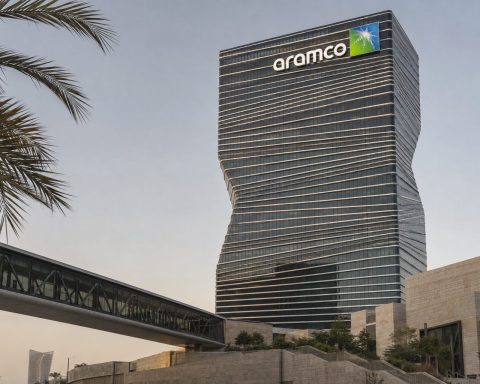
Saudi Arabian Oil Company TADAWUL:2222 put its crisis premium to the test on Wednesday, with trading sources reporting it will provide full September contract volumes to at least three European refiners, even as regional shipping faces significant disruption. Shares closed up 0.23% at SAR 26.64.
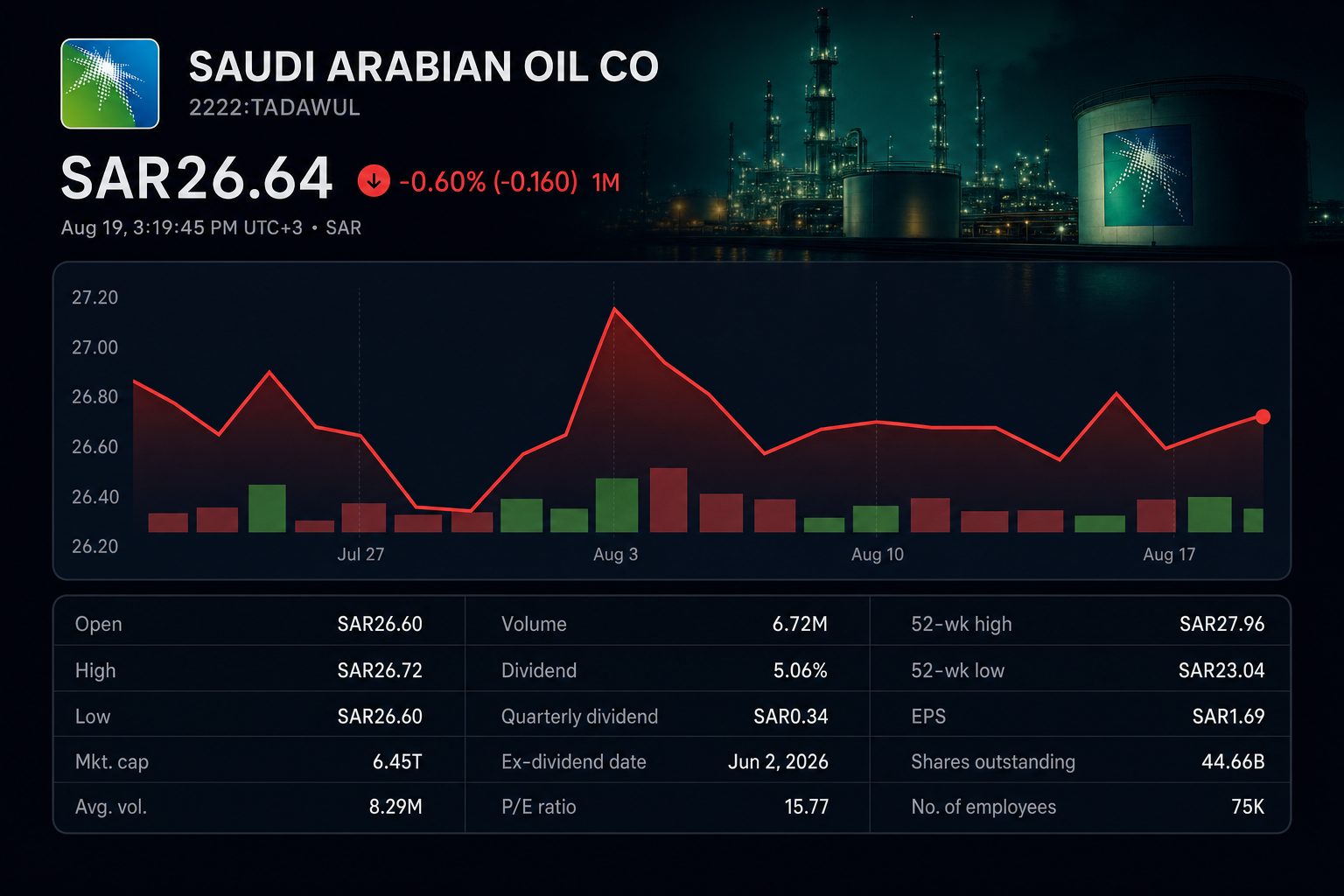
The commitment to deliver is more significant than the modest movement in the share price. Analysts’ average target of SAR 30.12 suggests an increase in market value of roughly $224 billion. This figure is based on 241.86 billion shares eligible for dividends and assumes the riyal is pegged at 3.75 to the dollar.
| Market measure | Latest reading | Investor signal |
|---|---|---|
| Close | SAR 26.64, +0.23% | Aug. 19, 15:20 AST; market closed |
| Five-day change | +0.15% | Gains limited despite crude price rise |
| 2026 change | +11.79% | Solid increase, remains under expected upside |
| 52-week range | SAR 23.04–27.96 | Trade is 4.7% off the 52-week peak |
| Calculated market value | About $1.72 trillion | Consensus points to around $1.94 trillion |
| Annualized base dividend | SAR 1.3572 per share | Yield near 5.09% at the last close |
Data collected following the market’s close on Wednesday indicated a five-day increase of 0.15% and a year-to-date advance of 11.79%, according to MarketScreener. The 52-week range was listed as SAR 23.04 to SAR 27.96.
Two European purchasers are set to load crude oil at Egypt’s Sidi Kerir terminal. A third buyer may choose between Sidi Kerir, Yanbu, or a ship-to-ship transfer near Malta. These options transform Aramco’s pipeline and storage system into a competitive asset, beyond serving as just backup facilities.
| Customer or corridor | Current arrangement | Measured friction |
|---|---|---|
| At least three European refiners | All September contracted allocations confirmed | Short notice; transferred at Sidi Kerir, Yanbu or Malta |
| Selected Asian refiners | Arab Medium and Arab Heavy available beyond Hormuz | Ship-to-ship movements and limits on grades |
| Idemitsu Kosan (TYO:5019) | Saudi crude delivered using Suez and Cape paths | Travel duration increases from nearly 20 up to 50–60 days |
| East–West system | As much as 7 million barrels per day pipeline throughput | Approximately 2 million barrels daily supply western refiners |
Asia’s solution is more complex. Aramco has provided certain refiners with medium and heavy blends through transfers close to Fujairah. Japan’s Idemitsu reported that alternative shipping routes may require 50 to 60 days, compared with the usual 20. Increased transit times push up freight and working-capital costs. BSF Capital reported the East–West Pipeline is able to move 7 million barrels per day, with around 2 million directed to western refineries.
Oil prices provide solid support. Brent finished Wednesday at $91.62, up 0.7% and marking a four-week peak. U.S. WTI advanced 1.1% to $85.83. However, just six commodity ships passed through the Strait of Hormuz on Tuesday, 45% fewer than the 10-day average daily volume of 11.
“Crude futures continue to find support from ongoing geopolitical tensions in the Middle East,” said Dennis Kissler, senior vice president of trading at BOK Financial. Stronger realized prices contribute to earnings. However, they do not offset the expense of transporting barrels on diverted routes.
| Q2 or H1 measure | Amount | Coverage read-through |
|---|---|---|
| Q2 adjusted net earnings | $33.4 billion | 1.53 times the base dividend |
| Q2 operating cash inflow | $25.4 billion | 1.16 times the base dividend |
| Q2 free cash flow | $12.3 billion | 56% of the base dividend |
| Q2 base dividend | $21.9 billion | $9.6 billion higher than free cash flow |
| Q2 working capital accumulation | $13.6 billion | Principal factor weighing on free cash flow |
| H1 free-cash-flow coverage | About 71% | Based on two $21.9 billion base distributions |
The gap in cash flow represents a tougher hurdle for valuation. Free cash flow in Q2 was $12.3 billion, compared with a base dividend of $21.9 billion. The majority of the shortfall is due to a $13.6 billion increase in working capital. Longer shipping times may result in more cash being held up.
Aramco CEO Amin H. Nasser stated the company had “continued to demonstrate our ability to maintain business continuity.” Aramco pointed to its East–West Pipeline along with storage and export terminals. The allocations to Europe set for Wednesday will put that assertion to the test in the short term. Aramco Q2 results
| Analyst view | Recommendation | Target | Implied move |
|---|---|---|---|
| 18-analyst average | Outperform | SAR 30.12 | +13.06% |
| Highest consensus | — | SAR 35.00 | +31.38% |
| Lowest consensus | — | SAR 26.80 | +0.60% |
| BofA, Aug. 4 | Buy stance reiterated | Not disclosed publicly | Q2 income outperformance noted |
| HSBC, Aug. 5 | Hold stance reiterated | Lowered; not disclosed publicly | Adopts a more cautious approach to valuation |
The target range is skewed. The lower bound is just 0.6% above Wednesday’s close, while the upper bound stands at 31.4%. BofA maintained its Buy after the Q2 results beat expectations. HSBC reiterated Hold and cut its target price.
The following session brings a technical adjustment. Aramco shares will trade ex-dividend on August 20, reflecting a payout of SAR 0.3393 per share. This represents 1.27% of the stock’s Wednesday closing price, substantially higher than the 0.23% advance recorded that day. The dividend will be paid on August 27.
Risks: Any escalation in Hormuz or Red Sea could reduce export volumes, extend shipping times and increase working capital needs. Conversely, a diplomatic breakthrough could eliminate Brent’s risk premium. Analyst forecasts may not promptly reflect either scenario.
Investors need to distinguish the ex-dividend adjustment set for Thursday from the core operational outlook. The more significant assessment arrives with September loadings. Meeting full contracted delivery would underpin the $224 billion valuation; any delays would reveal the extent to which the valuation relies on logistics performance.
Related articles: TADAWUL:2222

Logistics now carries the valuation case
Market and oil data checked August 19, 2026. Share price captured at 15:20 AST after the Saudi market closed; crude settlements at 14:30 EDT.
The route test
September crude allocationsAt least three refiners. Sidi Kerir, Yanbu and Malta ship-to-ship options.
Selected Arab Medium and Heavy cargoes offered outside Hormuz.
Idemitsu says rerouted Saudi voyages can more than double in duration.
Cash supports the dividend — but not fully
Q2 2026 · USDThe $9.6 billion gap followed a $13.6 billion working-capital build.
| Q2 measure | Value | Dividend cover |
|---|---|---|
| Adjusted net income | $33.4B | 1.53× |
| Operating cash flow | $25.4B | 1.16× |
| Free cash flow | $12.3B | 0.56× |
| Base dividend | $21.9B | Payable Q3 |
Oil gives price support; traffic shows the risk
August 19 settlementsRecommendation spread
Checked August 19| View | Recommendation | Target | Upside |
|---|---|---|---|
| 18-analyst mean | Outperform | SAR 30.12 | +13.06% |
| Consensus high | — | SAR 35.00 | +31.38% |
| Consensus low | — | SAR 26.80 | +0.60% |
| BofA · Aug. 4 | Buy maintained | Not public | Q2 beat cited |
| HSBC · Aug. 5 | Hold maintained | Lowered; not public | Valuation caution |