
Today: 29 June 2026
Browse Category

NSE:BHARTIARTL 5 April 2025 - 2 December 2025

Bharti Airtel Share Price Today: Near Record High on Q2 FY26 Earnings, Tariff Hike Buzz and S&P Upgrade (2 December 2025)

Bharti Airtel Share Price Today: Near Record High on Q2 FY26 Earnings, Tariff Hike Buzz and S&P Upgrade (2 December 2025)

Bharti Airtel Limited’s stock continues to trade near all‑time highs as investors digest stellar Q2 FY26 results, an S&P Global credit rating upgrade, and expectations of another round of tariff hikes across the Indian telecom sector. On 2 December 2025, Bharti Airtel closed around ₹2,108.30, up 0.89% from the previous session, with the day’s range between ₹2,089.80 and ₹2,114.80. The stock is now less than 3% below its 52‑week high of ₹2,174.50 and has delivered roughly 30–35% gains over the past year. Investing.com+2Smart Investing+2
Stock Market Sizzle: Mukul Agrawal’s Semiconductor Coup, PTC India Promoter Drama, and Morgan Stanley’s ₹201Cr Shopping Spree

Stock Market Sizzle: Mukul Agrawal’s Semiconductor Coup, PTC India Promoter Drama, and Morgan Stanley’s ₹201Cr Shopping Spree

ASM Technologies Ltd – an Indian engineering services and design-led manufacturing firm – has been a hot stock this year. The company reported Q1FY26 revenues of ₹123 crore and net profit of ₹16 crore Tradebrains, beating expectations. Investors have taken note: Mukul Mahavir Agrawal, a well-known corporate investor, more than doubled his stake in ASM during recent quarters. He held 762,500 shares at end-June 2025, and by early September had amassed 1,525,000 shares Tradebrains. Business Standard reports that by early August he already held ~11.7% of ASM Business Standard. Agrawal’s buying coincided with an almost 200% rally in the stock over five months Business Standard, suggesting strong confidence. Industry analysts note that ASM is capitalizing on India’s burgeoning semiconductor ecosystem. The company has signed MoUs with Tamil Nadu and Karnataka state governments to invest ₹250 crore and ₹510 crore respectively in cutting-edge design and manufacturing facilities Tradebrains Tradebrains. ASM’s Managing Director Rabindra Srikantan explains that the “₹250 crore investment…will expand our design-led manufacturing capabilities in the ESDM [electronic systems design & manufacturing] sector…underscoring our commitment to innovation and global competitiveness” Dsij. The firm also has a JV to produce semiconductor equipment and is setting up India’s first semiconductor-focused equipment plant

AI Browser Wars Ignite: Perplexity’s Comet Lands in India to Challenge Chrome & Co.

AI Browser Wars Ignite: Perplexity’s Comet Lands in India to Challenge Chrome & Co.

Perplexity’s Comet is not just another Chrome or Firefox – it’s an AI-native browser built from the ground up to weave a digital assistant into your everyday web tasks. The startup behind it, Perplexity AI, first gained notoriety for its AI-powered answer engine that competes with Google Search indianexpress.com. With Comet, Perplexity has extended that technology into a full browser, betting that the browser itself can become a productivity and research assistant. “Comet is built on Perplexity’s AI search engine” and is designed to make internet work and research more efficient, explains CEO Aravind Srinivas economictimes.indiatimes.com. Unlike standard browsers that passively display websites, Comet comes alive with an AI sidebar omnipresent on the screen moneycontrol.com. This sidebar runs on OpenAI’s latest GPT model and Perplexity’s own large language model integration. It has awareness of the page you’re on and even multiple pages at once. The user can ask the AI assistant questions or give it commands related to the content in their tabs. For example, if you’re reading a dense article or a 20-minute video, you can ask Comet to summarize it in seconds rogerwong.me. You can highlight text and have the AI explain or translate it. But Comet goes
25 September 2025
Why 5G Internet Providers Are Replacing Cable Faster Than You Think

Why 5G Internet Providers Are Replacing Cable Faster Than You Think

Move Over, Cable – 5G Home Internet is Taking the Fast Lane: Not long ago, the idea of ditching your cable or fiber line for home internet sounded far-fetched. But the rapid rise of 5G fixed wireless access internet is turning the broadband market on its head – and it’s happening much faster than almost anyone predicted. Millions of consumers are already swapping coaxial cables for 5G home internet routers, drawn by lower prices, easy setup, and “good enough” performance. In this report, we’ll explore how 5G home internet is surging, who the big players are, how it stacks up against traditional cable/fiber, and what this all means for your internet choices. Prepare to be surprised at just how quickly wireless carriers are challenging the cable giants – and why this 5G vs. cable showdown matters for your wallet and online life. Just a few years ago, cable companies like Comcast and Charter had a stranglehold on home broadband in many regions, and the phrase “wireless home internet” usually meant slow, last-resort solutions. That changed with the rollout of 5G. Using upgraded cellular networks, carriers began offering 5G home internet – essentially a fixed wireless service where your home gets
India Grants License to Starlink: A New Era for Satellite Internet Connectivity

India Grants License to Starlink: A New Era for Satellite Internet Connectivity

Elon Musk’s Starlink satellite internet service has secured an official license in India, marking a major milestone in the country’s telecom sector. In mid-June 2025, India’s Department of Telecommunications granted Starlink a Global Mobile Personal Communication by Satellite services license economictimes.indiatimes.com economictimes.indiatimes.com. This approval – confirmed publicly by Communications Minister Jyotiraditya Scindia – removes a significant regulatory obstacle and paves the way for Starlink to launch commercial broadband services across India economictimes.indiatimes.com economictimes.indiatimes.com. Starlink becomes the third player after Eutelsat OneWeb and Reliance Jio’s satellite venture to receive such authorization, opening what Scindia described as India’s “next frontier of connectivity” economictimes.indiatimes.com economictimes.indiatimes.com. Minister Scindia announced the development on social media, following a meeting with SpaceX President and COO Gwynne Shotwell. He lauded Starlink’s license as a “great start to the journey”, emphasizing opportunities to collaborate in satellite communications to power the Digital India initiative economictimes.indiatimes.com government.economictimes.indiatimes.com. According to Scindia, integrating satellite internet will empower citizens across the country, especially in areas where traditional networks are hard to deploy economictimes.indiatimes.com timesofindia.indiatimes.com. The DoT’s license issuance will be followed by spectrum allocation to Starlink, after which full commercial operations can commence “at a rapid pace” once all security and technical compliance demonstrations
Why Starlink Keeps Hitting Red Tape Around the World

Why Starlink Keeps Hitting Red Tape Around the World

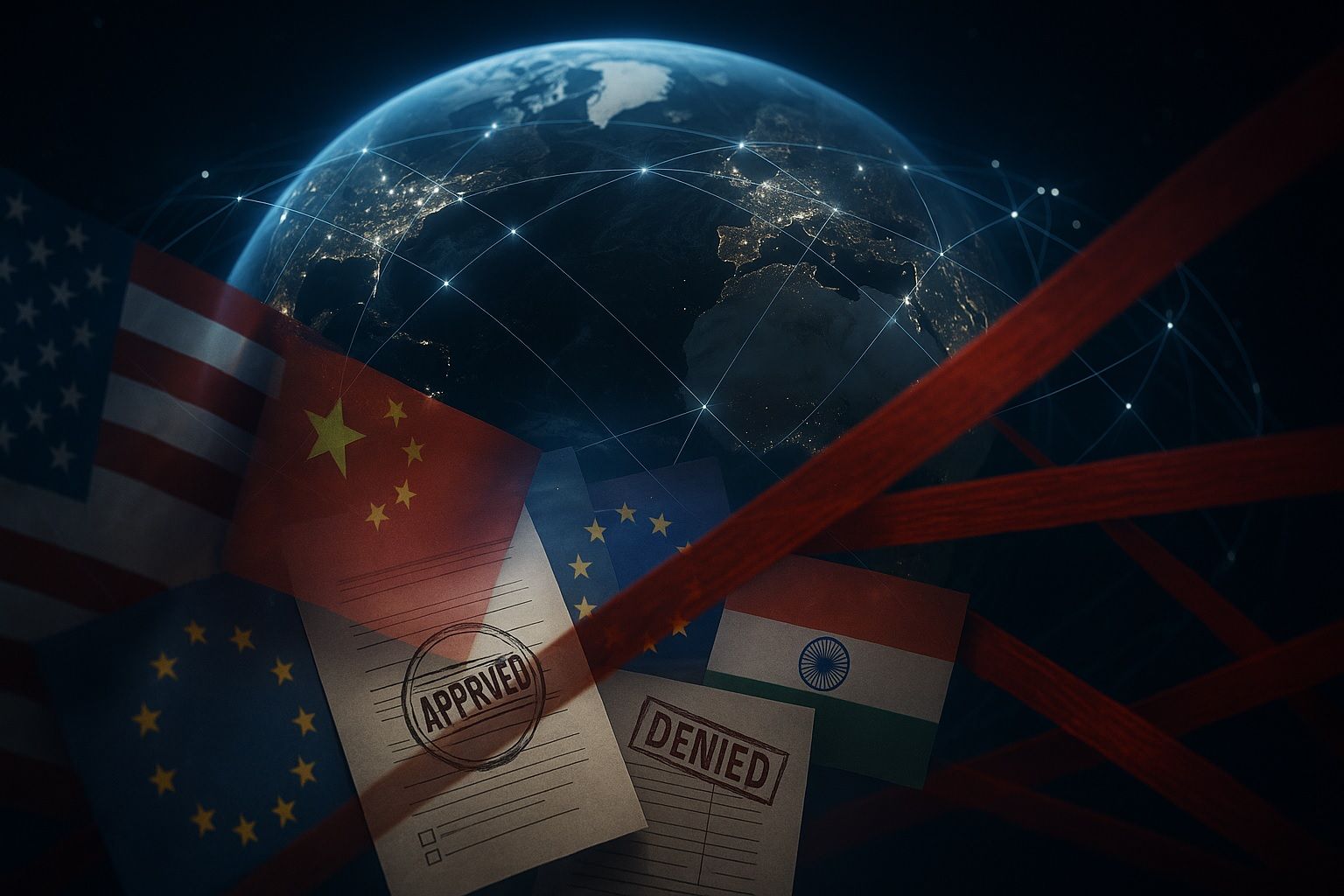
A Starlink user terminal installed on a riverboat in remote Brazil, reflecting the service’s reach into areas underserved by terrestrial internet reuters.com. Despite such promise, Starlink’s global expansion has repeatedly run into regulatory roadblocks in different countries. Starlink, the satellite internet constellation operated by SpaceX, aspires to deliver high-speed broadband worldwide – from megacities to the most remote villages. Its global ambitions to bridge the digital divide come with an inherent challenge: navigating a patchwork of national regulations and red tape. Unlike terrestrial internet services, which operate within national borders, Starlink’s space-based system crosses boundaries, requiring licensing and spectrum approval in each country it serves. Around the world, regulators have responded with varying degrees of caution or enthusiasm. Some nations have eagerly welcomed Starlink to boost connectivity, while others have imposed strict conditions, citing concerns over licensing, spectrum interference, national security, competition, and compliance with local telecom laws. This report provides a country-by-country analysis of the regulatory hurdles Starlink has encountered through 2025, highlighting supportive versus hostile environments, real examples of regulatory actions, and the evolving policy landscape.
Internet Access in India: A Comprehensive Guide for Residents and Tourists

Internet Access in India: A Comprehensive Guide for Residents and Tourists

India has made rapid strides in expanding its internet user base and network infrastructure. As of early 2024, India had roughly 750–950 million internet users, representing about 50–68% of the population m.economictimes.com fortuneindia.com. This marks an annual growth of around 8%, with tens of millions of new users coming online each year. Notably, rural areas now account for about half of India’s internet users, reflecting recent growth beyond the cities m.economictimes.com. However, internet penetration still lags in the countryside – roughly half of the rural population remains offline or not actively using the internet, compared to higher usage in urban areas m.economictimes.com m.economictimes.com. India’s digital infrastructure is characterized by a mobile-first paradigm. There are over 1.15 billion mobile connectionsin use, and the vast majority of internet subscriptions – over 95% – are via wireless mobile networks fortuneindia.com. By contrast, fixed broadband connections make up barely ~4% of the total internet subscriptions fortuneindia.com. This means most Indians access the internet on smartphones over cellular networks, while relatively few have fixed home broadband lines. The government’s Digital India initiative has prioritized expanding digital connectivity, promoting affordable data, and enabling online services nation-wide. There have been massive investments in both telecom towers and
High-Speed Himalayas: Inside Nepal’s Race to Connect Every Peak and Village

High-Speed Himalayas: Inside Nepal’s Race to Connect Every Peak and Village

Nepal’s unique geography – from the towering Himalayas to remote hill villages – makes internet access both challenging and crucial. In recent years, Nepal has made significant strides to expand digital connectivity across the country. This report examines Nepal’s internet landscape in detail: the major service providers and their market share, the state of mobile and broadband networks, typical speeds and costs, infrastructure hurdles, satellite internet plans, government policies, the urban-rural digital divide, and future connectivity initiatives. Despite formidable terrain and infrastructural challenges, Nepal is racing to bring high-speed internet from the capital Kathmandu all the way to Everest’s doorstep. Nepal’s internet market is served by a mix of state-owned telecom companies and private ISPs, divided broadly into mobile operators and fixed broadband providers:
Go toTop